


Examining the effects of birth order on personality
- PMID: 26483461
- PMCID: PMC4655522
- DOI: 10.1073/pnas.1506451112
Examining the effects of birth order on personality
Abstract
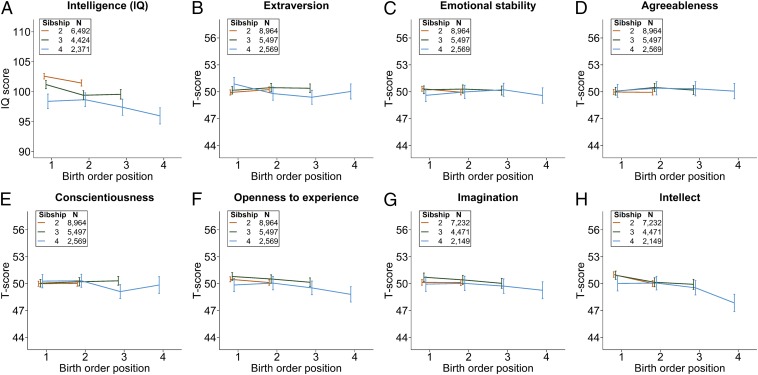
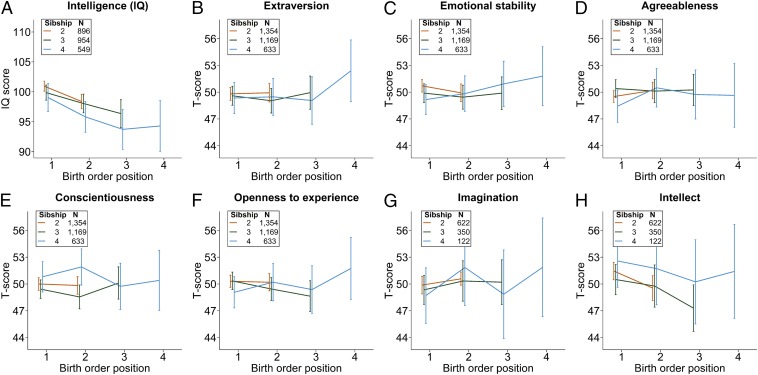
This study examined the long-standing question of whether a person's position among siblings has a lasting impact on that person's life course. Empirical research on the relation between birth order and intelligence has convincingly documented that performances on psychometric intelligence tests decline slightly from firstborns to later-borns. By contrast, the search for birth-order effects on personality has not yet resulted in conclusive findings. We used data from three large national panels from the United States (n = 5,240), Great Britain (n = 4,489), and Germany (n = 10,457) to resolve this open research question. This database allowed us to identify even very small effects of birth order on personality with sufficiently high statistical power and to investigate whether effects emerge across different samples. We furthermore used two different analytical strategies by comparing siblings with different birth-order positions (i) within the same family (within-family design) and (ii) between different families (between-family design). In our analyses, we confirmed the expected birth-order effect on intelligence. We also observed a significant decline of a 10th of a SD in self-reported intellect with increasing birth-order position, and this effect persisted after controlling for objectively measured intelligence. Most important, however, we consistently found no birth-order effects on extraversion, emotional stability, agreeableness, conscientiousness, or imagination. On the basis of the high statistical power and the consistent results across samples and analytical designs, we must conclude that birth order does not have a lasting effect on broad personality traits outside of the intellectual domain.
Keywords: Big Five; birth order; personality; siblings; within-family analyses.
Conflict of interest statement
The authors declare no conflict of interest.
Figures
Comment in
-
Settling the debate on birth order and personality.Proc Natl Acad Sci U S A. 2015 Nov 17;112(46):14119-20. doi: 10.1073/pnas.1519064112. Epub 2015 Oct 30. Proc Natl Acad Sci U S A. 2015. PMID: 26518507 Free PMC article. No abstract available.
References
-
- Galton F. English Men of Science: Their Nature and Nurture. Thoemmes; Bristol, UK: 1874.
-
- Adler A. Characteristics of the first, second and third child. Children. 1928;3(5):14–52.
-
- Belmont L, Marolla FA. Birth order, family size, and intelligence. Science. 1973;182(4117):1096–1101. - PubMed
-
- Breland HM. Birth order, family configuration, and verbal achievement. Child Dev. 1974;45(4):1011–1019. - PubMed
-
- Bjerkedal T, Kristensen P, Skjeret GA, Brevik JI. Intelligence test scores and birth order among young Norwegian men (conscripts) analyzed within and between families. Intelligence. 2007;35(5):503–514.
Publication types
MeSH terms
LinkOut - more resources
Full Text Sources
Other Literature Sources
