Review
. 2015 Oct 1:6:203.
doi: 10.3389/fphar.2015.00203. eCollection 2015.

Cardiac cAMP: production, hydrolysis, modulation and detection

Affiliations
Review

Cardiac cAMP: production, hydrolysis, modulation and detection

Cédric Boularan et al. Front Pharmacol. .

Abstract

Cyclic adenosine 3',5'-monophosphate (cAMP) modulates a broad range of biological processes including the regulation of cardiac myocyte contractile function where it constitutes the main second messenger for β-adrenergic receptors' signaling to fulfill positive chronotropic, inotropic and lusitropic effects. A growing number of studies pinpoint the role of spatial organization of the cAMP signaling as an essential mechanism to regulate cAMP outcomes in cardiac physiology. Here, we will briefly discuss the complexity of cAMP synthesis and degradation in the cardiac context, describe the way to detect it and review the main pharmacological arsenal to modulate its availability.

Keywords: Cyclic AMP; GPCR; phosphodiesterase; protein kinase A (PKA); resonance energy transfer.


Figures
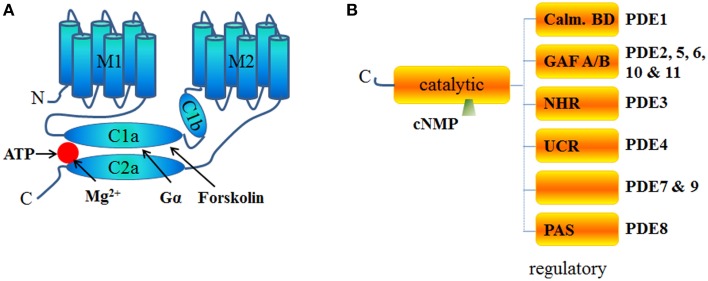
Figure 1
Figure 1
Schematic structure of ACs and PDEs. (A) Structure of Adenylyl cyclase is comprised of 2 transmembrane domains (M1 and M2 6 helixes each) and 2 cytosolic domains (C1 and C2) subdivided into a and b domains. C1 and C2 contain the catalytic core, the Gα and the forskolin binding sites and other regulatory sites. C2b domain is almost inexistent in all AC isoforms. (B) PDEs are homodimers with the exception of PDE1 and PDE6 (usually heterotetramers). PDEs have an NH2-terminal regulatory domain and share a conserved catalytic domain located in the COOH-terminal portion of the protein. The structure of the regulatory domain varies according the PDE isoform. GAF is an acronym for cGMP-specific PDE, Adenylyl cyclases and FhlA, NHR for N-terminal Hydrophobic Region, PAS for Per-ARNT-Sim and Calm. BD for calmodulin binding domain. No known domains are present in PDE7 or PDE9 regulatory C-terminal part. PDE4 proteins are classified as “long” or “short” isoforms, depending on the presence or absence of two highly conserved domains, Upstream Conserved Region 1 (UCR 1) and Upstream Conserved Region 2 (UCR 2) which interact to form a regulatory module that may influence catalytic activity by a PKA-dependent phosphorylation mechanism (Houslay, ; MacKenzie et al., 2002).
Figure 2
Figure 2
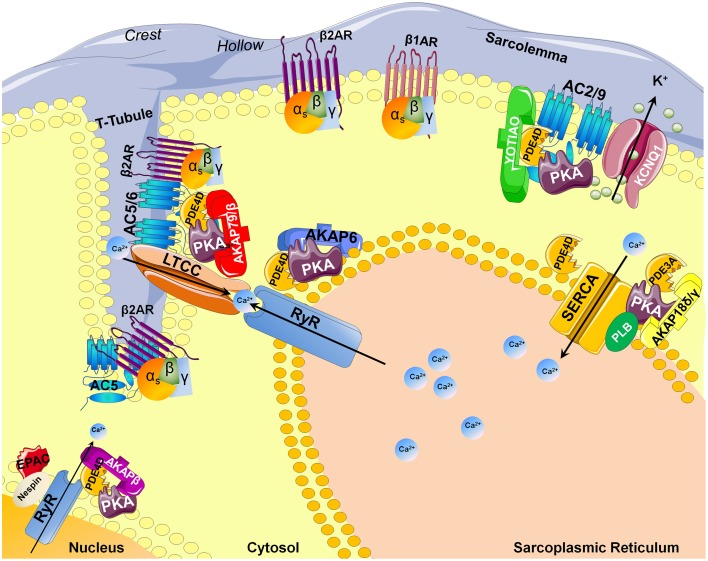
AKAP-dependent AC and PDE compartmentalizations in the cardiomyocyte. Abbreviations stand for: AKAP, A-kinase anchor proteins; PKA, Protein Kinase A; β2AR/β1AR, beta adrenergic receptor; PLN, Phospholamban; EPAC, cAMP-dependent exchange proteins; AC, Adenylyl cyclase; RyR, Ryanodine Receptor; SERCA, sarco/endoplasmic reticulum Ca2+-ATPase; KCNQ1, potassium channel voltage gated KQT-like subfamily Q; PDE, Phosphodiesterase; T-tubule, Transverse tubule; LTCC, L-type calcium channel.
Figure 3
Figure 3
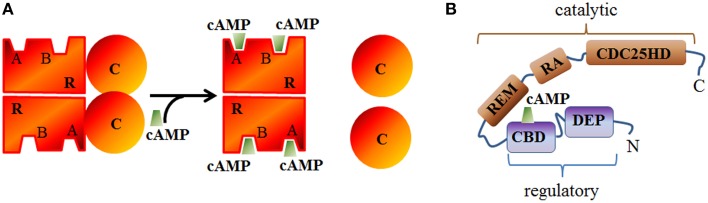
Schematic structure of PKA and EPAC. (A) The catalytic (c) subunit of cAMP-dependent Protein Kinase (PKA) is a serine/threonine protein kinase associated, in the absence of cAMP, with the regulatory (R) subunit to form the inactive PKA holoenzyme. cAMP can bind to A or B sites in the regulatory subunits and induces the dissociation of the catalytic subunits. (B) Epac structure showing the conserved cAMP binding domain (CBD), Disheveled/Egl-10/pleckstrin (DEP) domain, RAS exchange motif (REM) domain, RAS association (RA) domain, and CDC25-homology domain (CDC25HD).
Figure 4
Figure 4
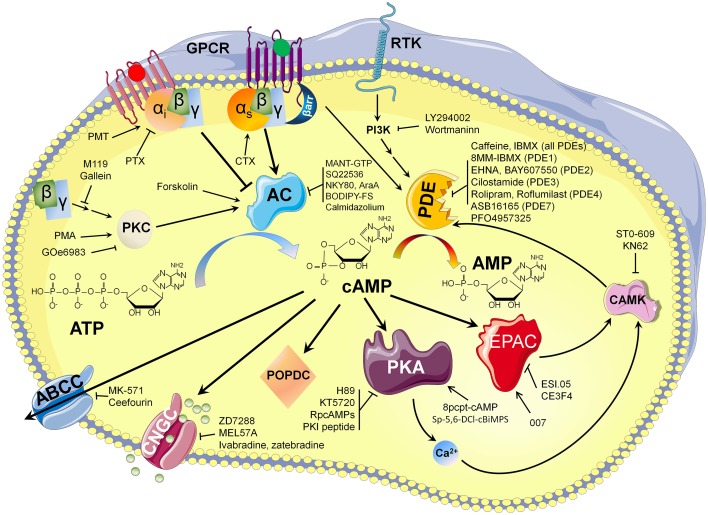
cAMP synthesis and hydrolysis: pharmacological way to modulate its availability.

References

    1. Airan R. D., Thompson K. R., Fenno L. E., Bernstein H., Deisseroth K. (2009). Temporally precise in vivo control of intracellular signalling. Nature 458, 1025–1029. 10.1038/nature07926 - DOI - PubMed
    1. Almahariq M., Tsalkova T., Mei F. C., Chen H., Zhou J., Sastry S. K., et al. . (2013). A novel EPAC-specific inhibitor suppresses pancreatic cancer cell migration and invasion. Mol. Pharmacol. 83, 122–128. 10.1124/mol.112.080689 - DOI - PMC - PubMed
    1. Anderson M. E., Brown J. H., Bers D. M. (2011). CaMKII in myocardial hypertrophy and heart failure. J. Mol. Cell. Cardiol. 51, 468–473. 10.1016/j.yjmcc.2011.01.012 - DOI - PMC - PubMed
    1. Asirvatham A. L., Galligan S. G., Schillace R. V., Davey M. P., Vasta V., Beavo J. A., et al. . (2004). A-kinase anchoring proteins interact with phosphodiesterases in T lymphocyte cell lines. J. Immunol. 173, 4806–4814. 10.4049/jimmunol.173.8.4806 - DOI - PubMed
    1. Baillie G. S. (2009). Compartmentalized signalling: spatial regulation of cAMP by the action of compartmentalized phosphodiesterases. FEBS J. 276, 1790–1799. 10.1111/j.1742-4658.2009.06926.x - DOI - PubMed

LinkOut - more resources