


Cellular Senescence and the Biology of Aging, Disease, and Frailty
- PMID: 26485647
- PMCID: PMC4780350
- DOI: 10.1159/000382054
Cellular Senescence and the Biology of Aging, Disease, and Frailty
Abstract
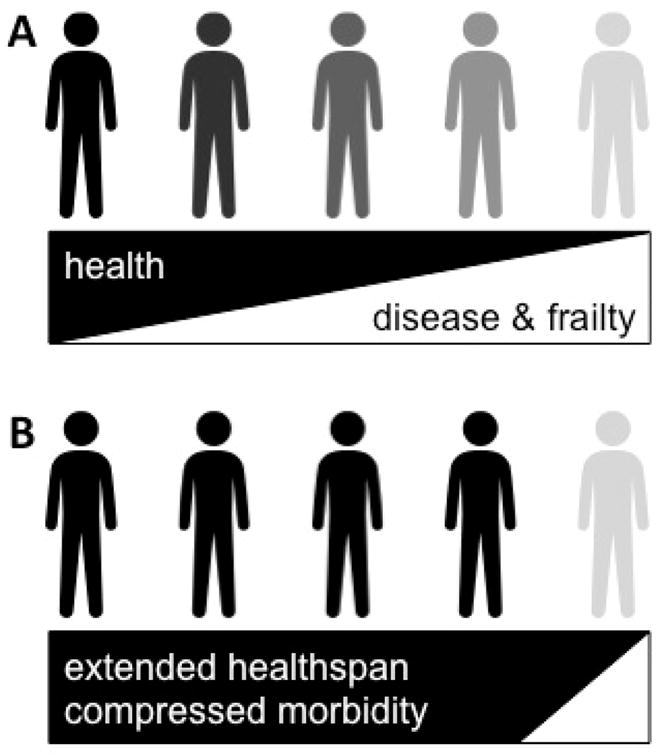
Population aging simultaneously highlights the remarkable advances in science, medicine, and public policy, and the formidable challenges facing society. Indeed, aging is the primary risk factor for many of the most common chronic diseases and frailty, which result in profound social and economic costs. Population aging also reveals an opportunity, i.e. interventions to disrupt the fundamental biology of aging could significantly delay the onset of age-related conditions as a group, and, as a result, extend the healthy life span, or health span. There is now considerable evidence that cellular senescence is an underlying mechanism of aging and age-related conditions. Cellular senescence is a process in which cells lose the ability to divide and damage neighboring cells by the factors they secrete, collectively referred to as the senescence-associated secretory phenotype (SASP). Herein, we discuss the concept of cellular senescence, review the evidence that implicates cellular senescence and SASP in age-related deterioration, hyperproliferation, and inflammation, and propose that this underlying mechanism of aging may play a fundamental role in the biology of frailty.
© 2015 Nestec Ltd., Vevey/S. Karger AG, Basel.
Figures
References
-
- Cohen JE. Human population: the next half century. Science. 2003;302:1172–5. - PubMed
-
- Fried LP, Tangen CM, Walston J, et al. Frailty in older adults: evidence for a phenotype. J Gerontol A Biol Sci Med Sci. 2001;56:M146–56. - PubMed
-
- Lipsitz LA. Physiological complexity, aging, and the path to frailty. Sci Aging Knowledge Environ. 2004;2004:pe16. - PubMed
-
- Makary MA, Segev DL, Pronovost PJ, et al. Frailty as a Predictor of Surgical Outcomes in Older Patients. Journal of the American College of Surgeons. 2010;210:901–908. - PubMed
-
- Ensrud Ke, ESKTBC, et al. Comparison of 2 frailty indexes for prediction of falls, disability, fractures, and death in older women. Archives of Internal Medicine. 2008;168:382–389. - PubMed
Publication types
MeSH terms
Grants and funding
LinkOut - more resources
Full Text Sources
Other Literature Sources
Medical
