


Hypothalamic leptin gene therapy reduces body weight without accelerating age-related bone loss
- PMID: 26487675
- PMCID: PMC4917201
- DOI: 10.1530/JOE-15-0280
Hypothalamic leptin gene therapy reduces body weight without accelerating age-related bone loss
Abstract
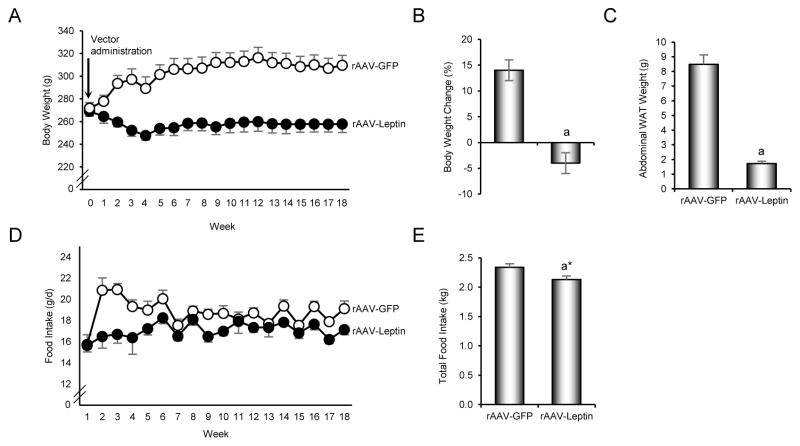
Excessive weight gain in adults is associated with a variety of negative health outcomes. Unfortunately, dieting, exercise, and pharmacological interventions have had limited long-term success in weight control and can result in detrimental side effects, including accelerating age-related cancellous bone loss. We investigated the efficacy of using hypothalamic leptin gene therapy as an alternative method for reducing weight in skeletally-mature (9 months old) female rats and determined the impact of leptin-induced weight loss on bone mass, density, and microarchitecture, and serum biomarkers of bone turnover (CTx and osteocalcin). Rats were implanted with cannulae in the 3rd ventricle of the hypothalamus and injected with either recombinant adeno-associated virus encoding the gene for rat leptin (rAAV-Leptin, n=7) or a control vector encoding green fluorescent protein (rAAV-GFP, n=10) and sacrificed 18 weeks later. A baseline control group (n=7) was sacrificed at vector administration. rAAV-Leptin-treated rats lost weight (-4±2%) while rAAV-GFP-treated rats gained weight (14±2%) during the study. At study termination, rAAV-Leptin-treated rats weighed 17% less than rAAV-GFP-treated rats and had lower abdominal white adipose tissue weight (-80%), serum leptin (-77%), and serum IGF1 (-34%). Cancellous bone volume fraction in distal femur metaphysis and epiphysis, and in lumbar vertebra tended to be lower (P<0.1) in rAAV-GFP-treated rats (13.5 months old) compared to baseline control rats (9 months old). Significant differences in cancellous bone or biomarkers of bone turnover were not detected between rAAV-Leptin and rAAV-GFP rats. In summary, rAAV-Leptin-treated rats maintained a lower body weight compared to baseline and rAAV-GFP-treated rats with minimal effects on bone mass, density, microarchitecture, or biochemical markers of bone turnover.
Keywords: dual energy absorptiometry; microcomputed tomography; rAAV-Leptin; white adipose tissue.
© 2015 Society for Endocrinology.
Conflict of interest statement
Figures


References
-
- Arounleut P, Bowser M, Upadhyay S, Shi XM, Fulzele S, Johnson MH, Stranahan AM, Hill WD, Isales CM, Hamrick MW. Absence of functional leptin receptor isoforms in the POUND (Lepr(db/lb)) mouse is associated with muscle atrophy and altered myoblast proliferation and differentiation. PLoS One. 2013;8:e72330. - PMC - PubMed
-
- Bagnasco M, Dube MG, Kalra PS, Kalra SP. Evidence for the existence of distinct central appetite, energy expenditure, and ghrelin stimulation pathways as revealed by hypothalamic site-specific leptin gene therapy. Endocrinology. 2002;143:4409–4421. - PubMed
-
- Banks WA, DiPalma CR, Farrell CL. Impaired transport of leptin across the blood-brain barrier in obesity. Peptides. 1999;20:1341–1345. - PubMed
-
- Banks WA, Kastin AJ, Huang W, Jaspan JB, Maness LM. Leptin enters the brain by a saturable system independent of insulin. Peptides. 1996;17:305–311. - PubMed
-
- Banks WA, Lebel CR. Strategies for the delivery of leptin to the CNS. J Drug Target. 2002;10:297–308. - PubMed
Publication types
MeSH terms
Substances
Grants and funding
LinkOut - more resources
Full Text Sources
Medical
Miscellaneous
