Observational Study
. 2015 Oct 21;10(10):e0141164.
doi: 10.1371/journal.pone.0141164. eCollection 2015.

Potential for Drug-Drug Interactions between Antiretrovirals and HCV Direct Acting Antivirals in a Large Cohort of HIV/HCV Coinfected Patients

Collaborators, Affiliations
Observational Study

Potential for Drug-Drug Interactions between Antiretrovirals and HCV Direct Acting Antivirals in a Large Cohort of HIV/HCV Coinfected Patients

Isabelle Poizot-Martin et al. PLoS One. .

Abstract

Objectives: Development of direct acting antivirals (DAA) offers new benefits for patients with chronic hepatitis C. The combination of these drugs with antiretroviral treatment (cART) is a real challenge in HIV/HCV coinfected patients. The aim of this study was to describe potential drug-drug interactions between DAAs and antiretroviral drugs in a cohort of HIV/HCV coinfected patients.

Methods: Cross-sectional study of all HIV/HCV coinfected patients attending at least one visit in 2012 in the multicenter French Dat'AIDS cohort. A simulation of drug-drug interactions between antiretroviral treatment and DAAs available in 2015 was performed.

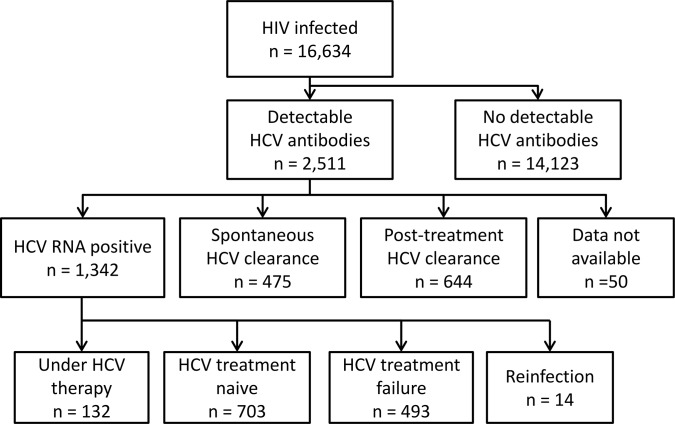
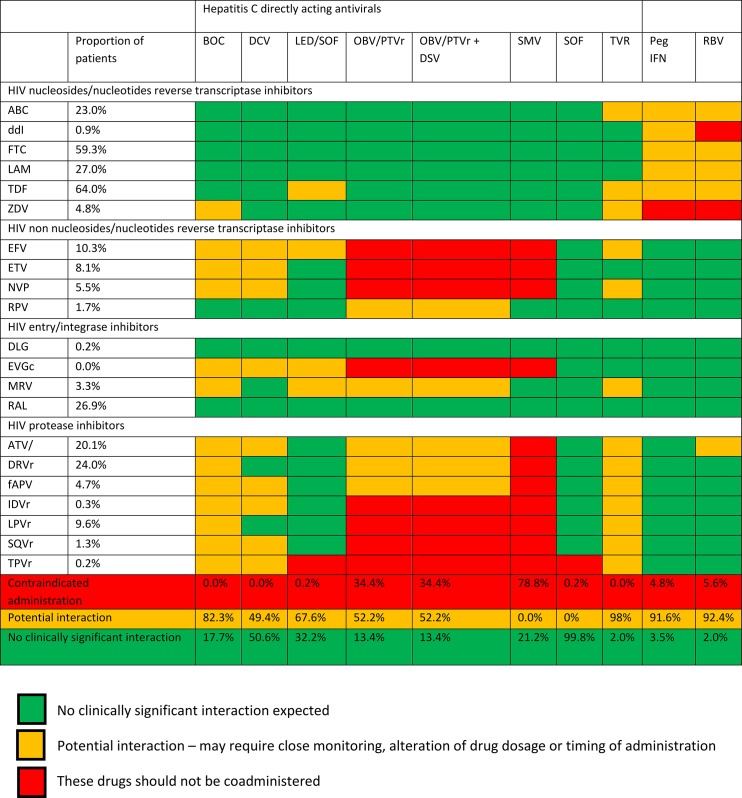
Results: Of 16,634 HIV-infected patients, 2,511 had detectable anti-HCV antibodies, of whom 1,196 had a detectable HCV-RNA and were not receiving HCV treatment at the time of analysis. 97.1% of these patients were receiving cART and 81.2% had a plasma HIV RNA <50 copies/mL. cART included combinations of nucleoside reverse transcriptase inhibitors with a boosted protease inhibitor in 43.6%, a non-nucleoside reverse transcriptase inhibitor in 17.3%, an integrase inhibitor in 15.4% and various combinations or antiretroviral drugs in 23.7% of patients. A previous treatment against HCV had been administered in 64.4% of patients. Contraindicated associations/potential interactions were expected between cART and respectively sofosbuvir (0.2%/0%), sofosbuvir/ledipasvir (0.2%/67.6%), daclatasvir (0%/49.4%), ombitasvir/boosted paritaprevir (with or without dasabuvir) (34.4%/52.2%) and simeprevir (78.8%/0%).

Conclusions: Significant potential drug-drug interactions are expected between cART and the currently available DAAs in the majority of HIV/HCV coinfected patients. Sofosbuvir/ledipasvir and sofosbuvir/daclatasvir with or without ribavirin appeared the most suitable combinations in our population. A close collaboration between hepatologists and HIV/AIDS specialists appears necessary for the management of HCV treatment concomitantly to cART.


Conflict of interest statement

Competing Interests: Isabelle POIZOT-MARTIN is member of advisory boards for GILEAD, BMS, and ABVIE. She received speaker fees from Gilead, MSD, and BMS, and travel/accommodation grants from BMS. Marc- Antoine VALANTIN has received honoraria for consulting/educational lectures and travel grants from Janssen-Cilag, Gilead Science, ViiV Healthcare, Bristol-Myers Squibb, and Merck/Schering-Plough. Lise CUZIN participated in advisory board meetings for BMS, ViiV Healthcare and received travel grants from BMS and MSD. Eric BILLAUD received travel grants from ViiV Healthcare, Janssen, Gilead, Merck, and BMS, and expertise fees from Gilead and BMS. He also participated in advisory board meetings for MSD. David REY is member of advisory board for Gilead, received speaker fees from MSD and travel grants from Gilead, BMS, and MSD. Christine JACOMET reports grants and nonfinancial support from MSD, non-financial support from ViiV, grants from Roche, grants, personal fees and non-financial support from Janssen, personal fees from Gilead, personal fees from BMS, personal fees from Mylan, personal fees and non-financial support from Abbott, outside the submitted work. Claudine DUVIVIER has received travel grants, honoraria or study grants from various pharmaceutical companies, including Bristol- Myers-Squibb, Gilead Sciences, Janssen, Merck and ViiV Healthcare. Pascal PUGLIESE is member of advisory boards for Gilead and BMS. Laurent COTTE has received research grants from ViiV healthcare and MSD, personal fees from Mylan and non-financial support from BMS, Gilead Science, Janssen Cilag, MSD and ViiV healthcare. Alissa NAQVI, Véronique OBRY-ROGUET, Antoine CHERET, and Pierre PRADAT have no conflict of interest to disclose. This does not alter the authors' adherence to PLOS ONE policies on sharing data and materials.

Figures

Fig 1
Fig 1. Flow chart of patient analysis.
Fig 2
Fig 2. Distribution of antiretroviral drugs received in 1161 HIV/HCV coinfected patients under cART and potential drug-drug interactions between antiretrovirals and currently available DAAs (patients not under antiretroviral treatment, patients under HCV treatment at the time of analysis and patients with HCV reinfection excluded).
Adapted from www.hep-druginteractions.org (Abbreviations: ABC abacavir; ddI didanosine; FTC emtricitabine; LAM lamivudine; TDF tenofovir; ZDV zidovudine; EFV efavirenz; ETV etravirine; NVP nevirapine; RPV rilpivirine; DLG dolutegravir; EVGc cobicistat boosted elvitegravir; MRV maraviroc; RAL raltegravir; ATV atazanavir; ATVr ritonavir boosted atazanavir; DRVr ritonavir boosted darunavir; fAPVr ritonavir boosted fosamprenavir; IDVr ritonavir boosted indinavir; LPVr ritonavir boosted lopinavir; SQVr ritonavir boosted saquinavir; TPVr ritonavir boosted tipranavir; BOC boceprevir; DCV daclatasvir; LED Ledipasvir; OBV ombitasvir; PTVr ritonavir boosted paritaprevir; DSV dasabuvir; SMV simeprevir; SOF sofosbuvir; TVR telaprevir; PegIFN Peg interferon alpha; RBV ribavirin.)

References

    1. Hernandez MD, Sherman KE. HIV/hepatitis C coinfection natural history and disease progression. Curr Opin HIV AIDS. 2011;6(6):478–82. Epub 2011/10/18. 10.1097/COH.0b013e32834bd365 01222929-201111000-00007 [pii]. - DOI - PMC - PubMed
    1. Cacoub P, Dabis F, Costagliola D, Almeida K, Lert F, Piroth L, et al. Burden of HIV and hepatitis C co-infection: the changing epidemiology of hepatitis C in HIV-infected patients in France. Liver Int. 2015;35(1):65–70. Epub 2014/07/22. 10.1111/liv.12639 . - DOI - PubMed
    1. Graham CS, Baden LR, Yu E, Mrus JM, Carnie J, Heeren T, et al. Influence of human immunodeficiency virus infection on the course of hepatitis C virus infection: a meta-analysis. Clin Infect Dis. 2001;33(4):562–9. Epub 2001/07/20. CID001179 [pii] 10.1086/321909 . - DOI - PubMed
    1. Thein HH, Yi Q, Dore GJ, Krahn MD. Natural history of hepatitis C virus infection in HIV-infected individuals and the impact of HIV in the era of highly active antiretroviral therapy: a meta-analysis. AIDS. 2008;22(15):1979–91. Epub 2008/09/12. 10.1097/QAD.0b013e32830e6d51 00002030-200810010-00010 [pii]. . - DOI - PubMed
    1. Operskalski EA, Kovacs A. HIV/HCV co-infection: pathogenesis, clinical complications, treatment, and new therapeutic technologies. Curr HIV/AIDS Rep. 2011;8(1):12–22. Epub 2011/01/12. 10.1007/s11904-010-0071-3 - DOI - PMC - PubMed

Publication types