Uncommon Candida Species Fungemia among Cancer Patients, Houston, Texas, USA
- PMID: 26488845
- PMCID: PMC4625381
- DOI: 10.3201/eid2111.150404
Uncommon Candida Species Fungemia among Cancer Patients, Houston, Texas, USA
Abstract
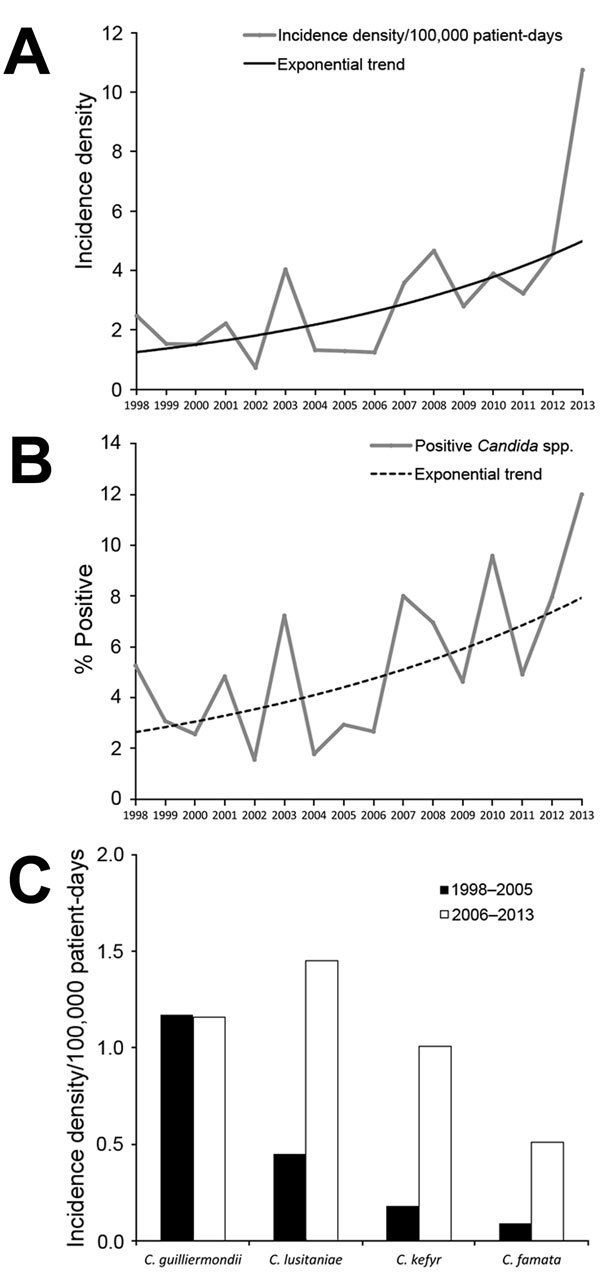
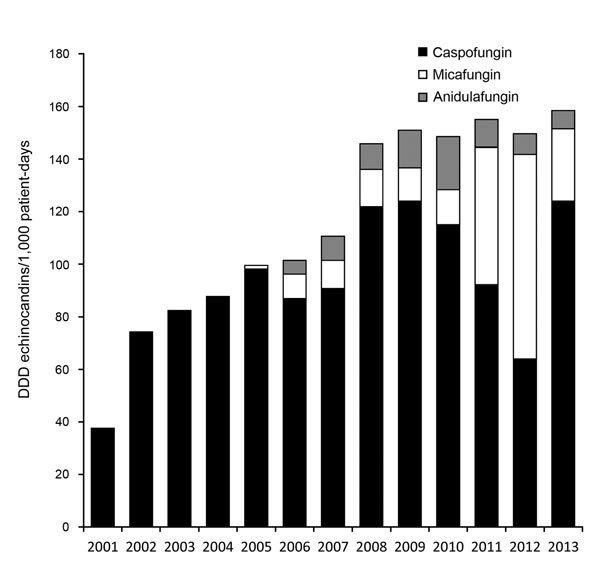
Many uncommon Candida species that cause bloodstream infections (BSIs) are not well-characterized. We investigated the epidemiology, antifungal use, susceptibility patterns, and factors associated with all-cause death among cancer patients in whom uncommon Candida spp. BSIs were diagnosed at a cancer treatment center during January 1998–September 2013. Of 1,395 Candida bloodstream isolates, 79 from 68 patients were uncommon Candida spp. The incidence density of uncommon Candida spp. BSIs and their proportion to all candidemia episodes substantively increased during the study period, and the rise was associated with increasing use of echinocandin antifungal drugs. Thirty-seven patients had breakthrough infections during therapy or prophylaxis with various systemic antifungal drugs for >7 consecutive days; 21 were receiving an echinocandin. C. kefyr (82%), and C. lusitaniae (21%) isolates frequently showed caspofungin MICs above the epidemiologic cutoff values. These findings support the need for institutional surveillance for uncommon Candida spp. among cancer patients.
Keywords: C. dublinensis; C. famata; C. guilliermondii; C. kefyr; C. lusitaniae; Candida; Houston; Texas; USA; antimicrobial drugs; cancer; candidemia; caspofungin; echinocandins; fungi; non-albicans.
Figures
References
-
- Sipsas NV, Lewis RE, Tarrand JJ, Hachem R, Rolston KV, Raad II, et al. Candidemia in patients with hematologic malignancies in the era of new antifungal agents (2001–2007): stable incidence but changing epidemiology of a still frequently lethal infection. Cancer. 2009;115:4745–52. 10.1002/cncr.24507 - DOI - PubMed
-
- Cleveland AA, Farley MM, Harrison LH, Stein B, Hollick R, Lockhart SR, et al. Changes in incidence and antifungal drug resistance in candidemia: results from population-based laboratory surveillance in Atlanta and Baltimore, 2008–2011. Clin Infect Dis. 2012;55:1352–61. 10.1093/cid/cis697 - DOI - PMC - PubMed
-
- Pfaller MA, Andes DR, Diekema DJ, Horn DL, Reboli AC, Rotstein C, et al. Epidemiology and outcomes of invasive candidiasis due to non-albicans species of Candida in 2,496 patients: data from the prospective antifungal therapy (PATH) Registry 2004–2008. PLoS ONE. 2014;9:e101510. 10.1371/journal.pone.0101510 - DOI - PMC - PubMed
Publication types
MeSH terms
Substances
LinkOut - more resources
Full Text Sources
Other Literature Sources
Medical
Miscellaneous