Review
. 2016 Mar;18(3):203-16.
doi: 10.1111/dom.12591. Epub 2016 Jan 5.

Incretin therapies: highlighting common features and differences in the modes of action of glucagon-like peptide-1 receptor agonists and dipeptidyl peptidase-4 inhibitors

Affiliations
Review

Incretin therapies: highlighting common features and differences in the modes of action of glucagon-like peptide-1 receptor agonists and dipeptidyl peptidase-4 inhibitors

M Nauck. Diabetes Obes Metab. 2016 Mar.

Abstract

Over the last few years, incretin-based therapies have emerged as important agents in the treatment of type 2 diabetes (T2D). These agents exert their effect via the incretin system, specifically targeting the receptor for the incretin hormone glucagon-like peptide 1 (GLP-1), which is partly responsible for augmenting glucose-dependent insulin secretion in response to nutrient intake (the 'incretin effect'). In patients with T2D, pharmacological doses/concentrations of GLP-1 can compensate for the inability of diabetic β cells to respond to the main incretin hormone glucose-dependent insulinotropic polypeptide, and this is therefore a suitable parent compound for incretin-based glucose-lowering medications. Two classes of incretin-based therapies are available: GLP-1 receptor agonists (GLP-1RAs) and dipeptidyl peptidase-4 (DPP-4) inhibitors. GLP-1RAs promote GLP-1 receptor (GLP-1R) signalling by providing GLP-1R stimulation through 'incretin mimetics' circulating at pharmacological concentrations, whereas DPP-4 inhibitors prevent the degradation of endogenously released GLP-1. Both agents produce reductions in plasma glucose and, as a result of their glucose-dependent mode of action, this is associated with low rates of hypoglycaemia; however, there are distinct modes of action resulting in differing efficacy and tolerability profiles. Furthermore, as their actions are not restricted to stimulating insulin secretion, these agents have also been associated with additional non-glycaemic benefits such as weight loss, improvements in β-cell function and cardiovascular risk markers. These attributes have made incretin therapies attractive treatments for the management of T2D and have presented physicians with an opportunity to tailor treatment plans. This review endeavours to outline the commonalities and differences among incretin-based therapies and to provide guidance regarding agents most suitable for treating T2D in individual patients.

Keywords: DPP-4 inhibitor; GLP-1; GLP-1 receptor agonist; glucagon-like peptide-1; incretin enhancer; incretin mimetics; mode of action; type 2 diabetes mellitus.


Figures

Figure 1
Figure 1
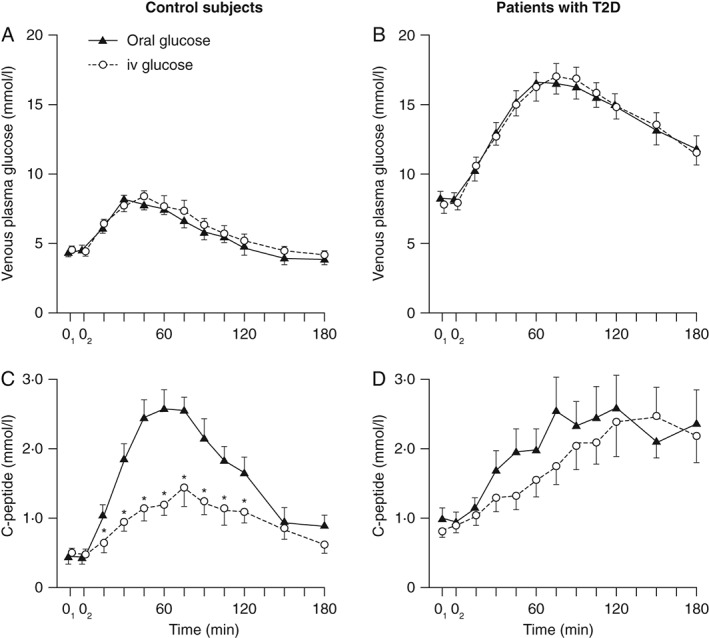
The incretin effect in control subjects and patients with type 2 diabetes (T2D). Venous plasma glucose and integrated incremental β‐cell secretory responses to oral glucose loads (black triangles) or ‘isoglycaemic’ intravenous glucose infusion (open circles). After an overnight fast, oral glucose (50 g glucose/400 ml) was ingested (time 0) and blood samples taken every 15–120 min and then every 30 min for the final two samples. Isoglycaemic intravenous glucose infusions were designed to mimic glucose concentration profiles after glucose ingestion. Asterisks denote significance (p < 0.05) to the respective value after oral load. © Springer‐Verlag 1986, reproduced with permission from Nauck et al. Diabetologia 1986; 29: 46–52 5. iv, intravenous.
Figure 2
Figure 2
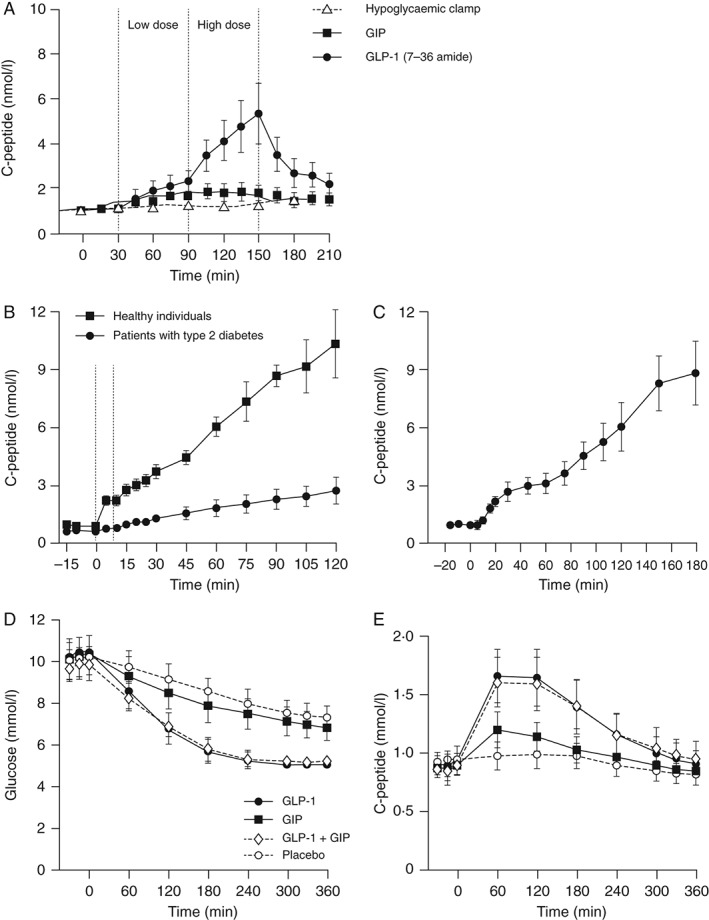
Insulinotropic activities of the incretin hormones glucagon‐like peptide 1 (GLP‐1) and glucose‐dependent insulinotropic polypeptide (GIP). (A) GLP‐1, but not GIP, can increase both early and late stage insulin secretion. Nine patients with type 2 diabetes (T2D) and nine subjects with normal glucose tolerance were included. All antidiabetic drugs were withheld until experimental completion and each experiment was performed following an overnight fast. At time 0, patients received intravenous glucose to a plasma glucose concentration of 8.75 mmol/l, at which point a hyperglycaemic glucose clamp was initiated. Either exogenous synthetic human GIP or GLP‐1 (7‐36 amide) was then infused to concentrations equivalent to physiological levels (0.8 and 0.4 pmol/kg/min, respectively) between 30 and 90 min (dotted lines). Between 90 and 150 min, infusion rates were increased threefold to supraphysiological concentrations (2.4 and 1.2 pmol/kg/min, respectively). C‐peptide level was determined from blood samples by radioimmunoassay. Data are mean ± standard error of the mean. © The American Society for Clinical Investigation 1993, reproduced with permission from Nauck et al. J Clin Invest 1993; 91: 301–7 7. (B, C): Insulin responses to physiological levels of GLP‐1 are severely impaired in T2D but can be restored by pharmacological doses of GLP‐1. Sixteen obese patients with T2D [eight patients per experiment (B, C)] underwent hyperglycaemic clamp (15 mmol/l) and infusion of physiological [0.5 pmol/kg/min (B)] or pharmacological [1 pmol/kg/min (C)] levels of GLP‐1 or GLP‐ 1 (7‐36 amide), respectively. C‐peptide concentrations were measured by Autodelphia automatic fluoroimmunoassay. © Springer‐Verlag 2009 and 2002, reproduced with permission from Højberg et al. Diabetologia 2009; 52: 199–207 13 (B) and Vilsbøll et al. Diabetologia 2002; 45: 1111–9 14 (C). (D, E) GIP does not augment the insulinotropic activity of GLP‐1. Twelve patients with T2D were included. Antidiabetic drugs were discontinued 1 day before each experiment and each experiment was performed after an overnight fast. Placebo (0.9% NaCl with 1% human serum albumin), GIP (4 pmol/kg/min), GLP‐1 (7‐36 amide; 1.2 pmol/kg/min), or a combination of GIP and GLP‐1 (7‐36 amide) was infused over a period of 360 min. Plasma glucose concentrations and C‐peptide secretion rates were determined from blood drawn in the basal state and during infusions. Glucose was measured using a glucose oxidase assay and C‐peptide determined by immunoassay. © American Diabetes Association 2011, reproduced with permission from Mentis et al. Diabetes 2011; 60: 1270–6 15.
Figure 3
Figure 3
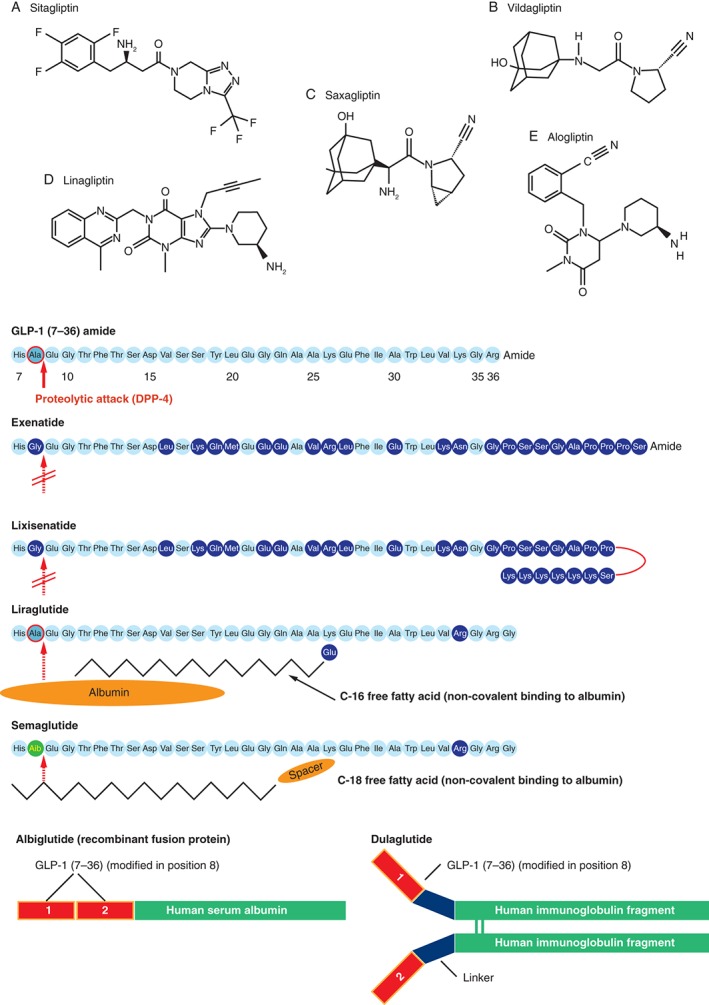
The chemically distinct structures of dipeptidyl peptidase 4 (DPP‐4) inhibitors [(A–E) for DPP‐4 inhibitors indicates order of approval] and GLP‐1RAs. Images (A–E) © of Wiley and reproduced with permission from Deacon et al., Diabetes Obes Metab 2011; 13: 7–18; Drucker and Nauck. Lancet 2006; 368: 1696–705 [glucagon‐like peptide‐1 (GLP‐1), exenatide, liraglutide] 8, 27.
Figure 4
Figure 4
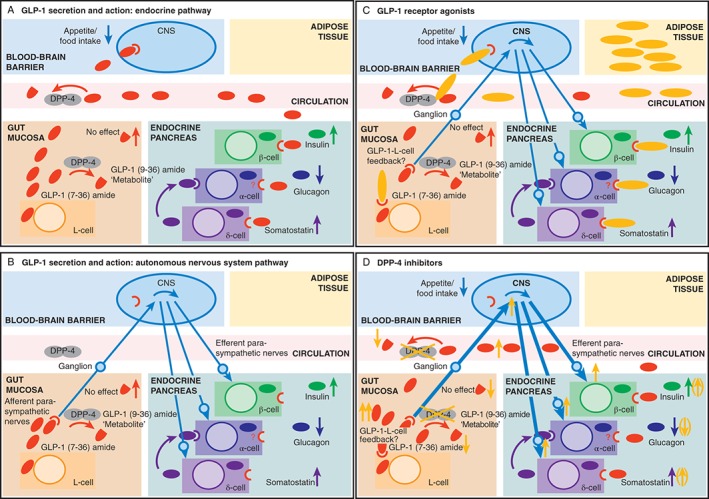
Illustrations of the endocrine (A) and nerve‐stimulating (B) elements of the mode of action of glucagon‐like peptide‐1 (GLP‐1) and of the predominant modes of action of GLP‐1 receptor agonists (GLP‐1RAs) (C) and DPP‐4 inhibitors (D). (A) GLP‐1 (depicted by red ovals) is released from L‐cells in the gut mucosa, and is partially degraded and inactivated by DPP‐4 in the vicinity of L‐cells in the gut mucosa and other compartments (circulatory system and other tissues). GLP‐1 surviving in its intact, biologically active form reaches target cells expressing the GLP‐1 receptor (GLP‐1R) via the bloodstream. (B) Afferent vagal nerve endings with GLP‐1Rs respond to GLP‐1 immediately after its release from L‐cells. The signal reaches the brain via ganglia belonging to the parasympathetic nervous system. The brain then sends efferent impulses to target organs for GLP‐1 activity, such as the endocrine pancreas, where insulin secretion is stimulated and glucagon secretion is suppressed. The endocrine and nerve‐stimulating elements of the mode of action of GLP‐1 co‐exist and may vary in their relative importance. (C) GLP‐1RAs (yellow ovals) are injected into the adipose tissue compartment and, from there, mainly reach target cells via the general circulation. (D) For DPP‐4 inhibitors, a substantial proportion of the effects may be mediated through enhanced interactions of GLP‐1 maintained in its intact, biologically active form, with receptors on afferent vagal fibres (i.e. the neural pathway).

References

    1. Defronzo RA. Banting Lecture. From the triumvirate to the ominous octet: a new paradigm for the treatment of type 2 diabetes mellitus. Diabetes 2009; 58: 773–795. - PMC - PubMed
    1. Lorber D. Importance of cardiovascular disease risk management in patients with type 2 diabetes mellitus. Diabetes Metab Syndr Obes 2014; 7: 169–183. - PMC - PubMed
    1. Ross SA. Breaking down patient and physician barriers to optimize glycemic control in type 2 diabetes. Am J Med 2013; 126: S38–S48. - PubMed
    1. Nauck MA. Unraveling the science of incretin biology. Eur J Intern Med 2009; 20(Suppl. 2): S303–S308. - PubMed
    1. Nauck M, Stockmann F, Ebert R, Creutzfeldt W. Reduced incretin effect in type 2 (non‐insulin‐dependent) diabetes. Diabetologia 1986; 29: 46–52. - PubMed

Publication types

MeSH terms