


Adherence to a Mediterranean diet, genetic susceptibility, and progression to advanced macular degeneration: a prospective cohort study
- PMID: 26490493
- PMCID: PMC4625588
- DOI: 10.3945/ajcn.115.111047
Adherence to a Mediterranean diet, genetic susceptibility, and progression to advanced macular degeneration: a prospective cohort study
Abstract
Background: Adherence to a Mediterranean-type diet is linked to a lower risk of mortality and chronic disease, but the association with the progression of age-related macular degeneration (AMD) and genetic susceptibility is unknown.
Objective: We examined the association of adherence to the Mediterranean diet and genetic susceptibility with progression to advanced AMD.
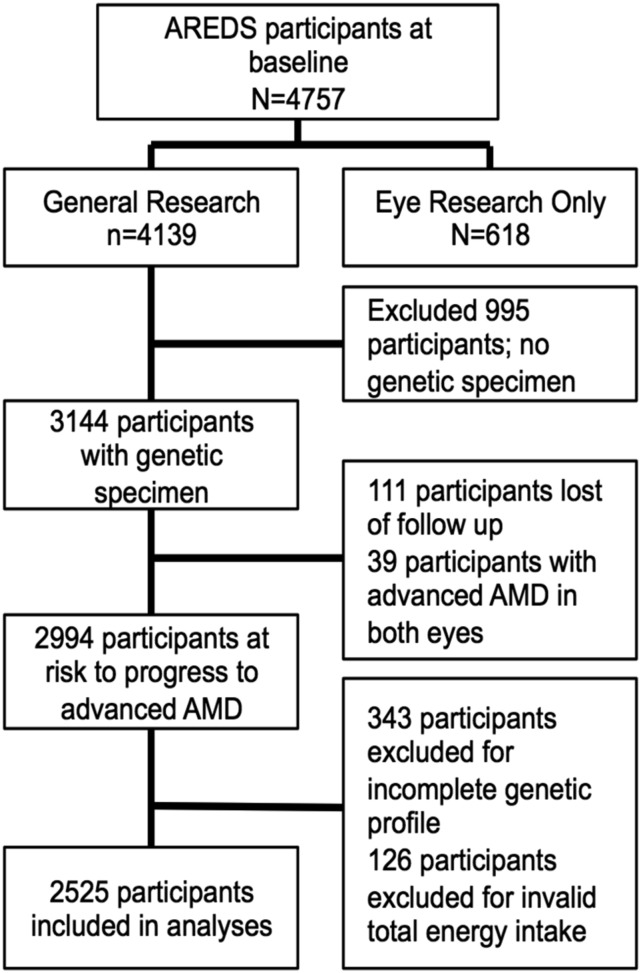
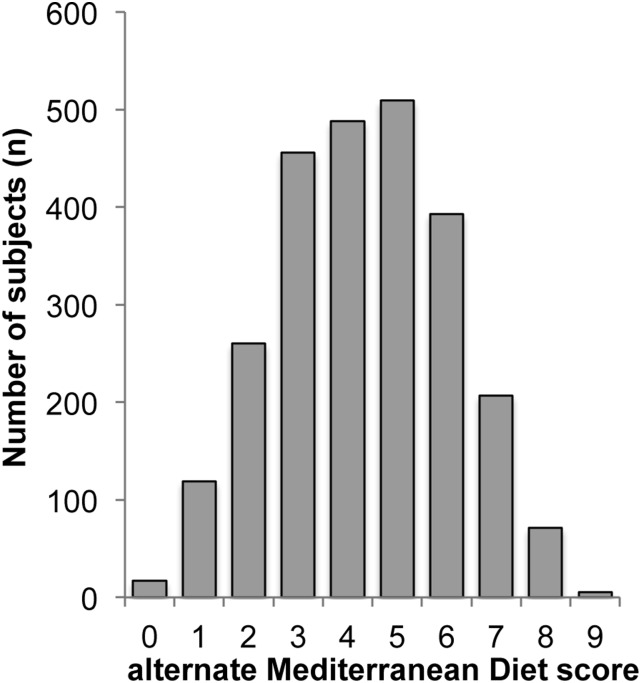
Design: Among 2525 subjects in the AREDS (Age-Related Eye Disease Study), 1028 eyes progressed to advanced AMD over 13 y. Baseline data for demographic and behavioral covariates were collected by using questionnaires. Dietary data were collected from food-frequency questionnaires. The alternate Mediterranean diet (aMeDi) score (range: 0-9) was constructed from individual intakes of vegetables, fruit, legumes, whole grains, nuts, fish, red and processed meats, alcohol, and the ratio of monounsaturated to saturated fats. Ten genetic loci in 7 genes [complement factor H (CFH), age-related maculopathy susceptibility 2/high-temperature requirement A serine peptidase 1 (ARMS2/HTRA1), complement component 2 (C2), complement factor B (CFB), complement component 3 (C3), collagen type VIII α 1 (COL8A1), and RAD51 paralog B (RAD51B)] were examined. Survival analysis was used to assess individual eyes for associations between incident AMD and aMeDi score, as well as interaction effects between aMeDi score and genetic variation on risk of AMD.
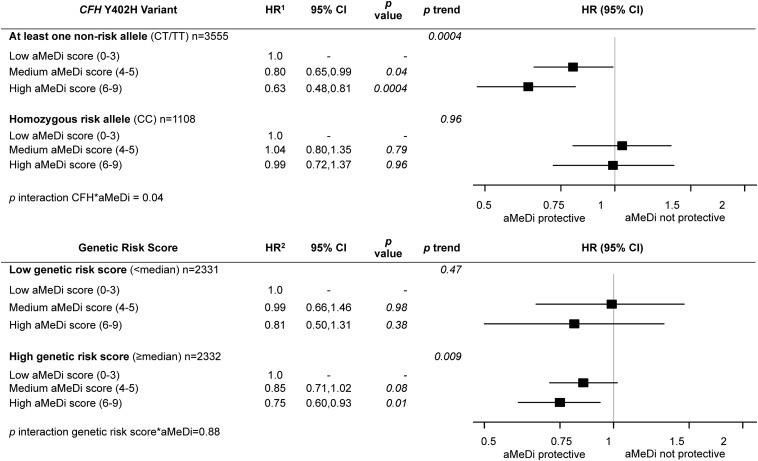
Results: A high aMeDi score (score of 6-9) was significantly associated with a reduced risk of progression to advanced AMD after adjustment for demographic, behavioral, ocular, and genetic covariates (HR: 0.74; 95% CI: 0.61, 0.91; P-trend = 0.007). The aMeDi score was significantly associated with a lower risk of incident advanced AMD among subjects carrying the CFH Y402H nonrisk (T) allele (P-trend = 0.0004, P-interaction = 0.04). The aMeDi score was not associated with AMD among subjects who were homozygous for the risk (C) allele.
Conclusion: Higher adherence to a Mediterranean diet was associated with reduced risk of progression to advanced AMD, which may be modified by genetic susceptibility. This trial was registered at clinicaltrials.gov as NCT00594672.
Keywords: AMD progression; Mediterranean diet; genetics; macular degeneration; nutrition.
© 2015 American Society for Nutrition.
Figures
References
-
- Lim LS, Mitchell P, Seddon JM, Holz FG, Wong TY. Age-related macular degeneration. Lancet 2012;379:1728–38. - PubMed
-
- Friedman DS, O’Colmain BJ, Munoz B, Tomany SC, McCarty C, de Jong PT, Nemesure B, Mitchell P, Kempen J; Eye Diseases Prevalence Research Group. Prevalence of age-related macular degeneration in the United States. Arch Ophthalmol 2004;122:564–72. - PubMed
-
- Mangione CM, Gutierrez PR, Lowe G, Orav EJ, Seddon JM. Influence of age-related maculopathy on visual functioning and health-related quality of life. Am J Ophthalmol 1999;128:45–53. - PubMed
-
- Rosenfeld PJ, Brown DM, Heier JS, Boyer DS, Kaiser PK, Chung CY, Kim RY, Marina Study Group. Ranibizumab for neovascular age-related macular degeneration. N Engl J Med 2006;355:1419–31. - PubMed
Publication types
MeSH terms
Substances
Associated data
Grants and funding
LinkOut - more resources
Full Text Sources
Other Literature Sources
Medical
Molecular Biology Databases
Research Materials
Miscellaneous
