


Inhibitory effect of curcumin on testosterone induced benign prostatic hyperplasia rat model
- PMID: 26490686
- PMCID: PMC4618860
- DOI: 10.1186/s12906-015-0825-y
Inhibitory effect of curcumin on testosterone induced benign prostatic hyperplasia rat model
Abstract
Background: Benign prostatic hyperplasia (BPH) is one of the common male diseases, which is provoked by dihydrotestosterone (DHT) and androgen signals. Several studies showed that curcumin has various effects of prevention and treatment to diseases. We investigated whether curcumin may repress the development of BPH in male Wistar rats.
Methods: Seven weeks male Wistar rats were and divided into 4 groups (normal group, BPH group, finasteride group, curcumin group; n = 8 for each group). In order to induce BPH in rats, rats were castrated and testosterone was injected subcutaneously everyday (s.c., 20 mg/kg). Rats in the curcumin group were treated 50 mg/kg, administered orally for 4 weeks. After 4 weeks, all rats were sacrificed and their prostate and serum were analyzed.
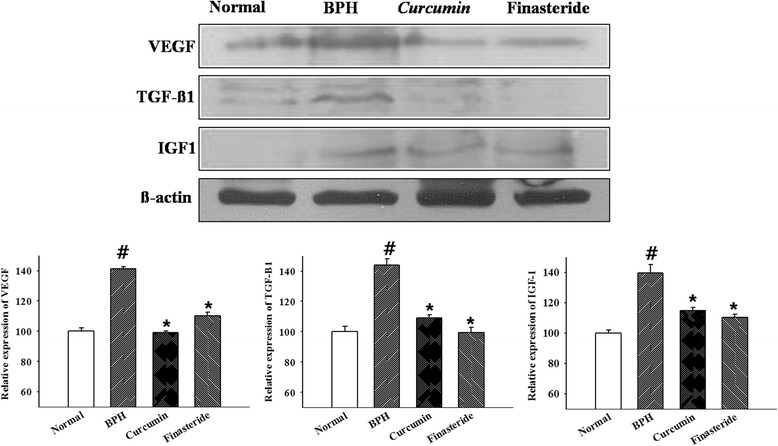
Results: Compared to the finasteride group as positive group, the curcumin group showed similarly protective effect on BPH in histopathologic morphology, prostate volume. Results of immunohistochemistry and western-blot showed decreased expressions of VEGF, TGF-ß1, and IGF1 were also decreased in the curcumin group.
Conclusions: These results suggested that curcumin inhibited the development of BPH and might a useful herbal treatment or functional food for BPH.
Figures


Comment in
-
Re: Inhibitory Effect of Curcumin on Testosterone Induced Benign Prostatic Hyperplasia Rat Model.J Urol. 2017 May;197(5):1322-1323. doi: 10.1016/j.juro.2017.02.042. Epub 2017 Feb 16. J Urol. 2017. PMID: 29539933 No abstract available.
References
Publication types
MeSH terms
Substances
LinkOut - more resources
Full Text Sources
Other Literature Sources
Medical
Miscellaneous
