. 2015 Dec;22(6):425-37.
doi: 10.1093/dnares/dsv024. Epub 2015 Oct 21.

Improving a Synechocystis-based photoautotrophic chassis through systematic genome mapping and validation of neutral sites

Affiliations

Improving a Synechocystis-based photoautotrophic chassis through systematic genome mapping and validation of neutral sites

Filipe Pinto et al. DNA Res. 2015 Dec.

Abstract

The use of microorganisms as cell factories frequently requires extensive molecular manipulation. Therefore, the identification of genomic neutral sites for the stable integration of ectopic DNA is required to ensure a successful outcome. Here we describe the genome mapping and validation of five neutral sites in the chromosome of Synechocystis sp. PCC 6803, foreseeing the use of this cyanobacterium as a photoautotrophic chassis. To evaluate the neutrality of these loci, insertion/deletion mutants were produced, and to assess their functionality, a synthetic green fluorescent reporter module was introduced. The constructed integrative vectors include a BioBrick-compatible multiple cloning site insulated by transcription terminators, constituting robust cloning interfaces for synthetic biology approaches. Moreover, Synechocystis mutants (chassis) ready to receive purpose-built synthetic modules/circuits are also available. This work presents a systematic approach to map and validate chromosomal neutral sites in cyanobacteria, and that can be extended to other organisms.

Keywords: Synechocystis; neutral sites; photoautotrophic chassis; synthetic biology.


Figures

Figure 1.
Figure 1.
Chromosomal location and genomic context of the Synechocystis' putative neutral sites. (A) Green, sites chosen for mutants construction, Red, sites that fulfil the neutral sites initial selection criteria, but that were subsequently disregarded after additional analyses. (B) Genomic context of each putative neutral site (5,000 bp). Blue, ORFs corresponding to the neutral sites, Red, ORFs encoding proteins with assigned functions; tp, putative transposase; ‘, partial ORFs.
Figure 2.
Figure 2.
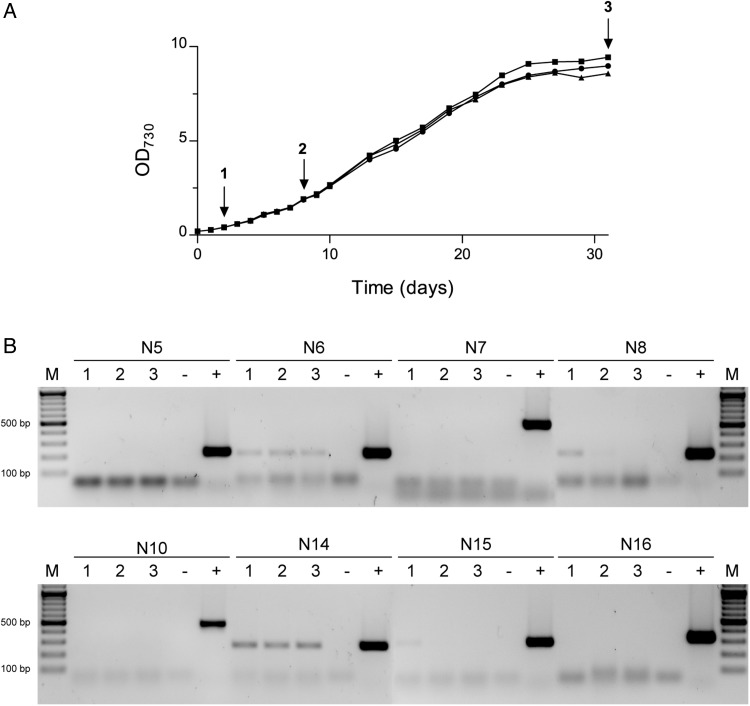
Synechocystis growth curves, sample collection and transcription analysis of eight selected loci (N5, N6, N7, N8, N10, N14, N15 and N16). (A) Growth curves of three independent cultures of Synechocystis with sample collection points for RNA extraction indicated by arrows (1—OD730 ≈ 0.4; 2—OD730 ≈ 1.9; 3—OD730 ≈ 9.0). (B) RT-PCR transcription analysis using total RNA extracted from cells collected at the time points indicated in A. These results are representative of three biological replicates and technical duplicates. −, negative control (absence of template); +, positive control (genomic DNA); and M, GeneRuler DNA ladder (Thermo Fisher Scientific Inc.).
Figure 3.
Figure 3.
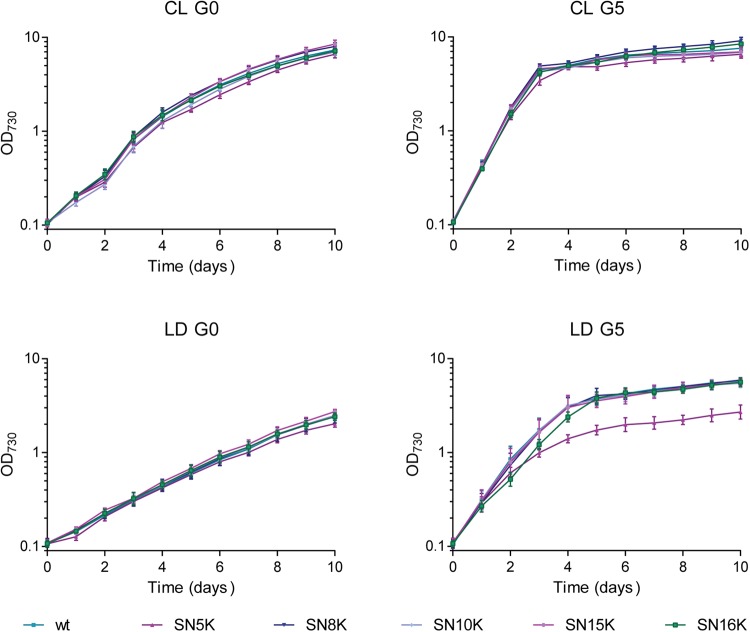
Growth curves of Synechocystis wild type and mutants in the five neutral sites (SN5K, SN8K, SN10K, SN15K, SN16K) cultivated under different conditions. Ten millilitres of culture was grown in 25-ml flasks at 30°C, and OD730 values were recorded daily for 10 consecutive days in continuous light (CL) or 12 h light (20µmolphotons/m2/s)/12 h dark cycles (LD), in autotrophy (G0) or mixotrophy (5 mM glucose, G5). These results are representative of three biological replicates and technical duplicates, and the differences among them are not significant; error bars show ±S.D.
Figure 4.
Figure 4.
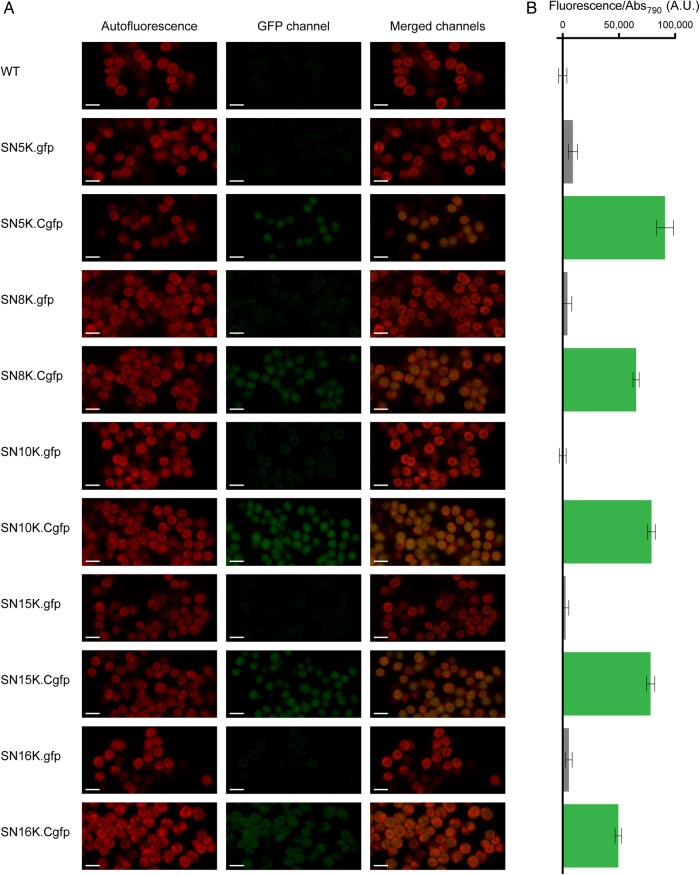
Detection of GFP expression in Synechocystis wild type (WT) and insertion mutants containing a promoterless GFP generator (SNnK.gfp) or the GFP generator under the control of the constitutive minimal Ppsba2* synthetic promoter (SNnK.Cgfp). (A) Confocal micrographs of Synechocystis: autofluorescence is depicted in the left column, GFP signal in the middle column and the merged signals in the right column. Scale bars, 2.5 µm. (B) Normalized fluorescence of the cultures analysed in A. Measurements were performed in triplicate, using 200 µl of each culture, and fluorescence was normalized to OD790. Normalized fluorescence from the wild type was used as baseline. Bars indicate mean ± S.D.
Figure 5.
Figure 5.
PCA of the relative abundances of proteins identified in the iTRAQ experiments for Synechocystis wild type and neutral site mutants containing a gfp module (with or without the constitutive promoter). The first component (x-axis) is responsible for 87.79% of the variation in the samples, and the second component (y-axis) is responsible for 8.79%. The heterologous proteins GFP (P42212) and NPTII (P00552, aminoglycoside 3′-phosphotransferase conferring resistance to neomycin/kanamycin), and a native small stress-related protein (P74485) are clearly separated from the bulk of the proteome (central protein cluster). This figure is available in black and white in print and in colour at DNA Research online.

References

    1. Madigan M.T., Martinko J.M., Stahl D.A., Clark D.P.. 2010, Brock biology of microorganisms. Benjamin Cummings: San Francisco.
    1. Harwood C.R., Pohl S., Smith W., Wipat A.. 2013, Bacillus subtilis: model Gram-positive synthetic biology chassis. In: Colin H., Anil W. (eds), Methods in microbiology. Academic Press: Amsterdam, The Netherlands, pp. 87–117.
    1. Li M., Borodina I.. 2014, Application of synthetic biology for production of chemicals in yeast Saccharomyces cerevisiae, FEMS Yeast Res., 15, 1–12. - PubMed
    1. Berla B.M., Saha R., Immethun C.M., Maranas C.D., Moon T.S., Pakrasi H.B.. 2013, Synthetic biology of cyanobacteria: unique challenges and opportunities, Front. Microbiol., 4, 246. - PMC - PubMed
    1. Whitton B.A., Potts M.. 2000, Introduction to the cyanobacteria. In: Whitton B., Potts M. (eds), The ecology of cyanobacteria—their diversity in time and space. Kluwer Academic Publishers: Dordrecht, The Netherlands, pp. 1–11.

Publication types

Substances