


Maraviroc: a review of its use in HIV infection and beyond
- PMID: 26491256
- PMCID: PMC4598208
- DOI: 10.2147/DDDT.S90580
Maraviroc: a review of its use in HIV infection and beyond
Abstract
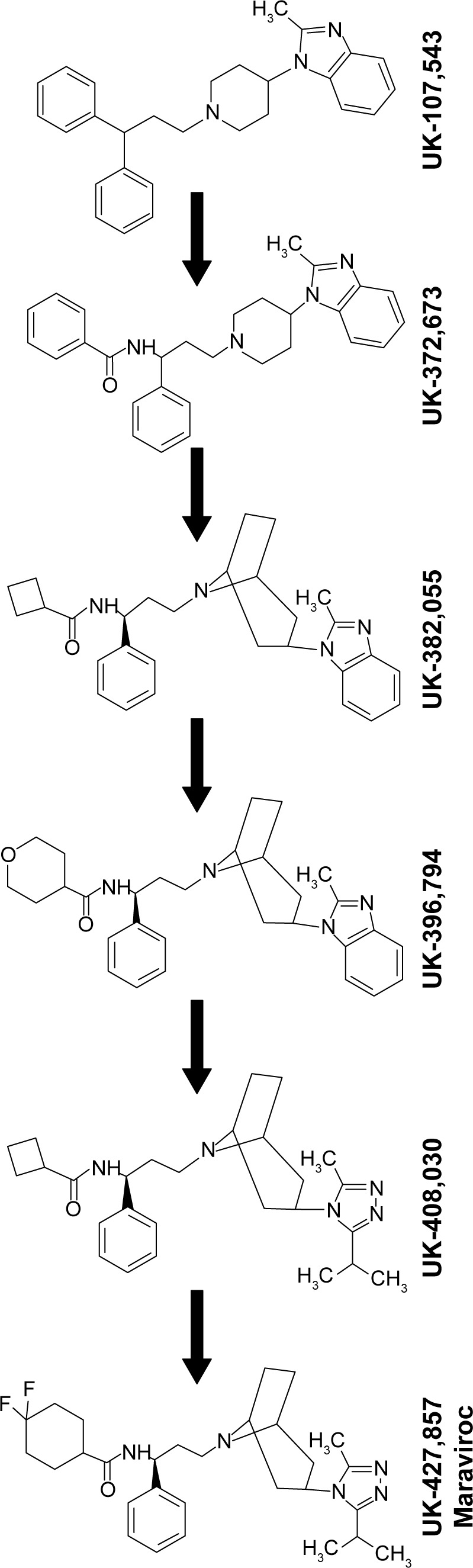
The human immunodeficiency virus-1 (HIV-1) enters target cells by binding its envelope glycoprotein gp120 to the CD4 receptor and/or coreceptors such as C-C chemokine receptor type 5 (CCR5; R5) and C-X-C chemokine receptor type 4 (CXCR4; X4), and R5-tropic viruses predominate during the early stages of infection. CCR5 antagonists bind to CCR5 to prevent viral entry. Maraviroc (MVC) is the only CCR5 antagonist currently approved by the United States Food and Drug Administration, the European Commission, Health Canada, and several other countries for the treatment of patients infected with R5-tropic HIV-1. MVC has been shown to be effective at inhibiting HIV-1 entry into cells and is well tolerated. With expanding MVC use by HIV-1-infected humans, different clinical outcomes post-approval have been observed with MVC monotherapy or combination therapy with other antiretroviral drugs, with MVC use in humans infected with dual-R5- and X4-tropic HIV-1, infected with different HIV-1 genotype or infected with HIV-2. This review discuss the role of CCR5 in HIV-1 infection, the development of the CCR5 antagonist MVC, its pharmacokinetics, pharmacodynamics, drug-drug interactions, and the implications of these interactions on treatment outcomes, including viral mutations and drug resistance, and the mechanisms associated with the development of resistance to MVC. This review also discusses available studies investigating the use of MVC in the treatment of other diseases such as cancer, graft-versus-host disease, and inflammatory diseases.
Keywords: AIDS; CCR5 antagonists; chemokine receptors; drug interactions; human immunodeficiency virus; mutations; pharmacodynamics; pharmacokinetics; resistance.
Figures
Comment in
-
Short-term maraviroc exposure, a clinical approach to decide on maraviroc prescription in HIV-1-infected treatment-naïve patients.Drug Des Devel Ther. 2016 Jan 18;10:353-4. doi: 10.2147/DDDT.S100639. eCollection 2016. Drug Des Devel Ther. 2016. PMID: 26848259 Free PMC article. No abstract available.
-
Author's reply.Drug Des Devel Ther. 2016;10:355-6. Drug Des Devel Ther. 2016. PMID: 27104225 No abstract available.
References
-
- Lee B, Ratajczak J, Doms RW, Gewirtz AM, Ratajczak MZ. Coreceptor/chemokine receptor expression on human hematopoietic cells: biological implications for human immunodeficiency virus-type 1 infection. Blood. 1999;93(4):1145–1156. - PubMed
-
- Huang Y, Paxton WA, Wolinsky SM, et al. The role of a mutant CCR5 allele in HIV-1 transmission and disease progression. Nature Med. 1996;2(11):1240–1243. - PubMed
-
- Samson M, Libert F, Doranz BJ, et al. Resistance to HIV-1 infection in caucasian individuals bearing mutant alleles of the CCR-5 chemokine receptor gene. Nature. 1996;382(6593):722–725. - PubMed
Publication types
MeSH terms
Substances
Grants and funding
LinkOut - more resources
Full Text Sources
Other Literature Sources
Medical
Research Materials
