


Prefrontal Cortex Activation While Walking Under Dual-Task Conditions in Stroke: A Multimodal Imaging Study
- PMID: 26493732
- PMCID: PMC5404717
- DOI: 10.1177/1545968315613864
Prefrontal Cortex Activation While Walking Under Dual-Task Conditions in Stroke: A Multimodal Imaging Study
Abstract
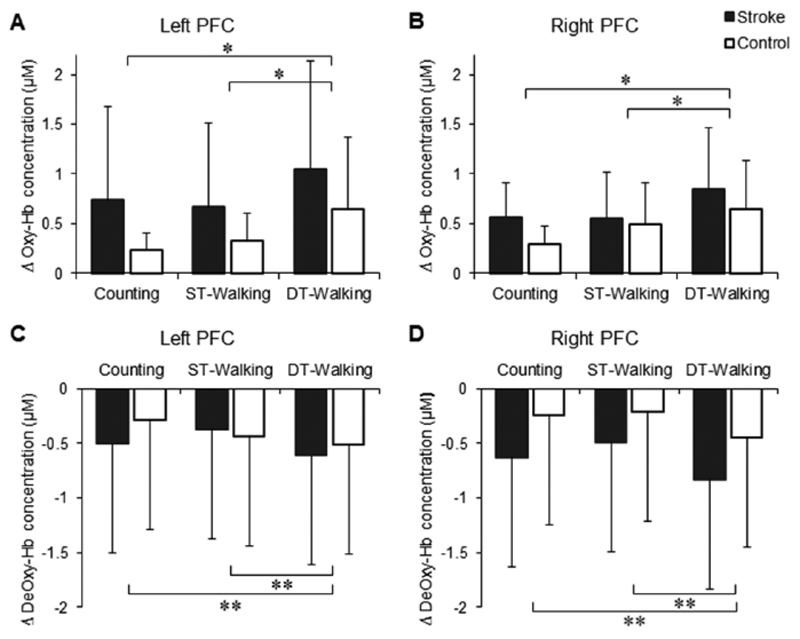
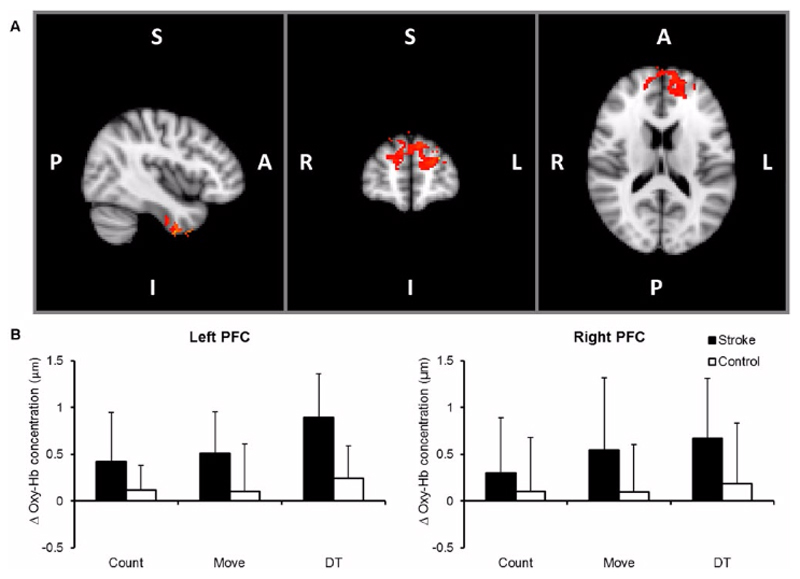
Background Walking while performing another task (eg, talking) is challenging for many stroke survivors, yet its neural basis are not fully understood. Objective To investigate prefrontal cortex activation and its relationship to gait measures while walking under single-task (ST) and dual-task (DT) conditions (ie, walking while simultaneously performing a cognitive task) in stroke survivors. Methods We acquired near-infrared spectroscopy (NIRS) data from the prefrontal cortex during treadmill walking in ST and DT conditions in chronic stroke survivors and healthy controls. We also acquired functional magnetic resonance imaging (fMRI) and NIRS during simulated walking under these conditions. Results NIRS revealed increased oxygenated hemoglobin concentration in DT-walking compared with ST-walking for both groups. For simulated walking, NIRS showed a significant effect of group and group × task, being greater on both occasions, in stroke survivors. A greater increase in brain activation observed from ST to DT walking/ simulated walking was related to a greater change in motor performance in stroke survivors. fMRI revealed increased activity during DT relative to ST conditions in stroke patients in areas including the inferior temporal gyri, superior frontal gyri and cingulate gyri bilaterally, and the right precentral gyrus. The DT-related increase in fMRI activity correlated with DT-related change in behavior in stroke participants in the bilateral inferior temporal gyrus, left cingulate gyrus, and left frontal pole. Conclusion Our results provide novel evidence that enhanced brain activity changes relate to dual task motor decrements.
Keywords: cognitive motor interference; dual task; fMRI; gait control; near-infrared spectroscopy; prefrontal cortex; rehabilitation; stroke.
© The Author(s) 2015.
Conflict of interest statement
The authors declare no potential conflicts of interest with respect to the research, authorship and/or publication of this article.
Figures
References
-
- Pound P, Gompertz P, Ebrahim S. A patient-centred study of the consequences of stroke. Clin Rehabil. 1998;12:338–347. - PubMed
-
- Flansbjer UB, Holmback AM, Downham D, Patten C, Lexell J. Reliability of gait performance tests in men and women with hemiparesis after stroke. J Rehabil Med. 2005;37:75–82. - PubMed
-
- Robinson CA, Shumway-Cook A, Ciol MA, Kartin D. Participation in community walking following stroke: subjective versus objective measures and the impact of personal factors. Phys Ther. 2011;91:1865–1876. - PubMed
-
- Al-Yahya E, Dawes H, Smith L, Dennis A, Howells K, Cockburn J. Cognitive motor interference while walking: a systematic review and meta-analysis. Neurosci Biobehav Rev. 2011;35:715–728. - PubMed
-
- Harada T, Miyai I, Suzuki M, Kubota K. Gait capacity affects cortical activation patterns related to speed control in the elderly. Exp Brain Res. 2009;193:445–454. - PubMed
Publication types
MeSH terms
Grants and funding
LinkOut - more resources
Full Text Sources
Other Literature Sources
Medical
