


Catheter Insertion and Perioperative Practices Within the ISPD North American Research Consortium
- PMID: 26493754
- PMCID: PMC4934430
- DOI: 10.3747/pdi.2015.00089
Catheter Insertion and Perioperative Practices Within the ISPD North American Research Consortium
Abstract
♦
Background: In general, efforts to standardize care based on group consensus practice guidelines have resulted in lower morbidity and mortality. Although there are published guidelines regarding insertion and perioperative management of peritoneal dialysis (PD) catheters, variation in practice patterns between centers may exist. The objective of this study is to understand variation in PD catheter insertion practices in preparation for conducting future studies. ♦
Methods: An electronic survey was developed by the research committee of the International Society for Peritoneal Dialysis - North American Research Consortium (ISPD-NARC) to be completed by physicians and nurses involved in PD programs across North America. It consisted of 45 questions related to 1) organizational characteristics; 2) PD catheter insertion practices; 3) current quality-improvement initiatives; and 4) interest in participation in PD studies. Invitation to participate in the survey was given to nephrologists and nurses in centers across Canada and the United States (US) identified by participation in the inaugural meeting of the ISPD-NARC. Descriptive statistics were applied to analyze the data. ♦
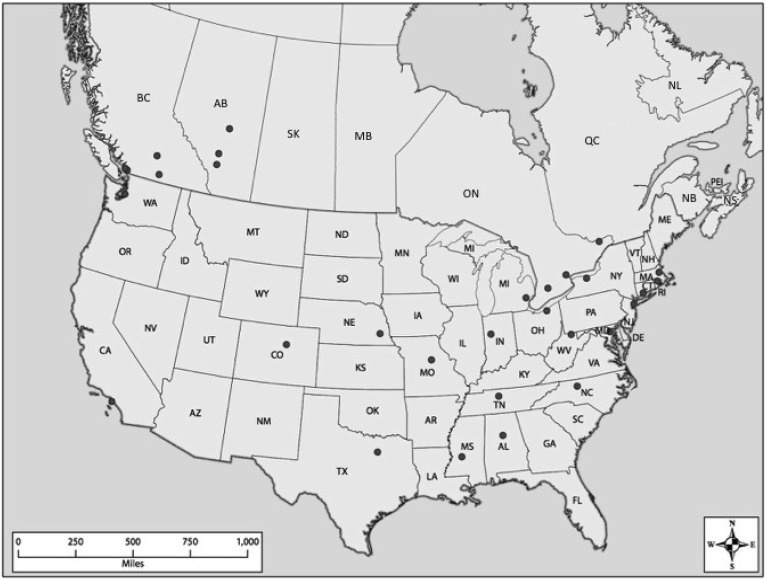
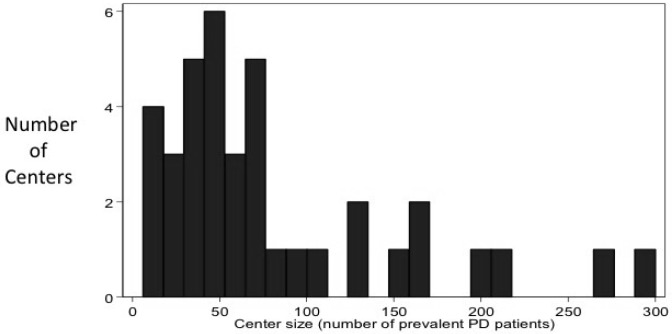
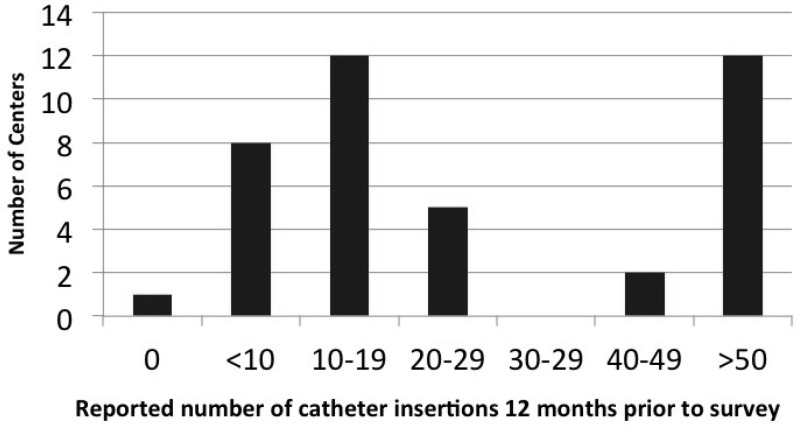
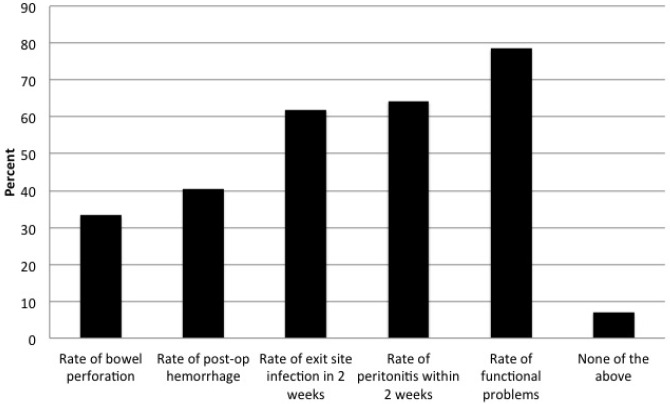
Results: Fifty-one ISPD-NARC sites were identified (45% in Canada and 55% in the US) of which 42 responded (82%). Center size varied significantly, with prevalent PD population ranging from 6 - 300 (median: 60) and incident PD patients in the year prior to survey administration ranging from 3 - 180 (median: 20). The majority of centers placed fewer than 19 PD catheters/year, with a range of 0 - 50. Availability of insertion techniques varied significantly, with 83% of centers employing more than 1 insertion technique. Seventy-one percent performed laparoscopic insertion with advanced techniques (omentectomy, omentopexy, and lysis of adhesions), 62% of sites performed open surgical dissection, 10% performed blind insertion via trocar, and 29% performed blind placement with the Seldinger technique. Use of double-cuff catheters was nearly universal, with a near even distribution of catheters with pre-formed bend versus straight inter-cuff segments. There was also variation in the choice of perioperative antibiotics and perioperative flushing practices. Although 86% of centers had quality-improvement initiatives, there was little consensus as to appropriate targets. ♦
Conclusions: There is marked variability in PD catheter insertion techniques and perioperative management. Large multicenter studies are needed to determine associations between these practices and catheter and patient outcomes. This research could inform future trials and guidelines and improve practice. The ISPD-NARC is a network of PD units that has been formed to conduct multicenter studies in PD.
Keywords: Peritoneal dialysis; Tenckhoff catheter; peritoneal dialysis access; peritoneal dialysis catheter.
Copyright © 2016 International Society for Peritoneal Dialysis.
Figures
References
-
- Mehrotra R, Chiu YW, Kalantar-Zadeh K, Bargman J, Vonesh E. Similar outcomes with hemodialysis and peritoneal dialysis in patients with end-stage renal disease. Arch Intern Med 2011; 171:110–8. - PubMed
-
- USRDS 2012 Atlas of CKD and ESRD. Volume 2, Chapter 11, Figure 11.7–Total Medicare ESRD expenditures per person per year, by modality: 332 Available at http://www.usrds.org/atlas.aspx.
-
- Figueiredo A, Goh B-L, Jenkins S, Johnson DW, Mactier R, Ramalakshmi S, et al. Clinical practice guidelines for peritoneal access. Perit Dial Int 2010; 30(4):424–9. - PubMed
-
- SurveyMonkey Inc www.surveymonkey.com Palo Alto, California, USA.
Publication types
MeSH terms
LinkOut - more resources
Full Text Sources
Other Literature Sources
Medical
