. 2015:2015:593196.
doi: 10.1155/2015/593196. Epub 2015 Oct 1.

Effect of Auricular Acupressure on Uremic Pruritus in Patients Receiving Hemodialysis Treatment: A Randomized Controlled Trial

Affiliations

Effect of Auricular Acupressure on Uremic Pruritus in Patients Receiving Hemodialysis Treatment: A Randomized Controlled Trial

Cui-Na Yan et al. Evid Based Complement Alternat Med. 2015.

Abstract

Background. Uremic pruritus (UP) is a common symptom in patients undergoing maintenance hemodialysis for end-stage renal disease (ESRD). Objective. To determine the clinical efficacy of auricular acupressure therapy on pruritus in hemodialysis patients and to explore possible underlying mechanisms. Methods. Patients receiving maintenance hemodialysis at a referral medical center were recruited and assigned to intervention (n = 32) and control (n = 30) groups. The intervention group underwent auricular acupressure treatment three times a week for six weeks. Auricular acupressure was not applied to patients in the control group. However, tape without Vaccaria seeds was applied to the same six auricular acupoints as the intervention group. Pruritus scores were assessed using VAS scores, and enzyme-linked immunosorbent assays (ELISA) were used to measure levels of other possible contributory biochemical factors. Results. There was a significant difference in mean VAS scores between the postintervention and control groups during follow-up (3.844 ± 1.687 versus 5.567 ± 2.285, F = 22.32, P < 0.0001). Compared to the control group, serum histamine levels in the postintervention group at the six-week follow-up had decreased significantly (F = 5.01, P = 0.0290). Conclusion. Our findings suggest that auricular acupressure may be a useful treatment in the multidisciplinary management of UP in ESRD patients.


Figures

Figure 1
Figure 1
Participant screening, randomization, and completion in the six-week intervention study.
Figure 2
Figure 2
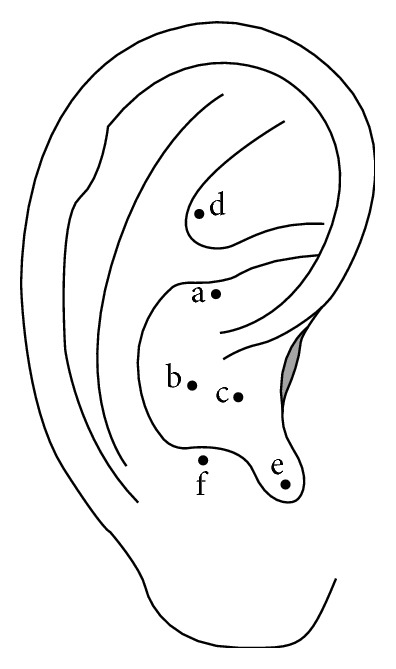
Location of auricular acupoints used in the auricular acupressure treatment group; a: the “kidney”: the back of the bottom ear helix (i.e., the concha 10 region, CO10); b: the “lung”: adjacent to the area of the “heart” and the “trachea” (i.e., the concha 14 region, CO14); c: the “heart”: in the middle ear cavity depression (i.e., the concha 15 region, CO15); d: the “Shenmen”: in the upper part of the posterior 1/3 of the triangular fossa (i.e., the triangular fossa 4 region, TF4); e: the “endocrine”: within the intertragic notch in the lower front concha (i.e., the concha 18 region, CO18); f: the “subcortical”: within the inner side of the tragus (i.e., the tragus 4 region, AT4).
Figure 3
Figure 3
Mean change in visual analog scale (VAS) scores after six weeks, according to the postintervention group. Participant visual analog scale (VAS) scores indicate pruritus intensity and severity: 0 means no pruritus and 10 means very intense pruritus. ∗∗∗ P < 0.001 versus control group.
Figure 4
Figure 4
Mean change of serum histamine levels after six weeks, according to the postintervention group. P < 0.05 versus control group.
Figure 5
Figure 5
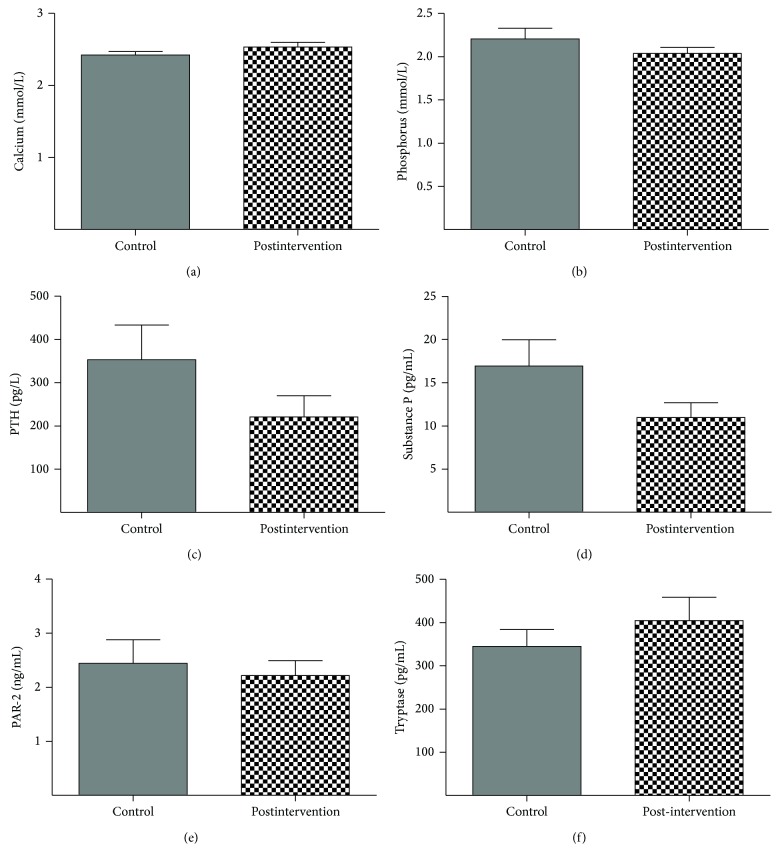
Mean changes in six secondary outcomes after six weeks, according to the postintervention group; P > 0.05 for postintervention group versus control group.

References

    1. Mathur V. S., Lindberg J., Germain M., et al. A longitudinal study of uremic pruritus in hemodialysis patients. Clinical Journal of the American Society of Nephrology. 2010;5(8):1410–1419. doi: 10.2215/CJN.00100110. - DOI - PMC - PubMed
    1. Feramisco J. D., Berger T. G., Steinhoff M. Innovative management of pruritus. Dermatologic Clinics. 2010;28(3):467–478. doi: 10.1016/j.det.2010.03.004. - DOI - PubMed
    1. Mettang M., Weisshaar E. Pruritus: control of itch in patients undergoing dialysis. Skin Therapy Letter. 2010;15(2):1–5. - PubMed
    1. Wang T.-J., Lan L.-C., Lu C.-S., et al. Efficacy of narrowband ultraviolet phototherapy on renal pruritus. Journal of Clinical Nursing. 2014;23(11-12):1593–1602. doi: 10.1111/jocn.12252. - DOI - PubMed
    1. Chen H.-Y., Chiu Y.-L., Hsu S.-P., et al. Elevated C-reactive protein level in hemodialysis patients with moderate/severe uremic pruritus: a potential mediator of high overall mortality. QJM. 2010;103(11):837–846. doi: 10.1093/qjmed/hcq036.hcq036 - DOI - PubMed

LinkOut - more resources