


Evidence of Extensive Alternative Splicing in Post Mortem Human Brain HTT Transcription by mRNA Sequencing
- PMID: 26496077
- PMCID: PMC4619731
- DOI: 10.1371/journal.pone.0141298
Evidence of Extensive Alternative Splicing in Post Mortem Human Brain HTT Transcription by mRNA Sequencing
Abstract
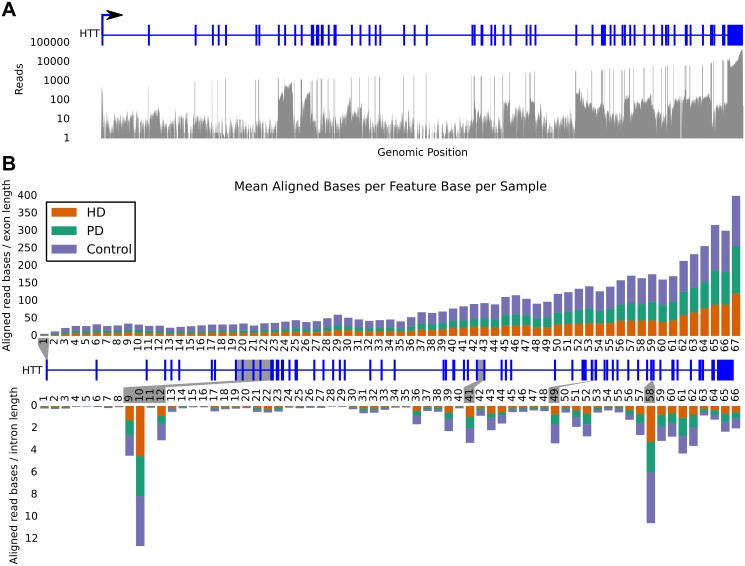
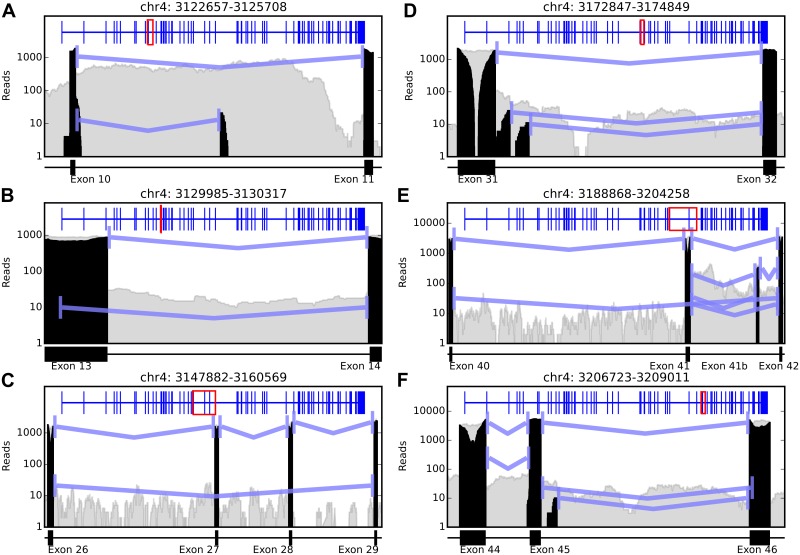
Despite 20 years since its discovery, the gene responsible for Huntington's Disease, HTT, has still not had its function or transcriptional profile completely characterized. In response to a recent report by Ruzo et al. of several novel splice forms of HTT in human embryonic stem cell lines, we have analyzed a set of mRNA sequencing datasets from post mortem human brain from Huntington's disease, Parkinson's disease, and neurologically normal control subjects to evaluate support for previously observed and to identify novel splice patterns. A custom analysis pipeline produced supporting evidence for some of the results reported by two previous studies of alternative isoforms as well as identifying previously unreported splice patterns. All of the alternative splice patterns were of relatively low abundance compared to the canonical splice form.
Conflict of interest statement
Figures
References
-
- Group THsDCR (1993) A novel gene containing a trinucleotide repeat that is expanded and unstable on Huntington's disease chromosomes. Cell 72: 971–983. - PubMed
-
- Lin B, Nasir J, MacDonald H, Hutchinson G, Graham RK, Rommens JM, et al. (1994) Sequence of the murine Huntington disease gene: evidence for conservation, alternate splicing and polymorphism in a triplet (CCG) repeat [corrected]. Hum Mol Genet 3: 85–92. - PubMed
-
- Hughes AC, Mort M, Elliston L, Thomas RM, Brooks SP, Dunnett SB, et al. (2014) Identification of novel alternative splicing events in the huntingtin gene and assessment of the functional consequences using structural protein homology modelling. J Mol Biol 426: 1428–1438. 10.1016/j.jmb.2013.12.028 - DOI - PubMed
Publication types
MeSH terms
Substances
Associated data
- Actions
Grants and funding
LinkOut - more resources
Full Text Sources
Other Literature Sources
Molecular Biology Databases
