


Differential relationships between chronic hormone profiles in pregnancy and maternal investment in rhesus monkey mothers with hair loss in the neonatal period
- PMID: 26496532
- PMCID: PMC6528798
- DOI: 10.1002/ajp.22489
Differential relationships between chronic hormone profiles in pregnancy and maternal investment in rhesus monkey mothers with hair loss in the neonatal period
Abstract
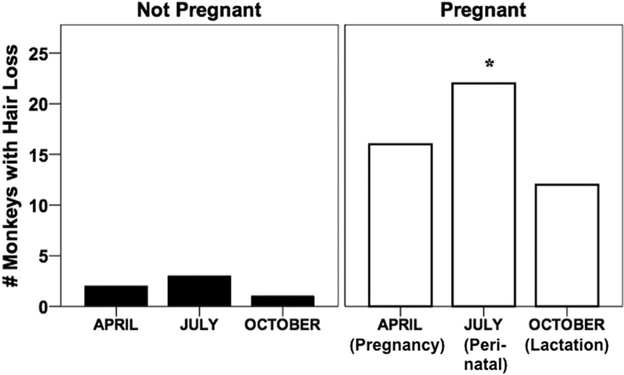
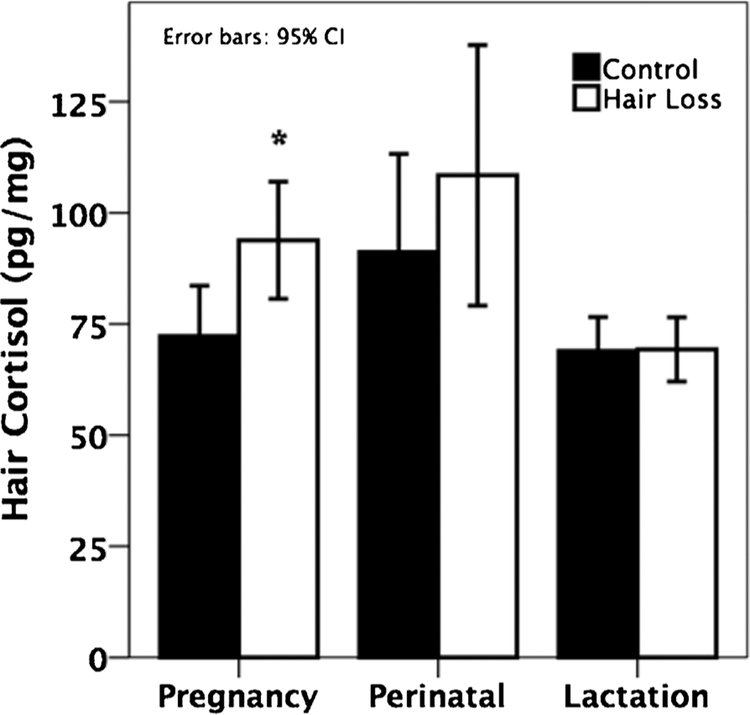
Hair loss is commonly used as an indicator of well being in primate facilities, yet it has been shown to also occur in otherwise healthy pregnant and postpartum females. There is significant variability in the incidence of hair loss during these important developmental periods, reasons for which remain unclear. We studied female rhesus monkeys (Macaca mulatta, n = 47) with and without hair loss in pregnancy/postpartum. We hypothesized that, similar to previously published reports, pregnancy would result in an increased likelihood of hair loss, and that hair loss would be correlated with higher hair cortisol concentrations (HCCs). We further hypothesized that hair loss among pregnant females is related to differential maternal investment. We studied a subset of monkeys (n = 26) from mid-to-late pregnancy through peak lactation, some of which exhibited hair loss in the perinatal period (n = 15), and some of which did not (n = 11). We examined fetal measurements, infant birth weight, infant growth rate, and milk yield volume (MYV) in the first 30 days as indices of investment. We found that pregnant monkeys showed a greater incidence of hair loss across the study year (χ2(2) = 6.55, P = 0.038), and that mothers with hair loss had significantly higher HCCs in pregnancy than those without (F(2,28) = 3.8, P = 0.017, ηp2 = 0.21). HCCs in pregnancy were correlated with severity of hair loss in the neonatal period (r(37) = 0.42, P = 0.008). Moreover, HCCs in pregnancy were positively correlated with infant birth weight (r(12) = 0.56, P = 0.038), infant growth rate (r(12) = 0.64, P = 0.014), and MYV (r(11) = 0.85, P < 0.001) for alopecic but not non-alopecic mothers. These mothers did not differ in fetal measurements, infant birth weight/growth rate, or MYV. Our results suggest that hair loss in some monkeys, especially during the birthing season, may be a signal of greater physiological stress during pregnancy and differential investment by mothers to their offspring. Am. J. Primatol. 79:e22489, 2017. © 2015 Wiley Periodicals, Inc.
Keywords: alopecia; hair loss; infant growth; maternal investment; pregnancy.
© 2016 Wiley Periodicals, Inc.
Figures

References
-
- Bales K, French JA, Dietz JM. 2002. Explaining variation in maternal care in a cooperatively breeding mammal. Animal Behavior 63:453–461.
-
- Beisner BA, Isbell LA. 2009. Factors influencing hair loss among female captive rhesus macaques (Macaca mulatta). Applied Animal Behaviour Science 119:91–100.
-
- Davenport MD, Tiefenbacher S, Lutz CK, Novak MA, Meyer JS. 2006. Analysis of endogenous cortisol concentrations in the hair of rhesus macaques. General and Comparative Endocrinology 147:255–261. - PubMed
-
- Davis EB, Suomi SJ. 2006. Hair loss and replacement cycles in socially housed, pregnant rhesus macaques. American Journal of Primatology 68:58. - PubMed
MeSH terms
Grants and funding
LinkOut - more resources
Full Text Sources
Other Literature Sources
Miscellaneous
