Review
. 2015 Dec:35:68-75.
doi: 10.1016/j.sbi.2015.09.007. Epub 2015 Nov 9.

Functional coupling between writers, erasers and readers of histone and DNA methylation

Affiliations
Review

Functional coupling between writers, erasers and readers of histone and DNA methylation

Idelisse Ortiz Torres et al. Curr Opin Struct Biol. 2015 Dec.

Abstract

DNA and histone lysine methylation are dynamic chemical modifications that play a crucial role in the establishment of gene expression patterns during development. Both types of genomic methylation patterns are enzymatically regulated by the opposing activities of enzymes that introduce and remove these marks, known as methylation 'writers' and 'erasers', respectively. The appropriate localization and activity of these enzymes on chromatin is, in part, regulated by chromatin 'readers', protein modules that recognize histone and DNA modifications. Such reading modules are either encoded within the same polypeptide as the catalytic domains of writers and erasers, or present in protein partners that associate with them. Here, we review recent structural, biochemical and biological studies that demonstrate that there are multiple mechanisms by which reader domains can regulate the writers and erasers of histone and DNA methylation.


Figures

Figure 1
Figure 1
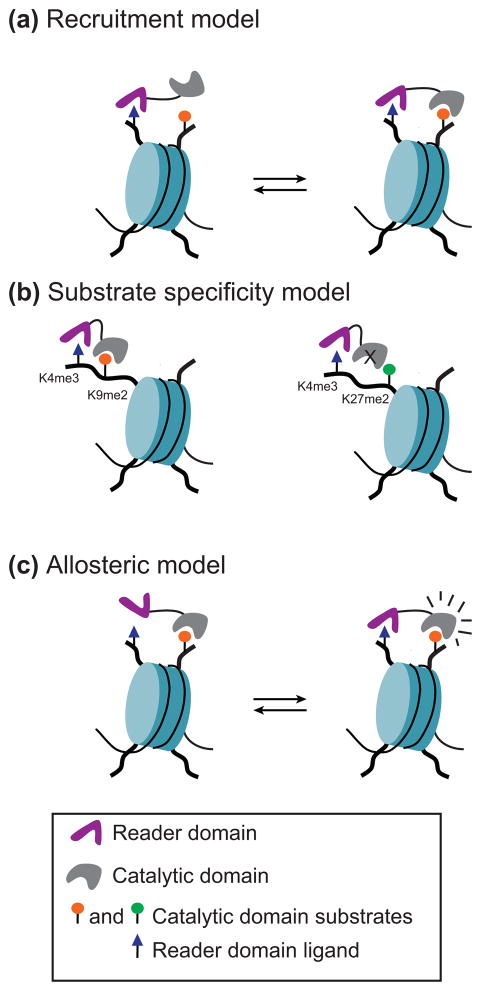
Functional coupling between domains that read and domains that write or erase methylation marks serves as a mean to (a) recruit or stabilize a catalytic activity to a specific chromatin location, (b) regulate substrate specificity as in the case of PHF8 and KIAA1718 [reviewed in 6, 39] and, (c) allosterically regulate activity. Reader domains can either stimulate or inhibit the catalytic activity of writers and erasers. Crosstalk between a reader and a catalytic domain can occur when both are encoded in the same polypeptide or are part of two distinct polypeptides within the same protein complex. Multivalent engagement of histone modifications can occur when on the same histone (cis), on adjacent histones within the same nucleosome (intranucleosomal) or on adjacent nucleosomes (internucleosomal).
Figure 2
Figure 2
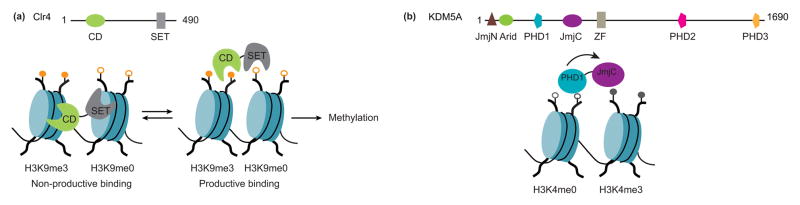
Regulation of histone methylation by reader domains within the same polypeptides. (a) The H3K9 methyltransferase Clr4 contains a chromodomain (CD) reader domain (green) that recognizes H3K9me3 (orange circle), the enzymatic product of the catalytic SET domain (gray). Recognition of H3K9me3 by the CD domain stimulates H3K9 (open orange circle) methyltransferase activity by orienting the SET domain to an adjacent nucleosome. (b) The H3K4me3 histone demethylase KDM5A contains a PHD1 domain (aqua) that recognizes H3K4me0 (open gray circles). Occupancy of the PHD1 domain allosterically stimulates H3K4me3 demethylation (gray circles) by the catalytic JmjC domain (purple).
Figure 3
Figure 3
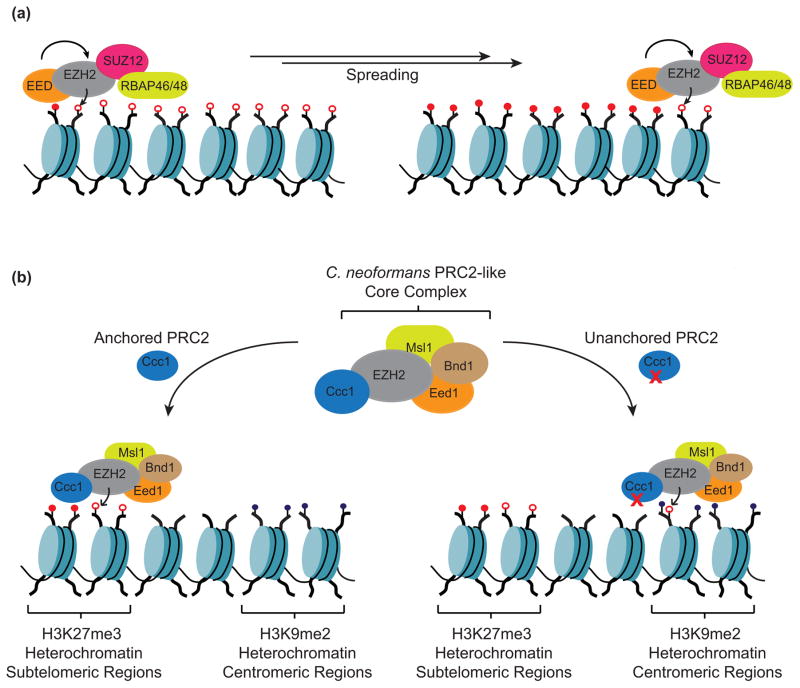
Regulation of PRC2-methyltransferase activity. (a) Representation of the mammalian PRC2 core complex. Recognition of H3K27me3 by the EED subunit allosterically stimulates H3K27 methyltransferase activity. (b) The C. neoformans PRC2-like complex subunit Ccc1 is a chromodomain-containing protein that recognizes H3K27me3. Impairment of the Ccc1-H3K27me3 complex causes a redistribution of the PRC2 complex to H3K9me2 heterochromatin suggesting a model by which Ccc1 suppresses the promiscuity of the PRC2 complex.
Figure 4
Figure 4
Cross-talk between histone and DNA methylation. (a) Domain architecture of DNMT3A. (b) A working model for the regulation of DNMT3A DNA methyltransferase activity by the recognition of histone H3. In the absence of H3, DNMT3A adopts an autoinhibitory closed conformation. Upon binding of the H3 tail to the ADD reader domain, DNMT3A switches to an active conformation that allows binding of DNA to the catalytic domain [adapted from 47]. (c) Superimposition of the autoinibitory (PDB accession number: 4U7P) and the H3-bound active conformations of DNMT3A (PDB accession number: 4U7T) [47]. ADD domain is in green, catalytic domain is gray and the histone H3 is in pink.

References

    1. Strahl BD, Allis CD. The language of covalent histone modifications. Nature. 2000;403:41–45. - PubMed
    1. Jenuwein T, Allis CD. Translating the histone code. Science. 2001;293:1074–1080. - PubMed
    1. Rothbart SB, Strahl BD. Interpreting the language of histone and DNA modifications. Biochimica et Biophysica Acta. 2014;1839:627–643. A recent overview of know histone and DNA modifications. - PMC - PubMed
    1. Martin C, Zhang Y. The diverse functions of histone lysine methylation. Nat Rev Mol Cell Biol. 2005;6:838–849. - PubMed
    1. Musselman CA, Khorasanizadeh S, Kutateladze TG. Towards understanding methyllysine readout. Biochimica et Biophysica Acta. 2014;1839:686–693. - PMC - PubMed

Publication types

LinkOut - more resources