


Prophylactic systemic antifungal agents to prevent mortality and morbidity in very low birth weight infants
- PMID: 26497056
- PMCID: PMC7156892
- DOI: 10.1002/14651858.CD003850.pub5
Prophylactic systemic antifungal agents to prevent mortality and morbidity in very low birth weight infants
Abstract
Background: Invasive fungal infection is an important cause of mortality and morbidity in very preterm and very low birth weight infants. Early diagnosis is difficult and treatment is often delayed. Systemically absorbed antifungal agents (usually azoles) are increasingly used as prophylaxis against invasive fungal infection in this population.
Objectives: To assess the effect of prophylactic systemic antifungal therapy on mortality and morbidity in very preterm or very low birth weight infants.
Search methods: We used the standard search strategy of the Cochrane Neonatal Review Group. This included searches of the Cochrane Central Register of Controlled Trials (CENTRAL) (The Cochrane Library 2015, Issue 8), MEDLINE, EMBASE, and CINAHL (to May 2015), conference proceedings, and previous reviews.
Selection criteria: Randomised controlled trials or quasi-randomised controlled trials that compared the effect of prophylactic systemic antifungal therapy versus placebo or no drug or another antifungal agent or dose regimen in very low birth weight infants.
Data collection and analysis: We extracted data using the standard methods of the Cochrane Neonatal Review Group, with separate evaluation of trial quality and data extraction by two review authors.
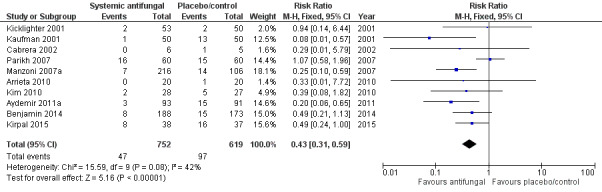
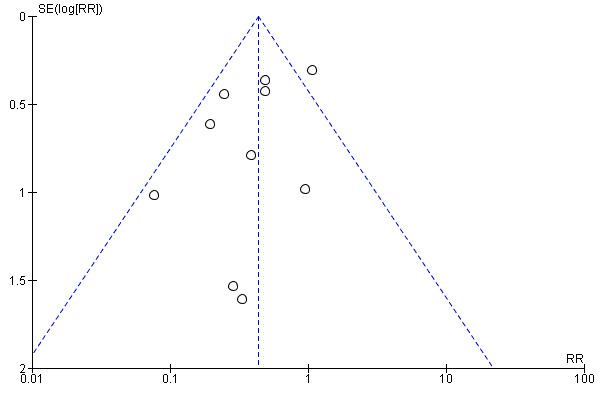
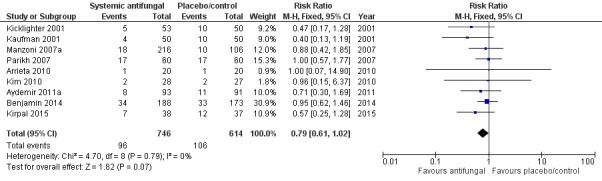
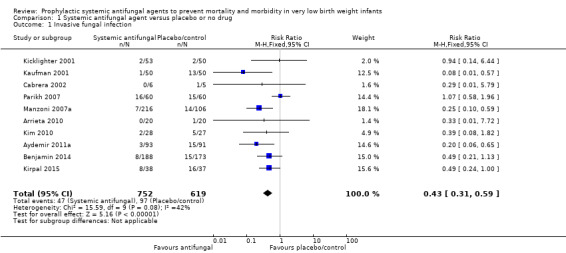
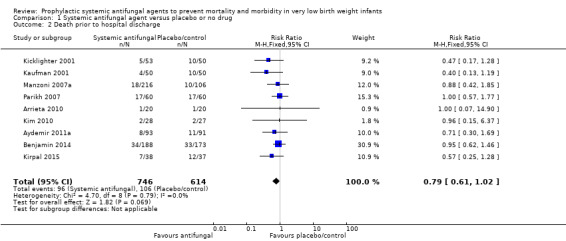
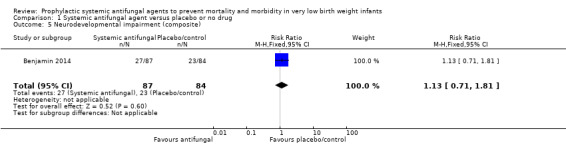
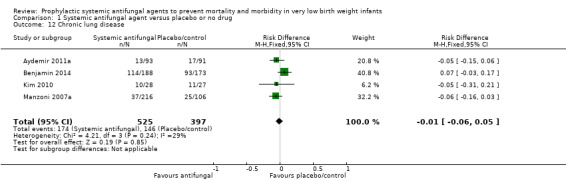
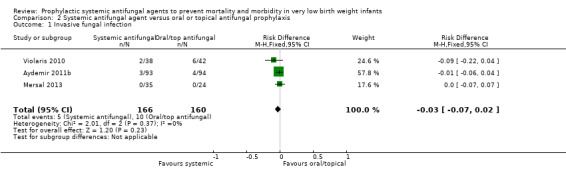
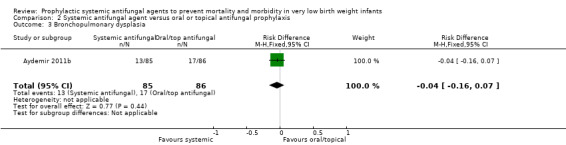
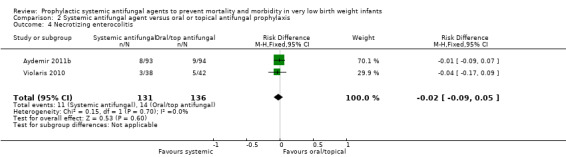
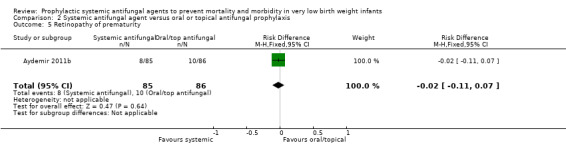
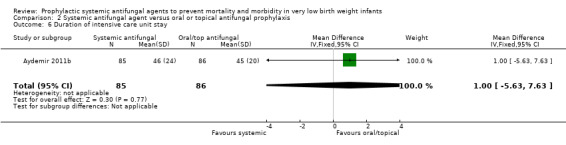
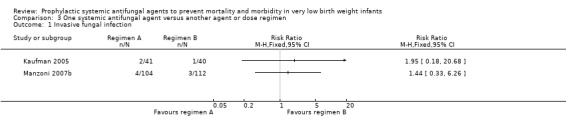
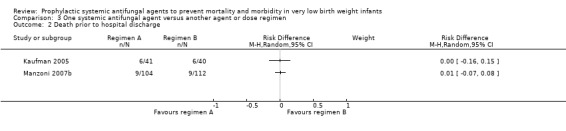
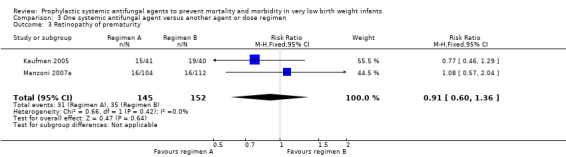
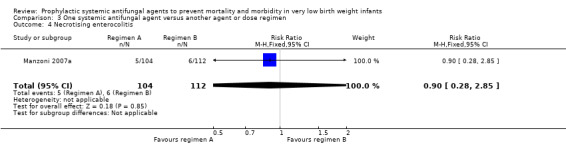
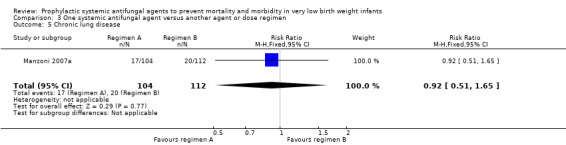
Main results: We identified 15 eligible trials enrolling a total of 1690 infants. Ten trials (1371 infants) compared systemic antifungal prophylaxis versus placebo or no drug. These trials were generally of good methodological quality. Meta-analysis found a statistically significant reduction in the incidence of invasive fungal infection (typical risk ratio (RR) 0.43, 95% confidence interval (CI) 0.31 to 0.59; risk difference (RD) -0.09, 95% CI -0.12 to -0.06). The average incidence of invasive fungal infection in the control groups of the trials (16%) was much higher than that generally reported from large cohort studies. Meta-analysis did not find a statistically significant difference in the risk of death prior to hospital discharge (typical RR 0.79, 95% CI 0.61 to 1.02; typical RD -0.04, 95% CI -0.07 to 0.00). Very limited data on long-term neurodevelopmental outcomes were available. Three trials that compared systemic versus oral or topical non-absorbed antifungal prophylaxis did not detect any statistically significant effects on invasive fungal infection or mortality. Two trials that compared different dose regimens of prophylactic intravenous fluconazole did not detect any significant differences in infection rates or mortality.
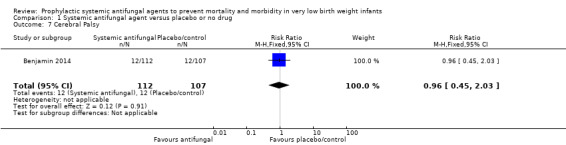
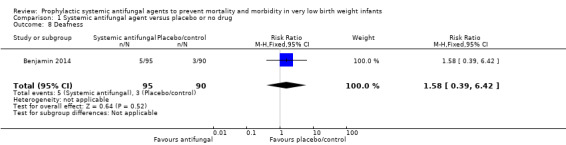
Authors' conclusions: Prophylactic systemic antifungal therapy reduces the incidence of invasive fungal infection in very preterm or very low birth weight infants. This finding should be interpreted and applied cautiously since the incidence of invasive fungal infection was very high in the control groups of many of the included trials. Meta-analysis does not demonstrate a statistically significant effect on mortality. There are currently only limited data on the long-term neurodevelopmental consequences for infants exposed to this intervention. In addition, there is a need for further data on the effect of the intervention on the emergence of organisms with antifungal resistance.
Conflict of interest statement
None
Figures







Update of
-
Prophylactic systemic antifungal agents to prevent mortality and morbidity in very low birth weight infants.Cochrane Database Syst Rev. 2013 Apr 30;(4):CD003850. doi: 10.1002/14651858.CD003850.pub4. Cochrane Database Syst Rev. 2013. Update in: Cochrane Database Syst Rev. 2015 Oct 24;(10):CD003850. doi: 10.1002/14651858.CD003850.pub5. PMID: 23633315 Updated.
References
References to studies included in this review
Arrieta 2010 {published data only}
-
- Arrieta AC, Shea K, Dhar V, Cleary JP, Kukreja S, Morris M, et al. Once‐weekly liposomal amphotericin B as Candida prophylaxis in very low birth weight premature infants: a prospective, randomized, open‐label, placebo‐controlled pilot study. Clinical Therapeutics 2010;32(2):265‐71. [PUBMED: 20206784] - PubMed
Aydemir 2011a {published data only}
-
- Aydemir C, Oguz SS, Dizdar EA, Akar M, Sarikabadayi YU, Saygan S, et al. Randomised controlled trial of prophylactic fluconazole versus nystatin for the prevention of fungal colonisation and invasive fungal infection in very low birth weight infants. Archives of Disease in Childhood. Fetal and Neonatal Edition 2011;96(3):F164‐8. [PUBMED: 20659937] - PubMed
Aydemir 2011b {published data only}
-
- Aydemir C, Oguz SS, Dizdar EA, Akar M, Sarikabadayi YU, Saygan S, et al. Randomised controlled trial of prophylactic fluconazole versus nystatin for the prevention of fungal colonisation and invasive fungal infection in very low birth weight infants. Archives of Disease in Childhood 2011;96:F164‐8. [PUBMED: 20659937] - PubMed
Benjamin 2014 {published data only}
Cabrera 2002 {published data only}
-
- Cabrera C, Frank M, Carter D, Bhatia J. Fluconazole prophylaxis against systemic candidiasis after colonization: a randomized, double‐blinded study. Journal of Perinatology 2002;22(7):604.
Kaufman 2001 {published data only}
-
- Kaufman D, Boyle R, Hazen KC, Patrie JT, Robinson M, Donowitz LG. Fluconazole prophylaxis against fungal colonization and infection in preterm infants. New England Journal of Medicine 2001;345(23):1660‐6. [PUBMED: 11759644] - PubMed
-
- Kaufman D, Boyle R, Hazen KC, Robinson M, Donowitz LG. Effectiveness of fluconazole prophylaxis in the prevention of colonization and invasive infection in preterm infants. Pediatric Research 2001;50:309A. - PubMed
-
- Kaufman D, Boyle R, Robinson M, Grossman LB. Long‐term safety of intravenous prophylactic fluconazole use in preterm infants less than 1000 grams. Pediatric Research 2003;53:2735.
-
- Kaufman DA, Cuff AL, Wamstad JB, Boyle R, Gurka MJ, Grossman LB, et al. Fluconazole prophylaxis in extremely low birth weight infants and neurodevelopmental outcomes and quality of life at 8 to 10 years of age. The Journal of Pediatrics 2011;158(5):759‐65.e1. [PUBMED: 21168853] - PubMed
Kaufman 2005 {published data only}
-
- Kaufman D, Boyle R, Hazen K, Patrie J, Robinson M, Grossman LB. Twice weekly fluconazole for prophylaxis for prevention of invasive Candida infection in high‐risk infants of <1000 grams birth weight. The Journal of Pediatrics 2005;147(2):172‐9. [PUBMED: 16126045] - PubMed
Kicklighter 2001 {published data only}
-
- Kicklighter SD, Springer SC, Cox T, Hulsey TC, Turner RB. Fluconazole for prophylaxis against candidal rectal colonization in the very low birth weight infant. Pediatrics 2001;107(2):293‐8. [PUBMED: 11158461] - PubMed
-
- Kicklighter SD, Springer SC, Phaller MA, Messer S, Cox T, Hulsey TC, et al. Fluconazole for prophylaxis against fungal rectal colonization in the very low birth weight infant. Pediatric Research 2000;47:342A. - PubMed
Kim 2010 {published data only}
-
- Kim CS. Prevention of invasive candida infections in the neonatal intensive care unit. Korean Journal of Pediatric Infectious Diseases 2011;18(1):15‐22.
-
- Kim CS, Hong SA, Lee SL, Kim HS. Effect of fluconazole prophylaxis to control candida infection in high‐risk preterm infants. Korean Journal of Perinatology 2010;21(4):378‐87.
Kirpal 2015 {published data only}
-
- Kirpal H, Gathwala G, Chaudhary U, Sharma D. Prophylactic fluconazole in very low birth weight infants admitted to neonatal intensive care unit: randomized controlled trial. The Journal of Maternal‐fetal & Neonatal Medicine 2015;Epub ahead of print:1‐5. [PUBMED: 25708488] - PubMed
Manzoni 2007a {published data only}
-
- Manzoni P, Stolfi I, Pugni L, Decembrino L, Magnani C, Vetrano G, et al. A multicenter, randomized trial of prophylactic fluconazole in preterm neonates. New England Journal of Medicine 2007;356(24):2483‐95. [PUBMED: 17568029] - PubMed
Manzoni 2007b {published data only}
-
- Manzoni P, Stolfi I, Pugni L, Decembrino L, Magnani C, Vetrano G, et al. A multicenter, randomized trial of prophylactic fluconazole in preterm neonates. New England Journal of Medicine 2007;356(24):2483‐95. [PUBMED: 17568029] - PubMed
Mersal 2013 {published data only}
Parikh 2007 {published data only}
-
- Parikh TB, Nanavati RN, Patankar CV, Rao S, Bisure K, Udani RH, et al. Fluconazole prophylaxis against fungal colonization and invasive fungal infection in very low birth weight infants. Indian Pediatrics 2007;44(11):830‐7. [PUBMED: 18057479] - PubMed
Violaris 2010 {published data only}
-
- Violaris K, Carbone T, Bateman D, Olawepo O, Doraiswamy B, LaCorte M. Comparison of fluconazole and nystatin oral suspensions for prophylaxis of systemic fungal infection in very low birthweight infants. American Journal of Perinatology 2010;27(1):73‐8. [PUBMED: 19504425] - PubMed
-
- Violaris K, Doraiswamy B, Olawepo O, Gulrajani‐LaCorte M. Fluconazole versus nystatin prophylaxis for fungal infection in very low birth weight (VLBW) infants. Pediatric Research 1998;44:254A.
References to studies excluded from this review
Aghai 2006 {published data only}
-
- Aghai ZH, Mudduluru M, Nakhla TA, Amendolia B, Longo D, Kemble N, et al. Fluconazole prophylaxis in extremely low birth weight infants: association with cholestasis. Journal of Perinatology 2006;26(9):550‐5. [PUBMED: 16940972] - PubMed
Al Qurashi 2008 {published data only}
-
- Al Qurashi MA, Alallah J, Salma EB, et al. Fluconazole prophylaxis is effective in reducing systemic fungal infection in VLBW infants. A single center four years retrospective study. Pediatric Research. 2008; Vol. 63.
Aziz 2010 {published data only}
-
- Aziz M, Patel AL, Losavio J, Iyengar A, Berven M, Schloemer N, et al. Efficacy of fluconazole prophylaxis for prevention of invasive fungal infection in extremely low birth weight infants. The Pediatric Infectious Disease Journal 2010;29(4):352‐6. [PUBMED: 19934791] - PubMed
Bertini 2005 {published data only}
-
- Bertini G, Perugi S, Dani C, Filippi L, Pratesi S, Rubaltelli FF. Fluconazole prophylaxis prevents invasive fungal infection in high‐risk, very low birth weight infants. The Journal of Pediatrics 2005;147(2):162‐5. [PUBMED: 16126042] - PubMed
Dutta 2005 {published data only}
-
- Dutta S, Murki S, Varma S, Narang A, Chakrabarti A. Effects of cessation of a policy of neonatal fluconazole prophylaxis on fungal resurgence. Indian Pediatrics 2005;42(12):1226‐30. [PUBMED: 16424560] - PubMed
Healy 2005 {published data only}
-
- Healy CM, Baker CJ, Zaccaria E, Campbell JR. Impact of fluconazole prophylaxis on incidence and outcome of invasive candidiasis in a neonatal intensive care unit. The Journal of Pediatrics 2005;147(2):166‐71. [PUBMED: 16126043] - PubMed
Healy 2008 {published data only}
-
- Healy CM, Campbell JR, Zaccaria E, Baker CJ. Fluconazole prophylaxis in extremely low birth weight neonates reduces invasive candidiasis mortality rates without emergence of fluconazole‐resistant Candida species. Pediatrics 2008;121(4):703‐10. [PUBMED: 18381534] - PubMed
Kim 2008 {published data only}
-
- Kim MR, Chavda C, Jha V, Badugu S, Chung NY, Jean‐Baptiste D, et al. Prophylactic fluconazole therapy for very low birth weight infants colonised with Candida. Pediatric Research. 2008; Vol. 62.
Maede 2013 {published data only}
-
- Maede Y, Ibara S, Nagasaki H, Inoue T, Tokuhisa T, Torikai M, et al. Micafungin versus fluconazole for prophylaxis against fungal infections in premature infants. Pediatrics International 2013;55(6):727‐30. [PUBMED: 23773357] - PubMed
Manzoni 2006 {published data only}
-
- Manzoni P, Agrisio R, Mostert M, Leonessa M, Farina D, Latino MA, et al. Prophylactic fluconazole is effective in preventing fungal colonization and fungal systemic infections in preterm neonates: a single‐center, 6‐year retrospective cohort study. The Journal of Pediatrics 2006;117(1):e22‐32. [PUBMED: 16326690] - PubMed
Manzoni 2008 {published data only}
-
- Manzoni P, Leonessa M, Galletto P, Latino MA, Arisio R, Maule M, et al. Routine use of fluconazole prophylaxis in a neonatal intensive care unit does not select natively fluconazole‐resistant Candida subspecies. The Pediatric Infectious Disease Journal 2008;27(8):731‐7. [PUBMED: 18600191] - PubMed
McCrossan 2007 {published data only}
Rueda 2010 {published data only}
-
- Rueda K, Moreno MT, Espinosa M, Saez‐Llorens X. Impact of routine fluconazole prophylaxis for premature infants with birth weights of less than 1250 grams in a developing country. The Pediatric Infectious Disease Journal 2010;29(11):1050‐2. [PUBMED: 20571460] - PubMed
Uko 2006 {published data only}
-
- Uko S, Soghier LM, Vega M, Marsh J, Reinersman GT, Herring L, et al. Targeted short‐term fluconazole prophylaxis among very low birth weight and extremely low birth weight infants. Pediatrics 2006;117(4):1243‐52. [PUBMED: 16585321] - PubMed
Wadhawan 2007 {published data only}
-
- Wadhawan R, Dumois J, Escoto D, et al. Near elimination of Candida sepsis after fluconazole prophylaxis in ELBW infants‐experience from a tertiary level NICU. Pediatric Research. 2007; Vol. 62.
Weitkamp 2008 {published data only}
-
- Weitkamp JH, Ozdas A, LaFleur B, Potts AL. Fluconazole prophylaxis for prevention of invasive fungal infections in targeted highest risk preterm infants limits drug exposure. Journal of Perinatology 2008;28(6):405‐11. [PUBMED: 18185518] - PubMed
References to studies awaiting assessment
Latif 2012 {published and unpublished data}
-
- Latif DA, Sultan MH, Mohamed HE. Efficacy of Prophylactic Fluconazole in Reducing Candidemia in High Risk NICU and PICU Patients. Life Science Journal 2012;9:817‐24.
Additional references
Adams‐Chapman 2013
Aliaga 2014
Ascher 2012
Austin 2009
Aydin 2012
-
- Aydin B, Dilli D, Zenciroglu A, Uzunalic N, Okumus N, Aydin M. Lengthening of QT interval caused by fluconazole in a newborn. Journal of Clinical Toxicology 2012;2:132.
Barton 2014
-
- Barton M, O'Brien K, Robinson JL, Davies DH, Simpson K, Asztalos E, et al. Invasive candidiasis in low birth weight preterm infants: risk factors, clinical course and outcome in a prospective multicenter study of cases and their matched controls. BMC Infectious Diseases 2014;14:327. [PUBMED: 24924877] - PMC - PubMed
Benjamin 2003
-
- Benjamin DK Jr, Poole C, Steibach WJ, Rowen JL, Walsh TJ. Neonatal candidemia and end‐organ damage: a critical appraisal of the literature using meta‐analytic techniques. Pediatrics 2003;112(3 Pt 1):634‐40. [PUBMED: 12949295] - PubMed
Benjamin 2006
-
- Benjamin DK Jr, Stoll BJ, Fanaroff AA, McDonald SA, Oh W, Higgins RD, et al. Neonatal candidiasis among extremely low birth weight infants: risk factors, mortality rates, and neurodevelopmental outcomes at 18 to 22 months. Pediatrics 2006;117(1):84‐92. [PUBMED: 16396864] - PubMed
Brecht 2009
-
- Brecht M, Clerihew L, McGuire W. Prevention and treatment of invasive fungal infection in very low birthweight infants. Archives of Disease in Childhood. Fetal and Neonatal Edition 2009;94(1):F65‐9. [PUBMED: 18838467] - PubMed
Brion 2007
-
- Brion LP, Uko SE, Goldman DL. Risk of resistance associated with fluconazole prophylaxis: systematic review. Journal of Infection 2007;54(6):521‐9. [PUBMED: 17239952] - PubMed
Burwell 2006
-
- Burwell LA, Kaufman D, Blakely J, Stoll BJ, Fridkin SK. Antifungal prophylaxis to prevent neonatal candidiasis: a survey of perinatal physician practices. Pediatrics 2006;118(4):e1019‐26. [PUBMED: 16982807] - PubMed
Camacho‐Gonzalez 2013
Clerihew 2006
Clerihew 2008
-
- Clerihew L, McGuire W. Antifungal prophylaxis for very low birthweight infants: UK national survey. Archives of Disease in Childhood. Fetal and Neonatal Edition 2008;93(3):F238‐9. [PUBMED: 17768153] - PubMed
Friedman 2000
-
- Friedman S, Richardson SE, Jacobs SE, O'Brien K. Systemic candida infection in extremely low birth weight infants: short term morbidity and long term neurodevelopmental outcome. The Pediatric Infectious Disease Journal 2000;19(6):499‐504. [PUBMED: 10877162] - PubMed
Gussenhoven 1991
-
- Gussenhoven MJ, Haak A, Peereboom‐Wynia JD, van't Wout JW. Stevens‐Johnson syndrome after fluconazole. Lancet 1991;338(8759):120. [PUBMED: 1676446] - PubMed
Higgins 2011
-
- Higgins JPT, Green S (editors). Cochrane Handbook for Systematic Reviews of Interventions. Version 5.1.0 [updated March 2011]. The Cochrane Collaboration, 2011. Available from www.cochrane‐handbook.org.
Horbar 2002
-
- Horbar JD, Badger GJ, Carpenter JH, Fanaroff AA, Kilpatrick S, LaCorte M, et al. Members of the Vermont Oxford Network. Trends in mortality and morbidity for very low birth weight infants, 1991–1999. Pediatrics 2002;110(1 Pt 1):143‐51. [PUBMED: 12093960] - PubMed
Hornik 2012
Huttova 1998
-
- Huttova M, Hartmanova I, Kralinsky K, Filka J, Uher J, Kurak J, et al. Candida fungemia in neonates treated with fluconazole: report of forty cases, including eight with meningitis. The Pediatric Infectious Disease Journal 1998;17(11):1012‐5. [PUBMED: 9849984] - PubMed
Kaguelidou 2012
Karlowicz 2002
-
- Karlowicz MG, Rowen JL, Barnes‐Eley ML, Burke BL, Lawson ML, Bendel CM, et al. The role of birth weight and gestational age in distinguishing extremely low birth weight infants at high risk of developing candidemia from infants at low risk: a multicenter study. Pediatric Research 2002;51:301A.
Kaufman 2004
Kaufman 2006
-
- Kaufman DA, Gurka MJ, Hazen KC, Boyle R, Robinson M, Grossman LB. Patterns of fungal colonization in preterm infants weighing less than 1000 grams at birth. The Pediatric Infectious Disease Journal 2006;25(8):733‐7. [PUBMED: 16874174] - PubMed
Kaufman 2010
-
- Kaufman DA, Manzoni P. Strategies to prevent invasive candidal infection in extremely preterm infants. Clinics in Perinatology 2010;37(3):611‐28. [PUBMED: 20813274] - PubMed
Koklu 2014
-
- Koklu E, Kalay S, Koklu S, Ariguloglu EA. Fluconazole administration leading to anaphylactic shock in a preterm newborn. Neonatal Network 2014;33(2):83‐5. [PUBMED: 24589899] - PubMed
Kossoff 1998
-
- Kossoff EH, Buescher ES, Karlowicz MG. Candidemia in a neonatal intensive care unit: trends during fifteen years and clinical features of 111 cases. The Pediatric Infectious Disease Journal 1998;17(6):504‐8. [PUBMED: 9655543] - PubMed
Makhoul 2002
-
- Makhoul IR, Sujov P, Smolkin T, Lusky A, Reichman B. Epidemiological, clinical, and microbiological characteristics of late‐onset sepsis among very low birth weight infants in Israel: a national survey. Pediatrics 2002;109(1):34‐9. [PUBMED: 11773539] - PubMed
Manzoni 2007
-
- Manzoni P, Farina D, Galletto P, Leonessa M, Priolo C, Arisio R, et al. Type and number of sites colonized by fungi and risk of progression to invasive fungal infection in preterm neonates in neonatal intensive care unit. Journal of Perinatal Medicine 2007;35(3):220‐6. [PUBMED: 17378718] - PubMed
Neely 2001
-
- Neely MN, Schreiber JR. Fluconazole prophylaxis in the very low birth weight infant: not ready for prime time. Pediatrics 2001;107(2):404‐5. [PUBMED: 11158475] - PubMed
O'Grady 2008
-
- O'Grady MJ, Dempsey EM. Antifungal prophylaxis for the prevention of neonatal candidiasis?. Acta Paediatrica 2008;97(4):430‐3. [PUBMED: 18363952] - PubMed
Oeser 2013
-
- Oeser C, Lamagni T, Heath PT, Sharland M, Ladhani S. The epidemiology of neonatal and pediatric candidemia in England and Wales, 2000‐2009. The Pediatric Infectious Disease Journal 2013;32(1):23‐6. [PUBMED: 23241987] - PubMed
Oeser 2014
-
- Oeser C, Vergnano S, Naidoo R, Anthony M, Chang J, Chow P, et al. Neonatal invasive fungal infection in England 2004‐2010. Clinical Microbiology and Infection 2014;20:936‐41. [PUBMED: 24479862] - PubMed
Pappu‐Katikaneni 1990
-
- Pappu‐Katikaneni LD, Rao KP, Banister E. Gastrointestinal colonization with yeast species and Candida septicemia in very low birth weight infants. Mycoses 1990;33(1):20‐3. [PUBMED: 2342516] - PubMed
Robinson 2009
-
- Robinson JL, Davies HD, Barton M, O'Brien K, Simpson K, Asztalos E, et al. Characteristics and outcome of infants with candiduria in neonatal intensive care ‐ a Paediatric Investigators Collaborative Network on Infections in Canada (PICNIC) study. BMC Infectious Diseases 2009;9:183. [PUBMED: 19930662] - PMC - PubMed
Saiman 2000
-
- Saiman L, Ludington E, Pfaller M, Rangel‐Frausto S, Wiblin RT, Dawson J, et al. Risk factors for candidemia in neonatal intensive care unit patients. The National Epidemiology of Mycosis Survey study group. The Pediatric Infectious Disease Journal 2000;19(4):319‐24. [PUBMED: 10783022] - PubMed
Sarvikivi 2008
Schelonka 2003
-
- Schelonka RL, Moser SA. Time to positive culture results in neonatal Candida septicemia. The Journal of Pediatrics 2003;142(5):564‐5. [PUBMED: 12756391] - PubMed
Shane 2013
-
- Shane AL, Stoll BJ. Recent developments and current issues in the epidemiology, diagnosis, and management of bacterial and fungal neonatal sepsis. American Journal of Perinatology 2013;30(2):131‐41. [PUBMED: 23297182] - PubMed
Stoll 1996
-
- Stoll BJ, Gordon T, Korones SB, Shankaran S, Tyson JE, Bauer CR, et al. Late‐onset sepsis in very low birth weight neonates: a report from the National Institute of Child Health and Human Development Neonatal Research Network. The Journal of Pediatrics 1996;129(1):63‐71. [PUBMED: 8757564] - PubMed
Stoll 2002
-
- Stoll BJ, Hansen N, Fanaroff AA, Wright LL, Carlo WA, Ehrenkranz RA, et al. Late‐onset sepsis in very low birth weight neonates: the experience of the NICHD Neonatal Research Network. Pediatrics 2002;110(2 Pt 1):285‐91. [PUBMED: 12165580] - PubMed
Stoll 2003
-
- Stoll BJ, Hansen N. Infections in VLBW infants: studies from the NICHD Neonatal Research Network. Seminars in Perinatology 2003;27(4):293‐301. [PUBMED: 14510320] - PubMed
Vergnano 2011
-
- Vergnano S, Menson E, Kennea N, Embleton N, Russell AB, Watts T, et al. Neonatal infections in England: the NeonIN surveillance network. Archives of Disease in Childhood. Fetal and Neonatal Edition 2011;96(1):F9‐14. [PUBMED: 20876594] - PubMed
References to other published versions of this review
Austin 2013
Clerihew 2007
Publication types
MeSH terms
Substances
LinkOut - more resources
Full Text Sources
Other Literature Sources
Medical
Miscellaneous
