


Prognostic significance of macrophage invasion in hilar cholangiocarcinoma
- PMID: 26497197
- PMCID: PMC4620011
- DOI: 10.1186/s12885-015-1795-7
Prognostic significance of macrophage invasion in hilar cholangiocarcinoma
Abstract
Background: Tumor-associated macrophages (TAMs) promote tumor progression and have an effect on survival in human cancer. However, little is known regarding their influence on tumor progression and prognosis in human hilar cholangiocarcinoma.
Methods: We analyzed surgically resected tumor specimens of hilar cholangiocarcinoma (n = 47) for distribution and localization of TAMs, as defined by expression of CD68. Abundance of TAMs was correlated with clinicopathologic characteristics, tumor recurrence and patients' survival. Statistical analysis was performed using SPSS software.
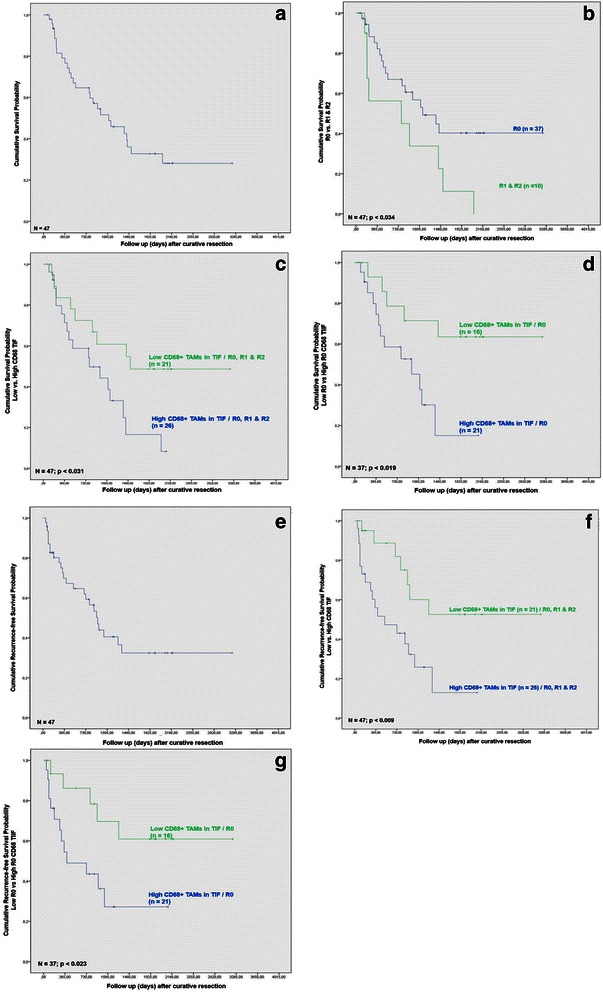
Results: Patients with high density of TAMs in tumor invasive front (TIF) showed significantly higher local and overall tumor recurrence (both ρ < 0.05). Furthermore, high density of TAMs was associated with decreased overall (one-year 83.6% vs. 75.1%; three-year 61.3% vs. 42.4%; both ρ < 0.05) and recurrence-free survival (one-year 93.9% vs. 57.4%; three-year 59.8% vs. 26.2%; both ρ < 0.05). TAMs in TIF and tumor recurrence, were confirmed as the only independent prognostic variables in the multivariate survival analysis (all ρ < 0.05).
Conclusions: Overall survival and recurrence free survival of patients with hilar cholangiocarcinoma significantly improved in patients with low levels of TAMs in the area of TIF, when compared to those with a high density of TAMs. These observations suggest their utilization as valuable prognostic markers in routine histopathologic evaluation, and might indicate future therapeutic approaches by targeting TAMs.
Figures

References
-
- Juntermanns B, Sotiropoulos GC, Radunz S, Reis H, Heuer M, Baba HA, Canbay A, Schuler M, Gerken G, Paul A, Kaiser GM. Comparison of the sixth and the seventh editions of the UICC classification for perihilar cholangiocarcinoma. Ann Surg Oncol. 2013;20(1):277–84. doi: 10.1245/s10434-012-2486-0. - DOI - PMC - PubMed
Publication types
MeSH terms
Substances
LinkOut - more resources
Full Text Sources
Other Literature Sources
Medical
