


Receipt of Preventive Services After Oregon's Randomized Medicaid Experiment
- PMID: 26497264
- PMCID: PMC4718854
- DOI: 10.1016/j.amepre.2015.07.032
Receipt of Preventive Services After Oregon's Randomized Medicaid Experiment
Abstract
Introduction: It is predicted that gaining health insurance via the Affordable Care Act will result in increased rates of preventive health services receipt in the U.S., primarily based on self-reported findings from previous health insurance expansion studies. This study examined the long-term (36-month) impact of Oregon's 2008 randomized Medicaid expansion ("Oregon Experiment") on receipt of 12 preventive care services in community health centers using electronic health record data.
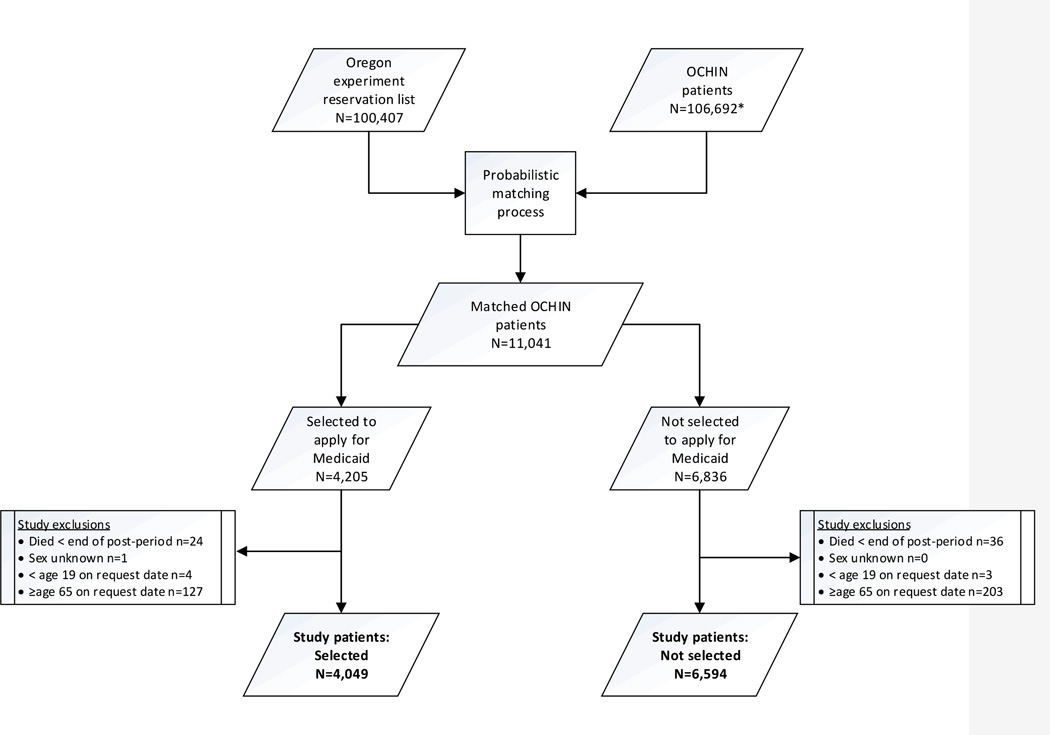
Methods: Demographic data from adult (aged 19-64 years) Oregon Experiment participants were probabilistically matched to electronic health record data from 49 Oregon community health centers within the OCHIN community health information network (N=10,643). Intent-to-treat analyses compared receipt of preventive services over a 36-month (2008-2011) period among those randomly assigned to apply for Medicaid versus not assigned, and instrumental variable analyses estimated the effect of actually gaining Medicaid coverage on preventive services receipt (data collected in 2012-2014; analysis performed in 2014-2015).
Results: Intent-to-treat analyses revealed statistically significant differences between patients randomly assigned to apply for Medicaid (versus not assigned) for 8 of 12 assessed preventive services. In intent-to-treat analyses, Medicaid coverage significantly increased the odds of receipt of most preventive services (ORs ranging from 1.04 [95% CI=1.02, 1.06] for smoking assessment to 1.27 [95% CI=1.02, 1.57] for mammography).
Conclusions: Rates of preventive services receipt will likely increase as community health center patients gain insurance through Affordable Care Act expansions. Continued effort is needed to increase health insurance coverage in an effort to decrease health disparities in vulnerable populations.
Copyright © 2016 American Journal of Preventive Medicine. Published by Elsevier Inc. All rights reserved.
Figures
References
-
- Bailey SR, O’Malley JP, Gold R, Heintzman J, Likumahuwa S, DeVoe JE. Diabetes care quality is highly correlated with patient panel characteristics. J Am Board Fam Med. 2013;26(6):669–679. http://dx.doi.org/10.3122/jabfm.2013.06.130018. - DOI - PMC - PubMed
-
- Freeman JD, Kadiyala S, Bell JF, Martin DP. The causal effect of health insurance on utilization, outcomes in adults: a systematic review of U.S studies. Med Care. 2008;46(10):1023–1032. http://dx.doi.org/10.1097/MLR.0b013e318185c913. - DOI - PubMed
-
- Buchmueller TC, Grumbach K, Kronick R, Kahn JG. The effect of health insurance on medical care utilization and implications for insurance expansion: A review of the literature. Med Care Res Rev. 2005;62(1):3–30. http://dx.doi.org/10.1177/1077558704271718. - DOI - PubMed
-
- DeVoe J, Fryer G, Phillips R, Green L. Receipt of preventive care among adults: insurance status and usual source of care. Am J Public Health. 2003;93:786–791. http://dx.doi.org/10.2105/AJPH.93.5.786. - DOI - PMC - PubMed
-
- Duru OK, Vargas RB, Kermah D, Pan D, Norris KC. Health insurance status and hypertension monitoring and control in the United States. Am J Hypertens. 2007;20(4):348–353. http://dx.doi.org/10.1016/j.amjhyper.2006.11.007. - DOI - PubMed
Publication types
MeSH terms
Grants and funding
LinkOut - more resources
Full Text Sources
Other Literature Sources
Medical
