. 2015 Oct 23;82(1):297-307.
doi: 10.1128/AEM.02250-15. Print 2016 Jan 1.

Anodes Stimulate Anaerobic Toluene Degradation via Sulfur Cycling in Marine Sediments

Affiliations

Anodes Stimulate Anaerobic Toluene Degradation via Sulfur Cycling in Marine Sediments

Matteo Daghio et al. Appl Environ Microbiol. .

Abstract

Hydrocarbons released during oil spills are persistent in marine sediments due to the absence of suitable electron acceptors below the oxic zone. Here, we investigated an alternative bioremediation strategy to remove toluene, a model monoaromatic hydrocarbon, using a bioanode. Bioelectrochemical reactors were inoculated with sediment collected from a hydrocarbon-contaminated marine site, and anodes were polarized at 0 mV and +300 mV (versus an Ag/AgCl [3 M KCl] reference electrode). The degradation of toluene was directly linked to current generation of up to 301 mA m(-2) and 431 mA m(-2) for the bioanodes polarized at 0 mV and +300 mV, respectively. Peak currents decreased over time even after periodic spiking with toluene. The monitoring of sulfate concentrations during bioelectrochemical experiments suggested that sulfur metabolism was involved in toluene degradation at bioanodes. 16S rRNA gene-based Illumina sequencing of the bulk anolyte and anode samples revealed enrichment with electrocatalytically active microorganisms, toluene degraders, and sulfate-reducing microorganisms. Quantitative PCR targeting the α-subunit of the dissimilatory sulfite reductase (encoded by dsrA) and the α-subunit of the benzylsuccinate synthase (encoded by bssA) confirmed these findings. In particular, members of the family Desulfobulbaceae were enriched concomitantly with current production and toluene degradation. Based on these observations, we propose two mechanisms for bioelectrochemical toluene degradation: (i) direct electron transfer to the anode and/or (ii) sulfide-mediated electron transfer.


Figures

FIG 1
FIG 1
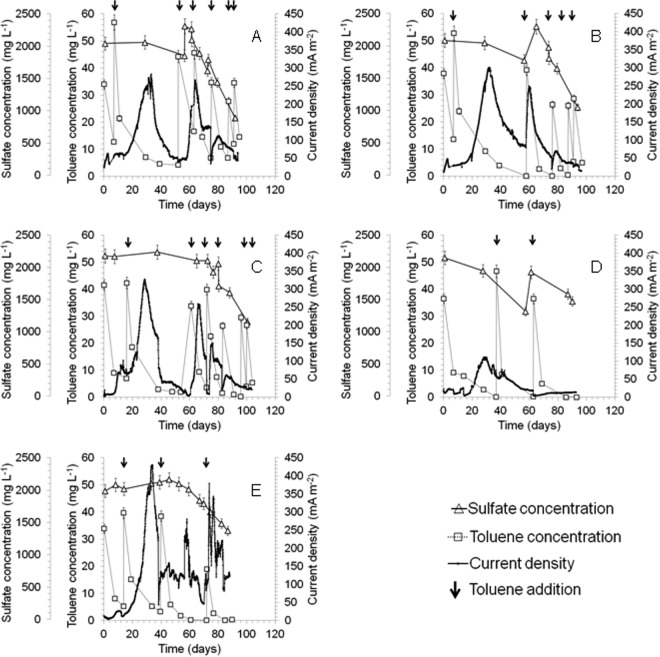
Current density, toluene concentration, and sulfate concentration profiles in bioanodes polarized at 0 mV (versus an Ag/AgCl [3 M KCl] reference electrode) (R0a [A] and R0b [B]) and at +300 mV (R300a [C], R300b [D], R300c [E]). Toluene degradation was concomitant with current production regardless of the anode polarization, and sulfate removal after around 60 to 80 days coincided with toluene removal, suggesting a link between SRB and hydrocarbon removal.
FIG 2
FIG 2
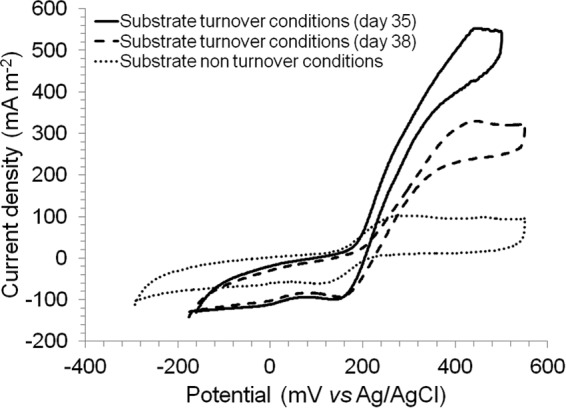
Cyclic voltammograms recorded with reactor R300c at +300 mV (versus an Ag/AgCl [3 M KCl] reference electrode) during substrate turnover and non-turnover conditions. The scan rate was 1 mV s−1. A catalytic wave (between +170 and +340 mV) and an oxidation peak (+200 mV) were observed.
FIG 3
FIG 3
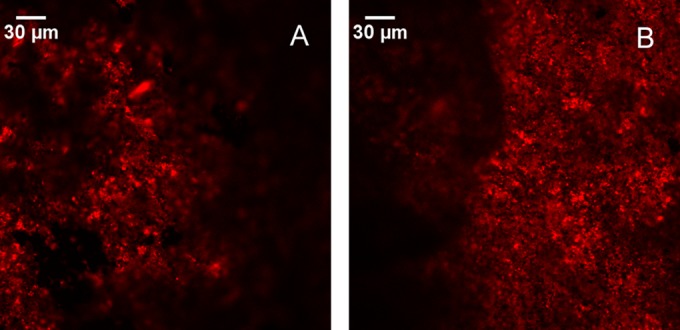
FISH images of the anode surface of reactor R300c at +300 mV (versus an Ag/AgCl [3 M KCl] reference electrode). Red fluorescence indicated the presence of sulfate-reducing bacteria. The hybridization was performed using a mixture of Cy3-labeled SRB385 and SRB385Db probes targeting the 16S rRNA of sulfate-reducing bacteria.
FIG 4
FIG 4
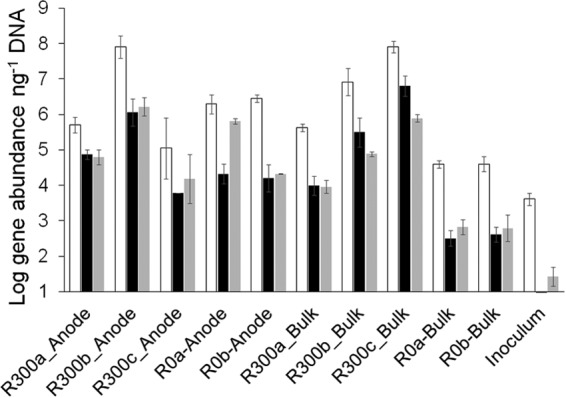
Quantification of toluene-degrading bacteria and SRB in the anode and bulk anolyte of reactors polarized at 0 mV and +300 mV (versus an Ag/AgCl [3 M KCl] reference electrode). White, black, and gray bars represent 16S rRNA, dsrA, and bssA gene abundances, respectively. Bars are averages from triplicate measurements, and standard deviations are shown. Sulfate reducers and toluene degraders were enriched during the bioelectrochemical process.
FIG 5
FIG 5
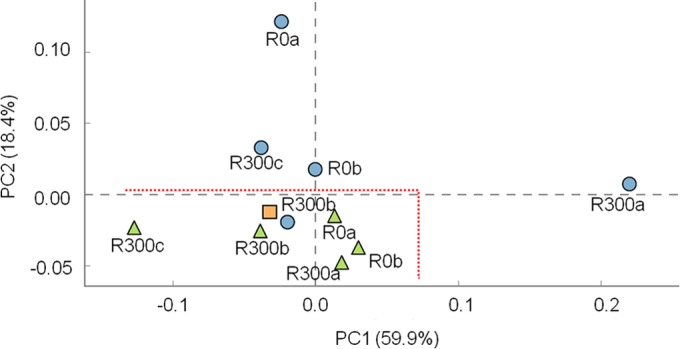
Principal component analysis on Hellinger-transformed data of family relative abundance calculated for microbial communities enriched at the anodes, in the bulk anolyte of reactors polarized at 0 mV and +300 mV (versus an Ag/AgCl [3 M KCl] reference electrode), and in the start-up sediment used as the inoculum. (Blue circles denote samples collected from the anodes, orange square denotes microbial inoculum, and green triangles denote samples collected from the bulk anolyte in the reactors at the end of the treatment.) The microbial communities enriched on the anodes and in the bulk anolyte formed separate groups.
FIG 6
FIG 6
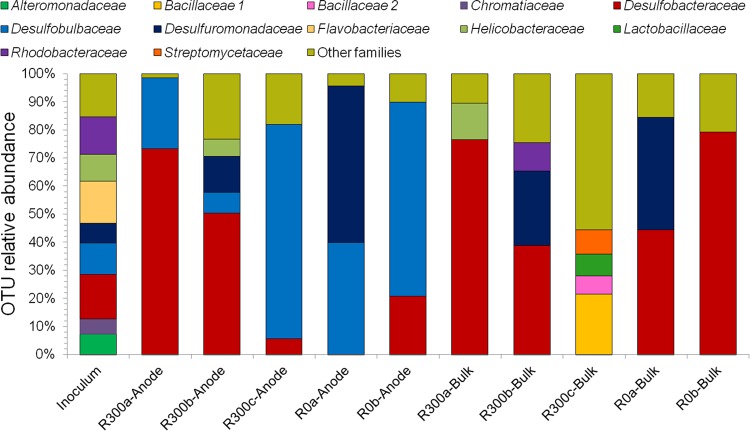
Taxonomic composition at the family level of the microbial communities enriched at the anodes, in the bulk anolyte of reactors polarized at 0 mV and +300 mV (versus an Ag/AgCl [3 M KCl] reference electrode), and in the sediment used as the inoculum. The families with a relative abundance of 5% (or higher) are reported. Sulfate reducers and sulfur reducers were enriched during the bioelectrochemical treatment.

References

    1. Sammarco PW, Kolian SR, Warby RAF, Bouldin JL, Subra WA, Porter SA. 2013. Distribution and concentrations of petroleum hydrocarbons associated with the BP/Deepwater Horizon oil spill, Gulf of Mexico. Mar Pollut Bull 73:129–143. doi:10.1016/j.marpolbul.2013.05.029. - DOI - PubMed
    1. Nelson-Smith A. 1972. Oil pollution and marine ecology. Elek Science, London, United Kingdom.
    1. U.S. EPA 2011. Screening-level hazard characterization. U.S. EPA, Washington, DC.
    1. Moreno R, Jover L, Diez C, Sardà F, Sanpera C. 2013. Ten years after the prestige oil spill: seabird trophic ecology as indicator of long-term effects on the coastal marine ecosystem. PLoS One 8:e77360. doi:10.1371/journal.pone.0077360. - DOI - PMC - PubMed
    1. Sumaila RU, Cisneros-Montemayor AM, Dyck A, Huang L, Cheung W, Jacquet J, Kleisner K, Lam V, McCrea-Strub A, Swartz W, Watson R, Zeller D, Pauly D. 2012. Impact of the Deepwater Horizon well blowout on the economics of US Gulf fisheries. Can J Fish Aquat Sci 69:499–510. doi:10.1139/f2011-171. - DOI

Publication types

LinkOut - more resources