


Clinical Electroencephalographic Biomarker for Impending Epilepsy in Asymptomatic Tuberous Sclerosis Complex Infants
- PMID: 26498039
- PMCID: PMC4691569
- DOI: 10.1016/j.pediatrneurol.2015.09.013
Clinical Electroencephalographic Biomarker for Impending Epilepsy in Asymptomatic Tuberous Sclerosis Complex Infants
Abstract
Background: We assessed the clinical utility of routine electroencephalography (EEG) in the prediction of epilepsy onset in asymptomatic infants with tuberous sclerosis complex.
Methods: This multicenter prospective observational study recruited infants younger than 7 months, seizure-free and on no antiepileptic drugs at enrollment, who all underwent serial physical examinations and video EEGs throughout the study. Parental education on seizure recognition was completed at the time of initial enrollment. Once seizure onset occurred, standard of care was applied, and subjects were followed up until 24 months.
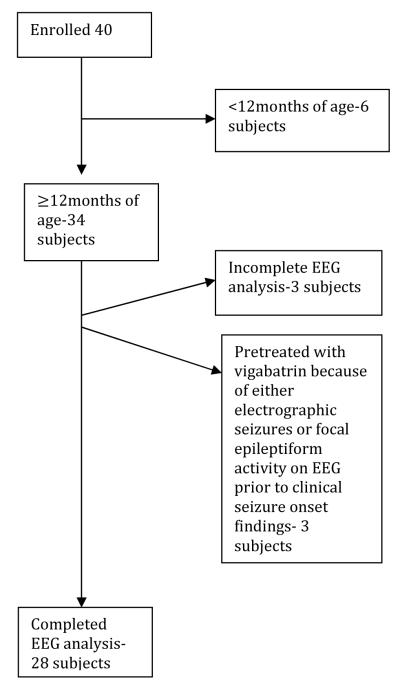
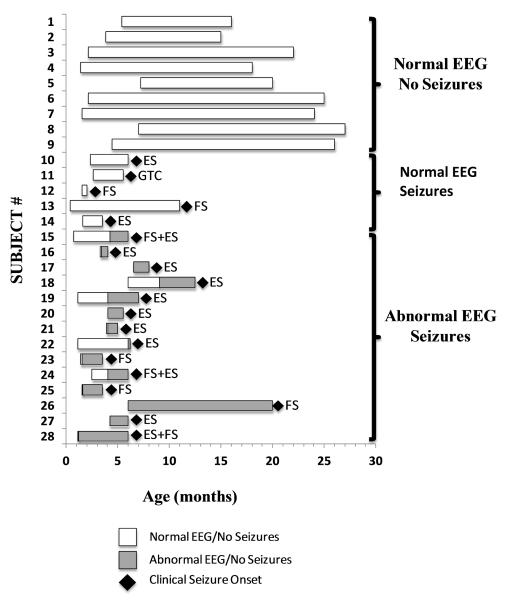
Results: Forty patients were enrolled, 28 older than 12 months with completed EEG evaluation at the time of this interim analysis. Of those, 19 (67.8%) developed seizures. Epileptic spasms occurred in 10 (52.6%), focal seizures in five (26.3%), generalized tonic-clonic seizure in one (5.3%), and a combination of epileptic spasms and focal seizures in three (15.7%). Fourteen infants (73.6%) had the first emergence of epileptiform abnormalities on EEG at an average age 4.2 months, preceding seizure onset by a median of 1.9 months. Hypsarrhythmia or modified hypsarrhythmia was not found in any infant before onset of epileptic spasms. All children with epileptiform discharges subsequently developed epilepsy (100% positive predictive value), and the negative predictive value for not developing epilepsy after a normal EEG was 64%.
Conclusions: Serial routine EEGs in infants with tuberous sclerosis complex is a feasible strategy to identify individuals at high risk for epilepsy. The most frequent clinical presentation was epileptic spasms followed by focal seizures, and then a combination of both seizure types.
Keywords: EEG; epileptic spasms; partial seizures; video EEG use in epilepsy.
Copyright © 2016 The Authors. Published by Elsevier Inc. All rights reserved.
Figures
Comment in
-
Seizures in tuberous sclerosis complex: hitting the target.Lancet. 2016 Oct 29;388(10056):2062-2064. doi: 10.1016/S0140-6736(16)31576-8. Epub 2016 Sep 6. Lancet. 2016. PMID: 27613522 No abstract available.
References
Publication types
MeSH terms
Grants and funding
- UL1RR033176/RR/NCRR NIH HHS/United States
- R01 NS082649/NS/NINDS NIH HHS/United States
- U01 NS082320/NS/NINDS NIH HHS/United States
- 8UL1TR000077/TR/NCATS NIH HHS/United States
- P20-NS080199/NS/NINDS NIH HHS/United States
- U01-NS082320/NS/NINDS NIH HHS/United States
- P20 NS080199/NS/NINDS NIH HHS/United States
- UL1 RR033176/RR/NCRR NIH HHS/United States
- UL1 TR001425/TR/NCATS NIH HHS/United States
- U54 HD090255/HD/NICHD NIH HHS/United States
- R01-NS082649/NS/NINDS NIH HHS/United States
- UL1 TR000077/TR/NCATS NIH HHS/United States
LinkOut - more resources
Full Text Sources
Other Literature Sources
Medical
