. 2016 Jan:487:68-74.
doi: 10.1016/j.virol.2015.10.002. Epub 2015 Oct 23.

Arterivirus RNA-dependent RNA polymerase: Vital enzymatic activity remains elusive

Affiliations

Arterivirus RNA-dependent RNA polymerase: Vital enzymatic activity remains elusive

Kathleen C Lehmann et al. Virology. 2016 Jan.

Abstract

All RNA viruses encode an RNA-dependent RNA polymerase (RdRp), which in arteriviruses is expressed as the C-terminal domain of nonstructural protein 9 (nsp9). Previously, potent primer-dependent RdRp activity has been demonstrated for the homologous polymerase subunit (nsp12) of the distantly related coronaviruses. The only previous study focusing on the in vitro activity of nsp9 of an arterivirus (equine arteritis virus; EAV) reported weak de novo polymerase activity on homopolymeric RNA templates. However, this activity was not retained when Mn(2+) ions were omitted from the assay or when biologically relevant templates were supplied, which prompted us to revisit the biochemical properties of this polymerase. Based on the properties of active-site mutants, we conclude that the RNA-synthesizing activities observed in de novo and primer-dependent polymerase and terminal transferase assays cannot be attributed to recombinant EAV nsp9-RdRp. Our results illustrate the potential pitfalls of characterizing polymerases using highly sensitive biochemical assays.

Keywords: Equine arteritis virus; In vitro RdRp activity; Nidovirus; Polymerase active site mutant; Recombinant nsp9; Reverse genetics.


Figures

Fig. 1
Fig. 1
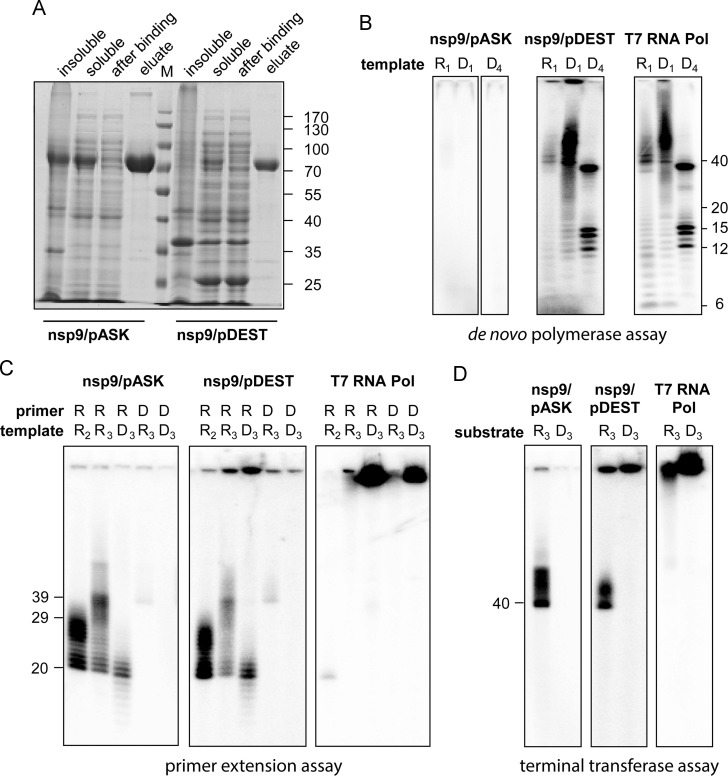
Expression, purification, and RNA polymerase activities of two recombinant EAV nsp9-His preparations. R and D indicate the use of RNA and DNA templates, respectively. Identical numbers indicate templates with equivalent sequences. Template sequences are listed in Supplementary Table S1. Product lengths (nt) are indicated on the right or left side of the figures. (A) Coomassie brilliant blue-stained SDS-PAGE gel of samples taken during metal ion chromatography using Co2+. Insoluble and soluble: respective fractions after cell lysis; after binding: unbound protein after removal of Co2+ resin; eluate: elution fraction after purification. The molecular weight of nsp9-His is 78 kDa. Size markers are depicted on the right in kDa. (B) de novo polymerase assay using nsp9 expressed from pASK (nsp9/pASK; final protein concentration 2 µM) or pDest (nsp9/pDEST; final protein concentration 0.6 µM) vectors, or using commercial T7 RNA polymerase (0.05 U per sample). Assays were performed in the presence of 1.5 mM ATP, 0.7 mM GTP, 0.7 mM UTP and 0.17 µM [α-32P]CTP. Products longer than template length, 30 nt for R1 and D1, result from terminal transferase activity acting on either the template or the newly synthesized strand. D4 template length 45 nt (C) Results of a primer extension assay (primer length 19 nt) using recombinant nsp9/pASK (final protein concentration 1 µM), nsp9/pDEST (final protein concentration 0.3 µM), or commercial T7 RNA polymerase (0.025 U per sample), in the presence of 50 µM ATP and 0.17 µM [α-32P]ATP. Products longer than template length (29 nt for R2, 39 nt for R3 and D3) must have resulted from terminal transferase activity acting on either the template or the newly synthesized strand. (D) Results of a terminal transferase assay. The signal at the very top of the gel likely represents products of >200 nt that cannot be resolved in the high-percentage acrylamide gel used here. Note that products resulting from end-labeling with ATP may be further extended by a back-priming mechanism.
Fig. 2
Fig. 2
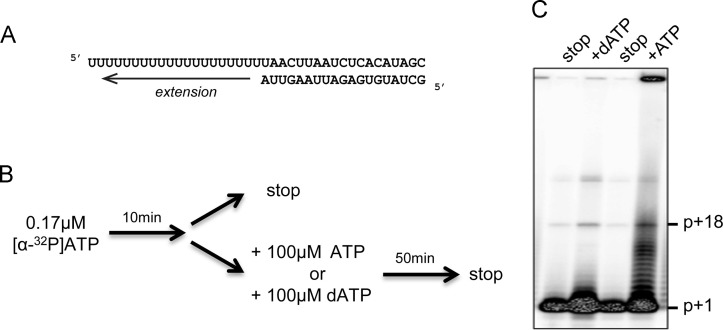
Stop-and-go primer extension assay using EAV nsp9-His expressed from a pASK vector and primer/template R/R3 in the presence of ATP or dATP. (A) Sequence of primer/template. (B) Schematic representation of the experimental design. (C) Polymerase products after interrupted and resumed synthesis. The sizes of primer extension products are indicated on the right.
Fig. 3
Fig. 3
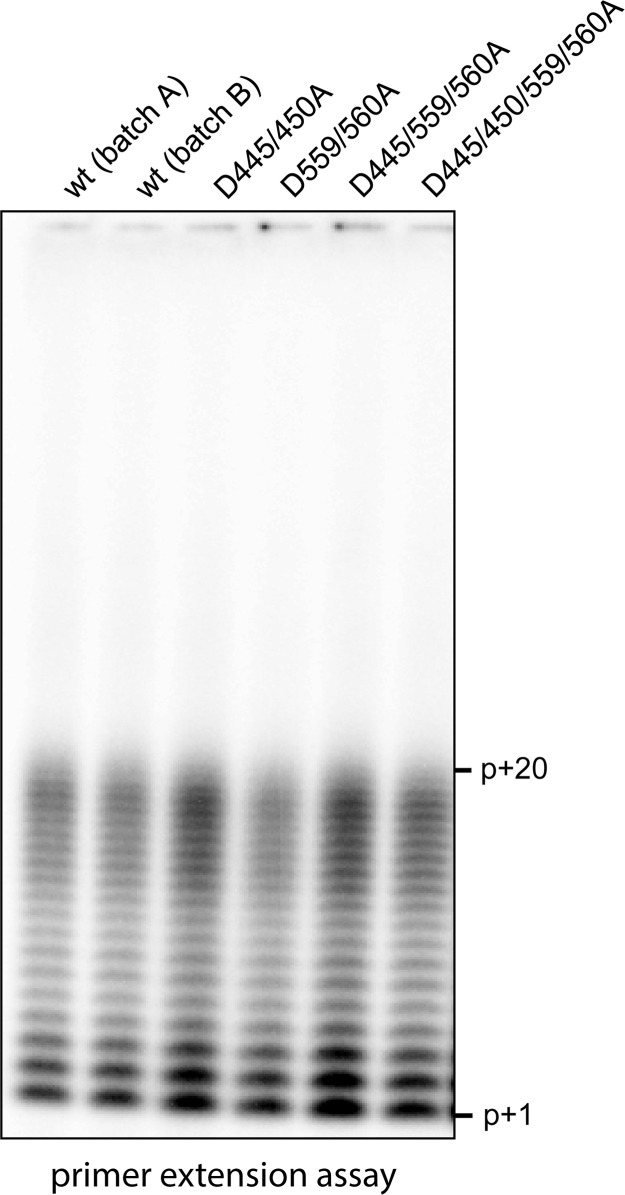
Primer extension assay on primer/template R/R3 using wild-type EAV nsp9-His expressed from a pASK vector and mutants in which essential aspartate residues of the RdRp domain were replaced with alanine (D445 and D450 of motif A, D559 and D560 of motif C). The sizes of primer extension products are indicated on the right; reactions were performed in the presence of 50 µM ATP and 0.17 µM [α-32P]ATP.
Fig. 4
Fig. 4
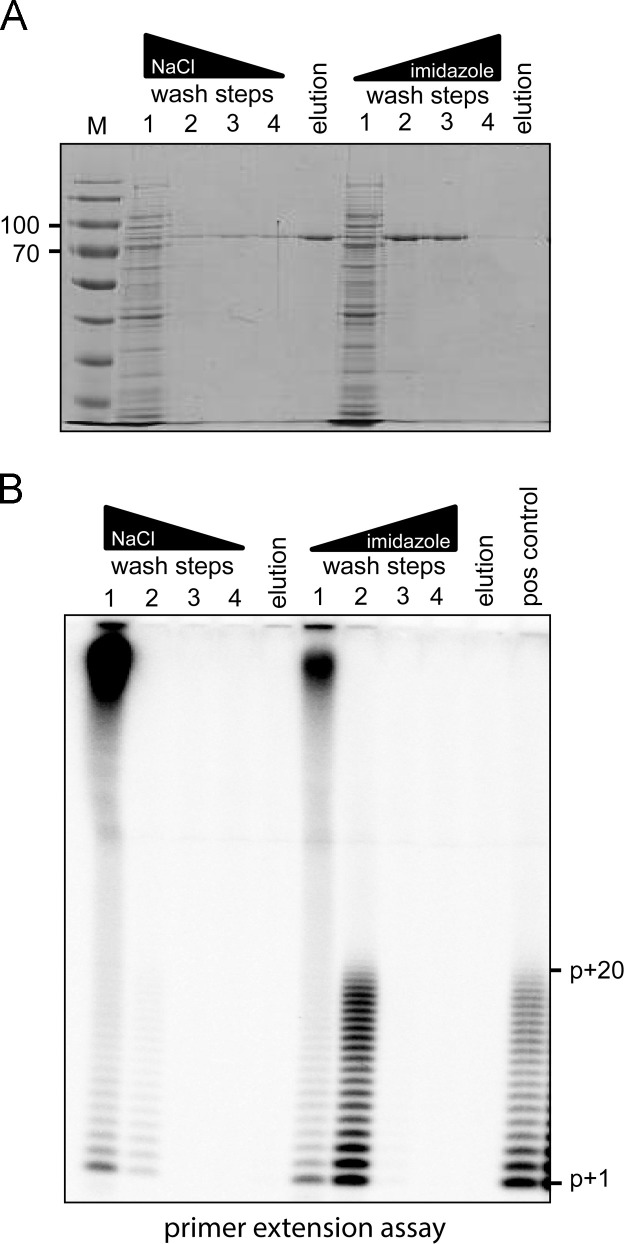
Correlation between EAV nsp9-containing fractions and primer extension activity. (A) Coomassie brilliant blue-stained SDS-PAGE gel of samples taken during the purification of nsp9/pASK by Co2+ affinity chromatography using wash buffers with either a decreasing NaCl concentration or an increasing imidazole concentration. Size markers are depicted on the left in kDa. (B) The samples shown in A were examined for primer extension activity on primer/template R/R3. The sizes of primer extension products are indicated on the right.

References

    1. Ahn D.G., Choi J.K., Taylor D.R., Oh J.W. Biochemical characterization of a recombinant SARS coronavirus nsp12 RNA-dependent RNA polymerase capable of copying viral RNA templates. Arch. Virol. 2012;157:2095–2104. - PMC - PubMed
    1. Arnold J.J., Cameron C.E. Poliovirus RNA-dependent RNA polymerase (3Dpol): pre-steady-state kinetic analysis of ribonucleotide incorporation in the presence of Mg2+ Biochemistry. 2004;43:5126–5137. - PMC - PubMed
    1. Arnold J.J., Ghosh S.K., Cameron C.E. Poliovirus RNA-dependent RNA polymerase (3D(pol)). Divalent cation modulation of primer, template, and nucleotide selection. J. Biol. Chem. 1999;274:37060–37069. - PubMed
    1. Arnold J.J., Vignuzzi M., Stone J.K., Andino R., Cameron C.E. Remote site control of an active site fidelity checkpoint in a viral RNA-dependent RNA polymerase. J. Biol. Chem. 2005;280:25706–25716. - PMC - PubMed
    1. Beerens N., Selisko B., Ricagno S., Imbert I., van der Zanden L., Snijder E.J., Canard B. De novo initiation of RNA synthesis by the arterivirus RNA-dependent RNA polymerase. J. Virol. 2007;81:8384–8395. - PMC - PubMed

Publication types

MeSH terms