Review
. 2015 Dec 25;290(52):30728-35.
doi: 10.1074/jbc.R115.676346. Epub 2015 Oct 23.

Pleiotropic Functions of Tumor Suppressor WWOX in Normal and Cancer Cells

Affiliations
Review

Pleiotropic Functions of Tumor Suppressor WWOX in Normal and Cancer Cells

Muhannad Abu-Remaileh et al. J Biol Chem. .

Abstract

WW domain-containing oxidoreductase (WWOX), originally marked as a likely tumor suppressor gene, has over the years become recognized for its role in a much wider range of cellular activities. Phenotypic effects displayed in animal studies, along with resolution of WWOX's architecture, fold, and binding partners, point to the protein's multifaceted biological functions. Results from a series of complementary experiments seem to indicate WWOX's involvement in metabolic regulation. More recently, clinical studies involving cases of severe encephalopathy suggest that WWOX also plays a part in controlling CNS development, further expanding our understanding of the breadth and complexity of WWOX behavior. Here we present a short overview of the various approaches taken to study this dynamic gene, emphasizing the most recent findings regarding WWOX's metabolic- and CNS-associated functions and their underlying molecular basis.

Keywords: SDR domain; WW domain; WWOX; animal model; animal models; cell metabolism; central nervous system (CNS); common fragile site; epilepsy; protein-protein interaction; tumor suppressor; tumor suppressor gene.


Figures

FIGURE 1.
FIGURE 1.
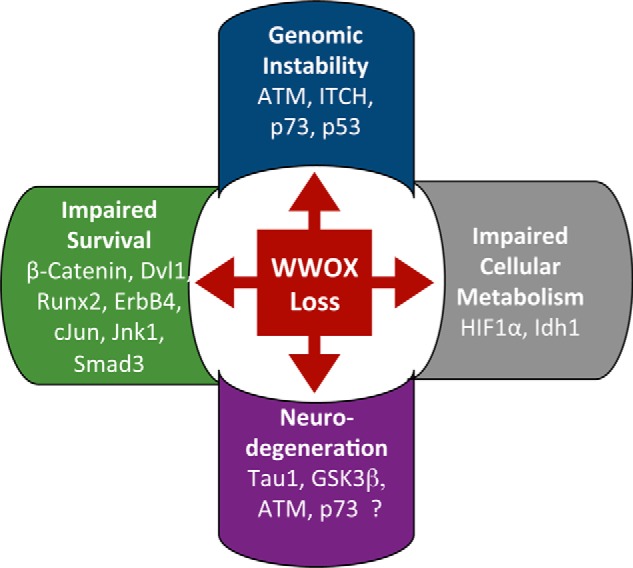
Overview of the biological effects of WWOX loss on signaling pathways. WWOX is involved in several biological functions through its ability to interact physically and functionally with many proteins. For example, upon DNA damage, WWOX interacts with ITCH and ATM, leading to ATM activation, and consequent activation of γH2AX, MDC1, and CHK2. Moreover, WWOX enhances apoptosis through interaction with p53 and p73. At the same time, WWOX inhibits cell growth by inhibiting the Wnt/β-catenin complex through Dvl1 inhibition. Besides, WWOX modulates cellular metabolism by interacting physically with HIF1α and functionally with Idh1. Finally, WWOX inhibits GSK3β activity to phosphorylate Tau that is crucial for proper neurodevelopment. Whether DDR proteins such as ATM and p73 are important for the neurodegeneration phenotype upon WWOX loss is unknown.
FIGURE 2.
FIGURE 2.
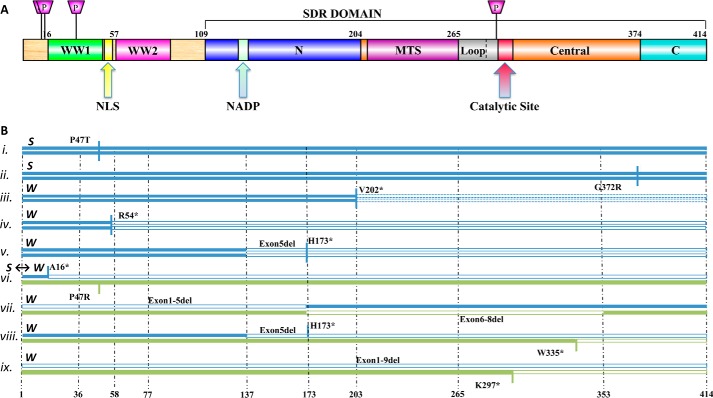
WWOX protein structure and WWOX mutations in CNS disorders. A, the architecture of the WWOX protein. WWOX contains two N-terminal WW domains (green and magenta, respectively) that are separated by a linker with a nuclear localization sequence (NLS, yellow), and a C-terminal SDR domain composed of an N-terminal (blue), central (orange), and C-terminal (cyan) parts. WW2 stands out by its inability to bind to peptide motifs (e.g. PPXY) when compared with classical WW domains. Features that are usually not observed in classical SDR domains include a long inserted loop adjacent to the catalytic site (gray), as well as a C-terminal extension (cyan). MTS, mitochondrial transmission signal; P, proline. B, mutations in WWOX genes of patients with CNS disorders. Changes include mutations in both WW and SDR domains, ranging from point mutations that lead to non-synonymous amino acid changes in the protein, stop codons (indicated by an asterisk), to skipped exons. The two alleles of each of the reported patients (59, 63) are presented below the architecture scheme, together with their phenotype; S stands for SCAR12, and W stands for WOREE. Patient i, Refs. , , and ; patient ii, Refs. and 63); patient iii, Ref. ; patient iv, Refs. and ; patient v, Ref. ; and patients vi–ix, Ref. . Phenotypes for all patients except patient v were defined and reviewed in Refs. and , whereas patient v has been identified by the authors according to the phenotype descriptions given by Refs. and . The exact genotype for patent iii (V202*) is still unknown (65). Its unresolved portion is represented by a dotted line.
FIGURE 3.
FIGURE 3.
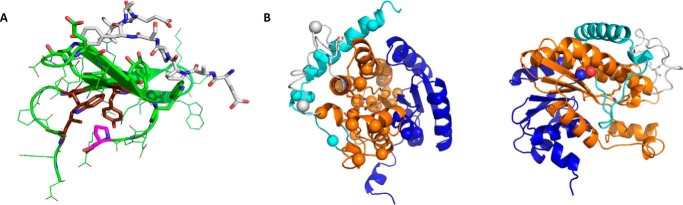
Structural models of the different domains of WWOX. A, the first WW domain WW1 (generated based on the structure of WW3 domain of ITCH, Protein Data Bank (PDB) ID 4n7f (76), using Rosetta with the following constraints: fixed backbone design, constrained relaxation, and minimization (77)). Pro-47 is mutated in several patients with reported CNS-related diseases, reducing the stability of WW and consequently its binding to peptide targets (white). The central position in the core of Pro-47 (in magenta) and its interacting residues (in brown) are highlighted as sticks. B, a structural model of the SDR region (generated by the RosettaCM protocol as implemented by the Robetta server (78), starting from PDB ID 3rd5 (58) as a template structure) shows an extended central β sheet formed by Rossmann folds. A sizeable loop insertion located in the central domain and common to both WWOX and the hypothetical protein of structure 3rd5 is colored gray. Catalytic residues identified by alanine scanning are shown as sticks. Left panel: view from the top of the β sheet onto the catalytic site, with cancer mutation positions (according to Ref. 6) highlighted as spheres. Right panel: G372R, the only point mutation associated with CNS-related diseases (highlighted as spheres) is located at the beginning of the C-terminal extension, which is suspected to play a central role in proper neurodevelopment, as suggested by epilepsy and seizures characterizing lde/lde rats lacking that extension due to a frameshift mutation (23). Basic coloring is kept as in Fig. 2.

References

    1. Bednarek A. K., Laflin K. J., Daniel R. L., Liao Q., Hawkins K. A., and Aldaz C. M. (2000) WWOX, a novel WW domain-containing protein mapping to human chromosome 16q23.3-24.1, a region frequently affected in breast cancer. Cancer Res. 60, 2140–2145 - PubMed
    1. Ried K., Finnis M., Hobson L., Mangelsdorf M., Dayan S., Nancarrow J. K., Woollatt E., Kremmidiotis G., Gardner A., Venter D., Baker E., and Richards R. I. (2000) Common chromosomal fragile site FRA16D sequence: identification of the FOR gene spanning FRA16D and homozygous deletions and translocation breakpoints in cancer cells. Hum. Mol. Genet. 9, 1651–1663 - PubMed
    1. Gao G., and Smith D. I. (2014) Very large common fragile site genes and their potential role in cancer development. Cell. Mol. Life Sci. 71, 4601–4615 - PMC - PubMed
    1. Durkin S. G., and Glover T. W. (2007) Chromosome fragile sites. Annu. Rev. Genet. 41, 169–192 - PubMed
    1. Beroukhim R., Mermel C. H., Porter D., Wei G., Raychaudhuri S., Donovan J., Barretina J., Boehm J. S., Dobson J., Urashima M., Mc Henry K. T., Pinchback R. M., Ligon A. H., Cho Y. J., Haery L., Greulich H., Reich M., Winckler W., Lawrence M. S., Weir B. A., Tanaka K. E., Chiang D. Y., Bass A. J., Loo A., Hoffman C., Prensner J., Liefeld T., Gao Q., Yecies D., Signoretti S., Maher E., Kaye F. J., Sasaki H., Tepper J. E., Fletcher J. A., Tabernero J., Baselga J., Tsao M. S., Demichelis F., Rubin M. A., Janne P. A., Daly M. J., Nucera C., Levine R. L., Ebert B. L., Gabriel S., Rustgi A. K., Antonescu C. R., Ladanyi M., Letai A., Garraway L. A., Loda M., Beer D. G., True L. D., Okamoto A., Pomeroy S. L., Singer S., Golub T. R., Lander E. S., Getz G., Sellers W. R., and Meyerson M. (2010) The landscape of somatic copy-number alteration across human cancers. Nature 463, 899–905 - PMC - PubMed

MeSH terms