


Examining the link between women's exposure to stressful life events prior to conception and infant and toddler health: the role of birth weight
- PMID: 26500337
- PMCID: PMC4752871
- DOI: 10.1136/jech-2015-205848
Examining the link between women's exposure to stressful life events prior to conception and infant and toddler health: the role of birth weight
Abstract
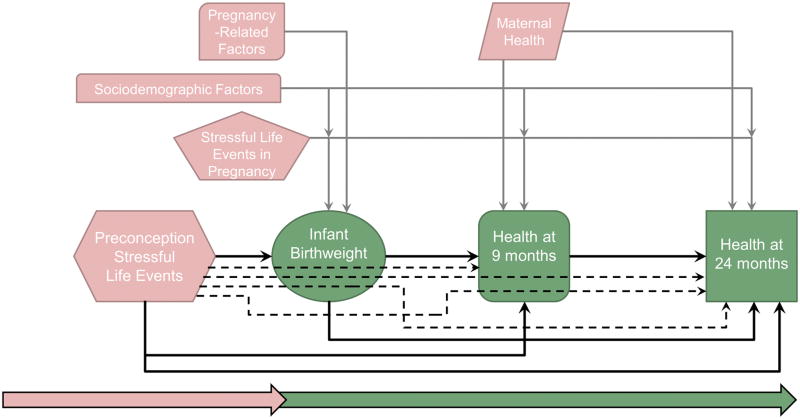
Background: The life course perspective suggests a pathway may exist among maternal exposure to stressful life events prior to conception (PSLEs), infant birth weight and subsequent offspring health, whereby PSLEs are part of a 'chains-of-risk' that set children on a certain health pathway. No prior study has examined the link between PSLEs and offspring health in a nationally representative sample of US mothers and their children. We used longitudinal, nationally representative data to evaluate the relation between maternal exposure to PSLEs and subsequent measures of infant and toddler health, taking both maternal and obstetric characteristics into account.
Methods: We examined 6900 mother-child dyads participating in 2 waves of the nationally representative Early Childhood Longitudinal Study-Birth Cohort (n=6900). Infant and toddler health outcomes assessed at 9 and 24 months included overall health status, special healthcare needs and severe health conditions. Adjusted path analyses examined associations between PSLEs, birth weight and child health outcomes.
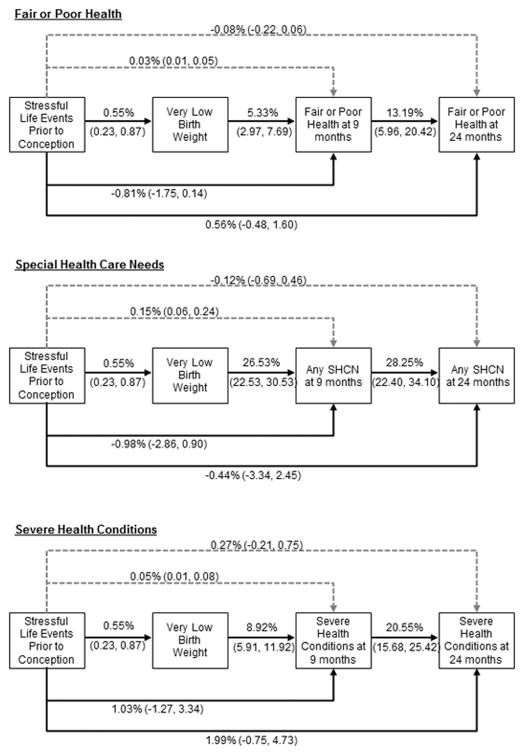
Results: In adjusted analyses, PSLEs increased the risk for very low birth weight (VLBW, <1500 g), which, in turn, predicted poor health at both 9 and 24 months of age. Path analyses demonstrated that PSLEs had small indirect effects on children's subsequent health that operated through VLBW.
Conclusions: Our analysis suggests a chains-of-risk model in which women's exposure to PSLEs increases the risk for giving birth to a VLBW infant, which, in turn, adversely affects infant and toddler health. Addressing women's preconception health may have important downstream benefits for their children, although more research is needed to replicate these findings.
Keywords: BIRTH WEIGHT; CHILD HEALTH; Life course epidemiology; MATERNAL HEALTH; PSYCHOSOCIAL FACTORS.
Published by the BMJ Publishing Group Limited. For permission to use (where not already granted under a licence) please go to http://www.bmj.com/company/products-services/rights-and-licensing/
Figures
References
-
- Lu MC, Halfon N. Racial and ethnic disparities in birth outcomes: a life-course perspective. Maternal and child health journal. 2003;7:13–30. - PubMed
-
- Elder GH., Jr The life course as developmental theory. Child development. 1998;69:1–12. - PubMed
-
- Pickles A, De Stavola B. An overview of models and methods for life course analysis. In: Pickles A, Maughan B, Wadsworth M, editors. Epidemiological Methods in Life Course Research. Oxford: Oxford University Press; 2007. pp. 181–220.
Publication types
MeSH terms
Grants and funding
LinkOut - more resources
Full Text Sources
Other Literature Sources
Medical
