


Intra- and inter-observer reliability of the Cobb measurement by chiropractic interns using digital evaluation methods
- PMID: 26500360
- PMCID: PMC4593040
Intra- and inter-observer reliability of the Cobb measurement by chiropractic interns using digital evaluation methods
Abstract
Introduction: It is important to create a body of evidence surrounding the reliability of certain diagnostic criteria. While the reliability of the Cobb measurement is well established with various licensed health care professionals, this study aims to determine the inter- and intra-observer reliability of the Cobb Measurement among chiropractic interns.
Methods: Fourteen chiropractic interns analyzed 10 pre-selected digital spinal radiographs on a Picture Archiving and Communication System (PACS) in two separate rounds of observation. The participants indicated their choice of end vertebra and Cobb Measurement in each round of observation. Agreement on vertebral levels selected was estimated using percentage agreement. Intra-observer reliability was estimated using the Pearson r correlation coefficient, and inter-observer correlation was estimated using the Inter-Class Coefficient (ICC).
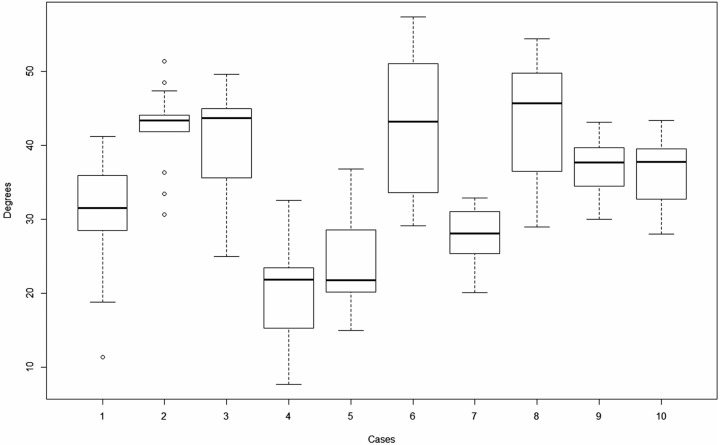
Results: The range of percentage agreement on vertebral level selection was 0.36 - 0.79. The Pearson r correlation coefficient for round 1 and round 2 was 0.79. The ICC (3,1) was 0.79 (round 1), and 0.70 (round 2).
Conclusion: Less than optimal agreement on end vertebrae selection was found between observers. Intra- and inter-observer reliability of the Cobb Measurement was 'excellent' (round 1) and 'good' (round 2).
Introduction: Il est important de créer un ensemble de preuves sur la fiabilité de certains critères de diagnostic. Bien que la fiabilité de la mesure Cobb soit bien établie chez divers professionnels de la santé, cette étude vise à déterminer la fiabilité des observations individuelles et entre ces observations de la mesure Cobb parmi des stagiaires en chiropratique.
Méthodologie: Quatorze stagiaires en chiropratique ont analysé 10 radiographies numériques de la colonne vertébrale sur un système d’archivage et de transmission d’image (PACS) en deux séances distinctes d’observation. Les participants ont indiqué leur choix de vertèbre limite et de mesure Cobb dans chaque observation. Un consensus sur les niveaux vertébraux sélectionnés a été établi en fonction du pourcentage de concordance. La fiabilité des observations individuelles a été estimée à l’aide du coefficient de corrélation de Pearson r, et la corrélation entre les observations des stagiaires a été estimée à l’aide du coefficient interclasse (ICC).
Résultats: La fourchette de pourcentage de concordance sur la sélection de niveau vertébral était de 0,36 à 0,79. Le coefficient de corrélation de Pearson r pour la première séance et la deuxième séance d’observations était de 0,79. Le coefficient interclasse (3,1) était de 0,79 (séance 1), et de 0,70 (séance 2).
Conclusion: Le consensus sur la sélection des vertèbres limites a été moins qu’optimal entre les observateurs. La fiabilité des observations individuelles et entre ces observations de la mesure Cobb a été « excellente » (séance 1) et « bonne » (séance 2).
Keywords: Cobb measurement; chiropractic; reliability; scoliosis.
Figures
References
-
- Carmen D, Browne R, Birch J. Measurement of scoliosis and kyphosis radiographs. J Bone Joint Surg Am. 1990;72(3):284–287. - PubMed
-
- Morrissy M, Goldsmith G, Hall E, Kehl D, Cowie G. Measurement of the Cobb angle on radiographs of patients who have scoliosis. Evaluation of intrinsic error. J Bone Joint Surg. 1999;72:320–327. - PubMed
-
- Oda M, Rauh S, Gregory P, Silverman F, Bleck E. The significance of roentgenographic measurement of scoliosis. J Pediatr Orthop B. 1982;2(4):378–382. - PubMed
-
- Portney LG, Watkins MP. Foundations of Clinical Research: Applications to Practice. 3rd ed. New Jersey: Prentice Hall; 2009.
LinkOut - more resources
Full Text Sources