


A high protein diet (3.4 g/kg/d) combined with a heavy resistance training program improves body composition in healthy trained men and women--a follow-up investigation
- PMID: 26500462
- PMCID: PMC4617900
- DOI: 10.1186/s12970-015-0100-0
A high protein diet (3.4 g/kg/d) combined with a heavy resistance training program improves body composition in healthy trained men and women--a follow-up investigation
Abstract
Background: The consumption of a high protein diet (>4 g/kg/d) in trained men and women who did not alter their exercise program has been previously shown to have no significant effect on body composition. Thus, the purpose of this investigation was to determine if a high protein diet in conjunction with a periodized heavy resistance training program would affect indices of body composition, performance and health.
Methods: Forty-eight healthy resistance-trained men and women completed this study (mean ± SD; Normal Protein group [NP n = 17, four female and 13 male]: 24.8 ± 6.9 yr; 174.0 ± 9.5 cm height; 74.7 ± 9.6 kg body weight; 2.4 ± 1.7 yr of training; High Protein group [HP n = 31, seven female and 24 male]: 22.9 ± 3.1 yr; 172.3 ± 7.7 cm; 74.3 ± 12.4 kg; 4.9 ± 4.1 yr of training). Moreover, all subjects participated in a split-routine, periodized heavy resistance-training program. Training and daily diet logs were kept by each subject. Subjects in the NP and HP groups were instructed to consume their baseline (~2 g/kg/d) and >3 g/kg/d of dietary protein, respectively.
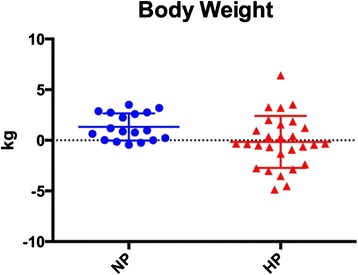
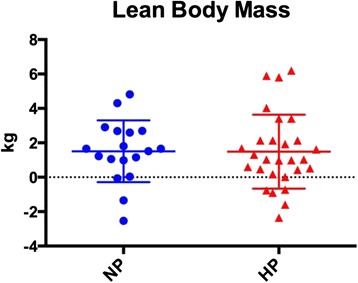
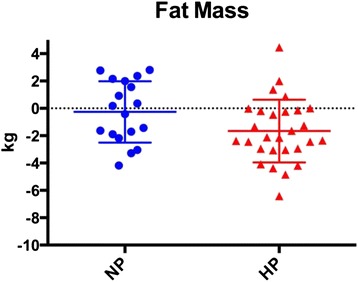
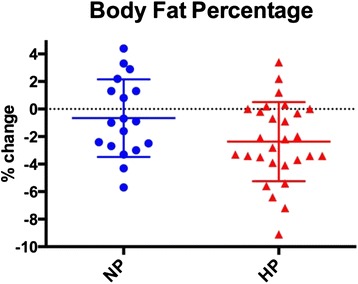
Results: Subjects in the NP and HP groups consumed 2.3 and 3.4 g/kg/day of dietary protein during the treatment period. The NP group consumed significantly (p < 0.05) more protein during the treatment period compared to their baseline intake. The HP group consumed more (p < 0.05) total energy and protein during the treatment period compared to their baseline intake. Furthermore, the HP group consumed significantly more (p < 0.05) total calories and protein compared to the NP group. There were significant time by group (p ≤ 0.05) changes in body weight (change: +1.3 ± 1.3 kg NP, -0.1 ± 2.5 HP), fat mass (change: -0.3 ± 2.2 kg NP, -1.7 ± 2.3 HP), and % body fat (change: -0.7 ± 2.8 NP, -2.4 ± 2.9 HP). The NP group gained significantly more body weight than the HP group; however, the HP group experienced a greater decrease in fat mass and % body fat. There was a significant time effect for FFM; however, there was a non-significant time by group effect for FFM (change: +1.5 ± 1.8 NP, +1.5 ± 2.2 HP). Furthermore, a significant time effect (p ≤ 0.05) was seen in both groups vis a vis improvements in maximal strength (i.e., 1-RM squat and bench) vertical jump and pull-ups; however, there were no significant time by group effects (p ≥ 0.05) for all exercise performance measures. Additionally, there were no changes in any of the blood parameters (i.e., basic metabolic panel).
Conclusion: Consuming a high protein diet (3.4 g/kg/d) in conjunction with a heavy resistance-training program may confer benefits with regards to body composition. Furthermore, there is no evidence that consuming a high protein diet has any deleterious effects.
Keywords: Body Composition; Body Fat; Diet; Nutrition; Protein.
Figures
References
-
- Phillips SM, Moore DR, Tang JE. A critical examination of dietary protein requirements, benefits, and excesses in athletes. Int J Sport Nutr Exerc Metab. 2007;17(Suppl):S58–76. - PubMed
-
- Daly RM, O’Connell SL, Mundell NL, Grimes CA, Dunstan DW, Nowson CA. Protein-enriched diet, with the use of lean red meat, combined with progressive resistance training enhances lean tissue mass and muscle strength and reduces circulating IL-6 concentrations in elderly women: a cluster randomized controlled trial. Am J Clin Nutr. 2014;99:899–910. doi: 10.3945/ajcn.113.064154. - DOI - PubMed
Publication types
MeSH terms
Substances
LinkOut - more resources
Full Text Sources
Other Literature Sources
Medical
Research Materials
Miscellaneous
