Effectiveness of a Statewide Abusive Head Trauma Prevention Program in North Carolina
- PMID: 26501945
- PMCID: PMC4687484
- DOI: 10.1001/jamapediatrics.2015.2690
Effectiveness of a Statewide Abusive Head Trauma Prevention Program in North Carolina
Abstract
Importance: Abusive head trauma (AHT) is a serious condition, with an incidence of approximately 30 cases per 100,000 person-years in the first year of life.
Objective: To assess the effectiveness of a statewide universal AHT prevention program.
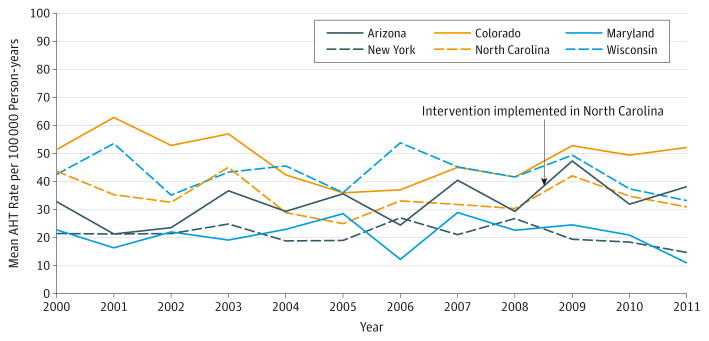
Design, setting, and participants: In total, 88.29% of parents of newborns (n = 405 060) in North Carolina received the intervention (June 1, 2009, to September 30, 2012). A comparison of preintervention and postintervention was performed using nurse advice line telephone calls regarding infant crying (January 1, 2005, to December 31, 2010). A difference-in-difference analysis compared AHT rates in the prevention program state with those of other states before and after the implementation of the program (January 1, 2000, to December 31, 2011).
Intervention: The Period of PURPLE Crying intervention, developed by the National Center on Shaken Baby Syndrome, was delivered by nurse-provided education, a DVD, and a booklet, with reinforcement by primary care practices and a media campaign.
Main outcomes and measures: Changes in proportions of telephone calls for crying concerns to a nurse advice line and in AHT rates per 100,000 infants after the intervention (June 1, 2009, to September 30, 2011) in the first year of life using hospital discharge data for January 1, 2000, to December 31, 2011.
Results: In the 2 years after implementation of the intervention, parental telephone calls to the nurse advice line for crying declined by 20% for children younger than 3 months (rate ratio, 0.80; 95% CI, 0.73-0.87; P < .001) and by 12% for children 3 to 12 months old (rate ratio, 0.88; 95% CI, 0.78-0.99; P = .03). No reduction in state-level AHT rates was observed, with mean rates of 34.01 person-years before the intervention and 36.04 person-years after the intervention. A difference-in-difference analysis from January 1, 2000, to December 31, 2011, controlling for economic indicators, indicated that the intervention did not have a statistically significant effect on AHT rates (β coefficient, -1.42; 95% CI, -13.31 to 10.45).
Conclusions and relevance: The Period of PURPLE Crying intervention was associated with a reduction in telephone calls to a nurse advice line. The study found no reduction in AHT rates over time in North Carolina relative to other states. Consequently, while this observational study was feasible and supported the program effectiveness in part, further programmatic efforts and evaluation are needed to demonstrate an effect on AHT rates.
Conflict of interest statement
Figures
Comment in
-
Challenges in Prevention of Abusive Head Trauma.JAMA Pediatr. 2015 Dec;169(12):1093-4. doi: 10.1001/jamapediatrics.2015.3023. JAMA Pediatr. 2015. PMID: 26501518 No abstract available.
References
-
- Keenan HT, Runyan DK, Marshall SW, Nocera MA, Merten DF, Sinal SH. A population-based study of inflicted traumatic brain injury in young children. JAMA. 2003;290(5):621–626. - PubMed
-
- Barlow KM, Minns RA. Annual incidence of shaken impact syndrome in young children. Lancet. 2000;356(9241):1571–1572. - PubMed
-
- Caffey J. On the theory and practice of shaking infants: its potential residual effects of permanent brain damage and mental retardation. Am J Dis Child. 1972;124(2):161–169. - PubMed
-
- Duhaime AC, Christian C, Moss E, Seidl T. Long-term outcome in infants with the shaking-impact syndrome. Pediatr Neurosurg. 1996;24(6):292–298. - PubMed
Publication types
MeSH terms
Grants and funding
LinkOut - more resources
Full Text Sources
Other Literature Sources
Medical