


Five Facets of Mindfulness and Psychological Health: Evaluating a Psychological Model of the Mechanisms of Mindfulness
- PMID: 26504498
- PMCID: PMC4617366
- DOI: 10.1007/s12671-014-0349-4
Five Facets of Mindfulness and Psychological Health: Evaluating a Psychological Model of the Mechanisms of Mindfulness
Abstract
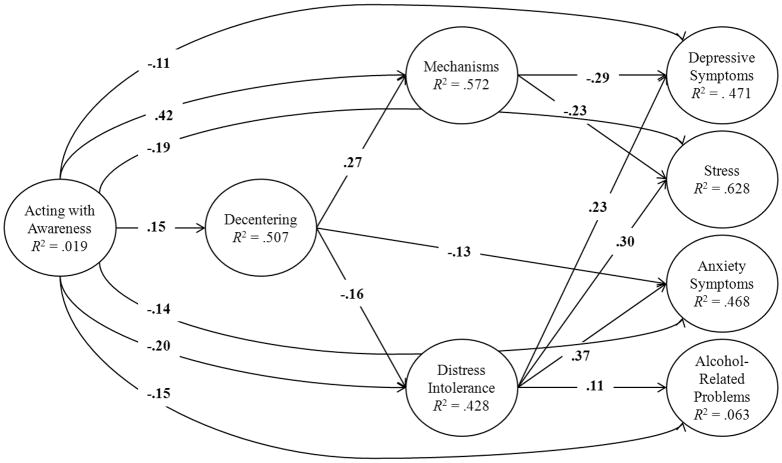
There has been an increasing focus on determining the psychological mechanisms underlying the broad effects of mindfulness on psychological health. Mindfulness has been posited to be related to the construct of reperceiving or decentering, defined as a shift in perspective associated with decreased attachment to one's thoughts and emotions. Decentering is proposed to be a meta-mechanism that mobilizes four psychological mechanisms (cognitive flexibility, values clarification, self-regulation, and exposure), which in turn are associated with positive health outcomes. Despite preliminary support for this model, extant studies testing this model have not examined distinct facets of mindfulness. The present study used a multidimensional measure of mindfulness to examine whether this model could account for the associations between ive facets of mindfulness and psychological symptoms (depressive symptoms, stress, anxiety symptoms, alcohol-related problems) in a sample of college students (N = 944). Our findings partially support this model. We found significant double-mediated associations in the expected directions for all outcomes (stress, anxiety symptoms, and depressive symptoms) except alcohol-related problems, and for each of the facets of mindfulness except observing. However, decentering and the specific mechanisms did not fully mediate the associations among mindfulness facets and psychological health outcomes. Experimental and ecological momentary assessment designs are needed to understand the psychological processes that account for the beneficial effects of mindfulness.
Keywords: alcohol-related problems; anxiety; decentering; depression; mindfulness; stress.
Figures


References
-
- Baer RA. Mindfulness training as a clinical intervention: A conceptual and empirical review. Clinical psychology: Science and practice. 2003;10(2):125–143. doi: 10.1093/clipsy/bpg015. - DOI
-
- Baer RA, Smith GT, Lykins E, Button D, Krietemeyer J, Sauer S, Williams JMG. Construct validity of the five facet mindfulness questionnaire in meditating and nonmeditating samples. Assessment. 2008;15(3):329–342. - PubMed
-
- Bishop SR, Lau M, Shapiro S, Carlson L, Anderson ND, Carmody J, Devins G. Mindfulness: A proposed Operational Definition. Clinical Psychology: Science and Practice. 2004;11:230–241. doi: 10.1093/clipsy.bph077. - DOI
Grants and funding
LinkOut - more resources
Full Text Sources
Other Literature Sources