


Dacomitinib in lung cancer: a "lost generation" EGFR tyrosine-kinase inhibitor from a bygone era?
- PMID: 26508839
- PMCID: PMC4610796
- DOI: 10.2147/DDDT.S52787
Dacomitinib in lung cancer: a "lost generation" EGFR tyrosine-kinase inhibitor from a bygone era?
Abstract
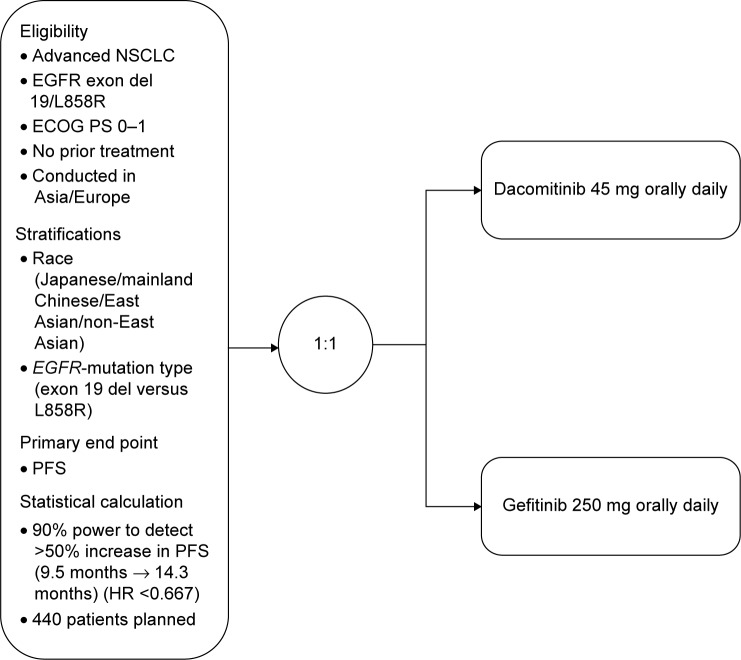
EGFR tyrosine-kinase inhibitors (TKIs) have now been firmly established as the first-line treatment for non-small-cell lung cancer (NSCLC) patients harboring activating EGFR mutations, based on seven prospective randomized Phase III trials. However, despite significantly improved overall response rate and improved median progression-free survival when compared to platinum-doublet chemotherapy, EGFR-mutant NSCLC patients treated with EGFR TKIs invariably progress due to the emergence of acquired resistances, with the gatekeeper T790M mutation accounting for up to 60% of the resistance mechanisms. Second-generation irreversible EGFR TKIs were developed in part to inhibit the T790M mutation, in addition to the common activating EGFR mutations. Dacomitinib is one such second-generation EGFR TKI designed to inhibit both the wild-type (WT) EGFR and EGFR T790M. Afatinib is another second-generation EGR TKI that has been now been approved for the first-line treatment of EGFR-mutant NSCLC patients, while dacomitinib continues to undergo clinical evaluation. We will review the clinical development of dacomitinib from Phase I to Phase III trials, including the two recently published negative large-scale randomized Phase III trials (ARCHER 1009, NCIC-BR-26). Results from another large-scale randomized trial (ARCHER 1050) comparing dacomitinib to gefitinib as first-line treatment of advanced treatment-naïve EGFR-mutant NSCLC patients will soon be available and will serve as the lynchpin trial for the potential approval of dacomitinib in NSCLC. Meanwhile, third-generation EGFR TKIs (eg, CO-1686 [rociletinib], AZ9291, HM61713, EGF816, and ASP8273) that preferentially and potently inhibit EGFR T790M but not WT EGFR are in full-scale clinical development, and some of these EGFR TKIs have received "breakthrough" designation by the US Food and Drug Administration and will likely be approved in late 2015. Given the rapid development of third-generation EGFR TKIs and the approval of gefitinib, erlotinib, and afatinib as first-line treatment of EGFR-mutant NSCLC patients, the future role of dacomitinib in the treatment of NSCLC seems to be limited.
Keywords: EGFR T790M; dacomitinib; epidermal growth factor receptor (EGFR); second-generation EGFR TKI; tyrosine-kinase inhibitor (TKI).
Figures
Similar articles
-
Next-generation epidermal growth factor receptor tyrosine kinase inhibitors in epidermal growth factor receptor -mutant non-small cell lung cancer.Lung Cancer. 2016 Mar;93:59-68. doi: 10.1016/j.lungcan.2016.01.003. Epub 2016 Jan 8. Lung Cancer. 2016. PMID: 26898616 Review.
-
Can we define the optimal sequence of epidermal growth factor receptor tyrosine kinase inhibitors for the treatment of epidermal growth factor receptor-mutant nonsmall cell lung cancer?Curr Opin Oncol. 2017 Mar;29(2):89-96. doi: 10.1097/CCO.0000000000000350. Curr Opin Oncol. 2017. PMID: 28085680 Review.
-
Optimal management of EGFR-mutant non-small cell lung cancer with disease progression on first-line tyrosine kinase inhibitor therapy.Lung Cancer. 2017 Aug;110:7-13. doi: 10.1016/j.lungcan.2017.05.009. Epub 2017 May 11. Lung Cancer. 2017. PMID: 28676222 Review.
-
Second and third-generation epidermal growth factor receptor tyrosine kinase inhibitors in advanced nonsmall cell lung cancer.Curr Opin Oncol. 2015 Mar;27(2):94-101. doi: 10.1097/CCO.0000000000000164. Curr Opin Oncol. 2015. PMID: 25611025 Review.
-
Clinical evaluation of dacomitinib for the treatment of metastatic non-small cell lung cancer (NSCLC): current perspectives.Drug Des Devel Ther. 2019 Sep 6;13:3187-3198. doi: 10.2147/DDDT.S194231. eCollection 2019. Drug Des Devel Ther. 2019. PMID: 31564835 Free PMC article. Review.
Cited by
-
Discovery of novel thiazolyl-pyrazolines as dual EGFR and VEGFR-2 inhibitors endowed with in vitro antitumor activity towards non-small lung cancer.J Enzyme Inhib Med Chem. 2022 Dec;37(1):2265-2282. doi: 10.1080/14756366.2022.2104841. J Enzyme Inhib Med Chem. 2022. PMID: 36000167 Free PMC article.
-
Next-generation EGFR/HER tyrosine kinase inhibitors for the treatment of patients with non-small-cell lung cancer harboring EGFR mutations: a review of the evidence.Onco Targets Ther. 2016 Sep 6;9:5461-73. doi: 10.2147/OTT.S94745. eCollection 2016. Onco Targets Ther. 2016. PMID: 27660463 Free PMC article. Review.
-
Profile of rociletinib and its potential in the treatment of non-small-cell lung cancer.Lung Cancer (Auckl). 2016 May 18;7:91-97. doi: 10.2147/LCTT.S94337. eCollection 2016. Lung Cancer (Auckl). 2016. PMID: 28210165 Free PMC article. Review.
-
EGFR T790M: revealing the secrets of a gatekeeper.Lung Cancer (Auckl). 2017 Oct 9;8:147-159. doi: 10.2147/LCTT.S117944. eCollection 2017. Lung Cancer (Auckl). 2017. PMID: 29070957 Free PMC article. Review.
-
Structural Insight and Development of EGFR Tyrosine Kinase Inhibitors.Molecules. 2022 Jan 26;27(3):819. doi: 10.3390/molecules27030819. Molecules. 2022. PMID: 35164092 Free PMC article. Review.
References
-
- Lynch TJ, Bell DW, Sordella R, et al. Activating mutations in the epidermal growth factor receptor underlying responsiveness of non-small-cell lung cancer to gefitinib. N Engl J Med. 2004;350:2129–2139. - PubMed
-
- Paez JG, Jänne PA, Lee JC, et al. EGFR mutations in lung cancer: correlation with clinical response to gefitinib therapy. Science. 2004;304:1497–1500. - PubMed
-
- Mok TS, Wu YL, Thongprasert S, et al. Gefitinib or carboplatin-paclitaxel in pulmonary adenocarcinoma. N Engl J Med. 2009;361:947–957. - PubMed
-
- Mitsudomi T, Morita S, Yatabe Y, et al. Gefitinib versus cisplatin plus docetaxel in patients with non-small-cell lung cancer harbouring mutations of the epidermal growth factor receptor (WJTOG3405): an open label, randomised phase 3 trial. Lancet Oncol. 2010;11:121–128. - PubMed
Publication types
MeSH terms
Substances
LinkOut - more resources
Full Text Sources
Medical
Research Materials
Miscellaneous
