The incidence of tuberculosis in patients treated with certolizumab pegol across indications: impact of baseline skin test results, more stringent screening criteria and geographic region
- PMID: 26509064
- PMCID: PMC4613160
- DOI: 10.1136/rmdopen-2014-000044
The incidence of tuberculosis in patients treated with certolizumab pegol across indications: impact of baseline skin test results, more stringent screening criteria and geographic region
Abstract
Objectives: We report the incidence of tuberculosis (TB) across certolizumab pegol (CZP) clinical trials in rheumatoid arthritis (RA), psoriasis, psoriatic arthritis (PsA) and axial spondyloarthritis (axSpA), before and after the introduction of stricter TB screening.
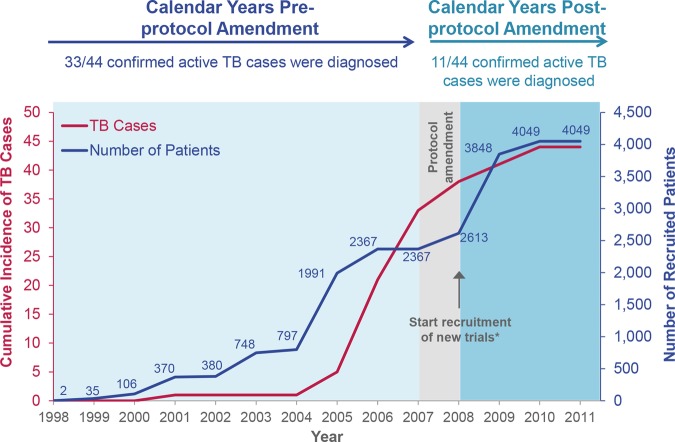
Methods: TB incidence rates (IRs) were assessed and stratified according to screening guidelines used at the time of CZP trials. Before 2007 (original trials), purified protein derivative (PPD) tuberculin skin test positivity varied according to local standards (induration ≥5 up to ≥20 mm). Since 2007, all CZP trial protocols have been amended, including trials spanning (intermediate) and initiated after 2007 (current), mandating that any patient with PPD≥5 mm receives treatment for latent TB infection (LTBI). All cases of suspected TB or PPD≥5 mm, in pooled data from 5402 CZP patients across all CZP trials up to 2012, underwent blinded central review by independent experts.
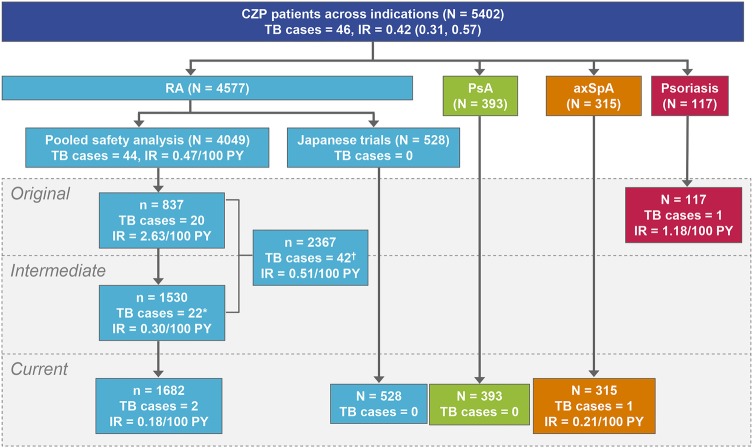
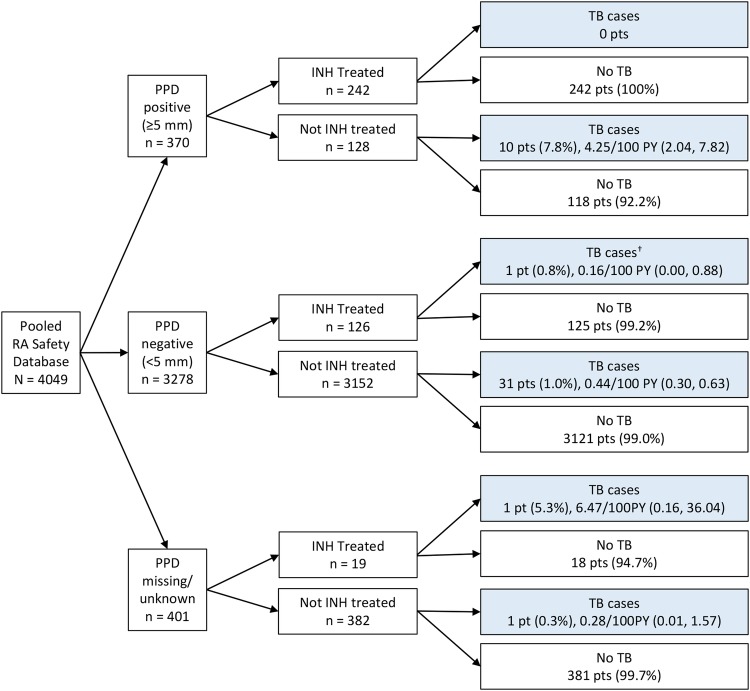
Results: 44 TB cases were confirmed in pooled CZP RA trials (IR 0.47/100PY, patient-years) with no cases in Japanese RA trials (J-RAPID, HIKARI). Single TB cases were confirmed in psoriasis and axSpA trials (RAPID-axSpA), and no cases in the PsA trial (RAPID-PsA). IR of TB was 0.51/100PY across original or intermediate RA trials and 0.18/100PY in current trials. The majority of TB cases in RA occurred in Eastern (IR 1.02/100PY) and Central Europe (IR 0.58/100PY). Of 242/370 PPD≥5 mm patients who received 9 months isoniazid (INH) treatment for latent TB infection (LTBI), none developed TB, versus 7.8% of 128 untreated PPD≥5 mm patients.
Conclusions: Implementation of more stringent LTBI screening, plus treatment for LTBI, reduced the IR of TB, even when INH was administered after starting CZP therapy.
Keywords: Anti-TNF; Autoimmune Diseases; Tuberculosis.
Figures
References
-
- Tubach F, Salmon D, Ravaud P et al. . Risk of tuberculosis is higher with anti–tumor necrosis factor monoclonal antibody therapy than with soluble tumor necrosis factor receptor therapy: the three-year prospective French Research Axed on Tolerance of Biotherapies Registry. Arthritis Rheum 2009;60:1884–94. 10.1002/art.24632 - DOI - PMC - PubMed
-
- Arkema EV, Jonsson J, Baecklund E, et al. Are patients with rheumatoid arthritis still at an increased risk of tuberculosis and what is the role of biological treatments? Ann Rheum Dis. 2014 Published Online First: 7 March 2014. doi: 10.1136/annrheumdis-2013–204960. - DOI - PubMed
LinkOut - more resources
Full Text Sources
Other Literature Sources
Research Materials
Miscellaneous