. 2015 Oct 28;35(43):14426-34.
doi: 10.1523/JNEUROSCI.1774-15.2015.

Consolidation of Complex Events via Reinstatement in Posterior Cingulate Cortex

Affiliations

Consolidation of Complex Events via Reinstatement in Posterior Cingulate Cortex

Chris M Bird et al. J Neurosci. .

Abstract

It is well-established that active rehearsal increases the efficacy of memory consolidation. It is also known that complex events are interpreted with reference to prior knowledge. However, comparatively little attention has been given to the neural underpinnings of these effects. In healthy adults humans, we investigated the impact of effortful, active rehearsal on memory for events by showing people several short video clips and then asking them to recall these clips, either aloud (Experiment 1) or silently while in an MRI scanner (Experiment 2). In both experiments, actively rehearsed clips were remembered in far greater detail than unrehearsed clips when tested a week later. In Experiment 1, highly similar descriptions of events were produced across retrieval trials, suggesting a degree of semanticization of the memories had taken place. In Experiment 2, spatial patterns of BOLD signal in medial temporal and posterior midline regions were correlated when encoding and rehearsing the same video. Moreover, the strength of this correlation in the posterior cingulate predicted the amount of information subsequently recalled. This is likely to reflect a strengthening of the representation of the video's content. We argue that these representations combine both new episodic information and stored semantic knowledge (or "schemas"). We therefore suggest that posterior midline structures aid consolidation by reinstating and strengthening the associations between episodic details and more generic schematic information. This leads to the creation of coherent memory representations of lifelike, complex events that are resistant to forgetting, but somewhat inflexible and semantic-like in nature.

Keywords: MVPA; episodic memory; fMRI; hippocampus.


Figures

Figure 1.
Figure 1.
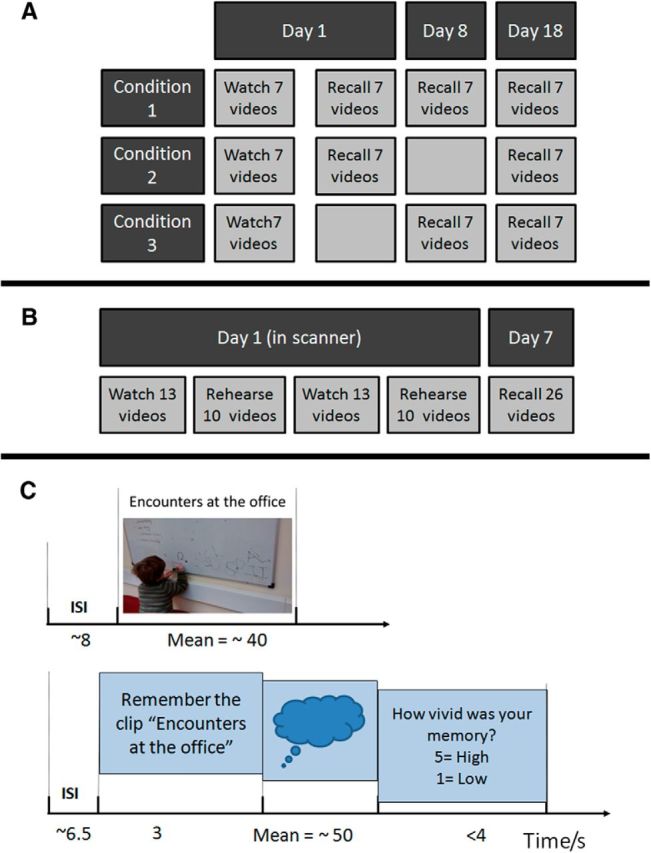
A, Study design for Experiment 1. All 21 videos were watched consecutively on day 1, and the videos from Conditions 1 and 2 were rehearsed/recalled (i.e., described aloud in response to the video title), with the experimenter present, after a break of 5 min. Videos from Conditions 2 and 3 were rehearsed/recalled on day 8. All 21 videos were recalled on day 18. B, Study design for Experiment 2. On day 1, 26 videos were watched, and 20 of these were silently rehearsed in an MRI scanner. The watching and rehearsal periods were divided into two runs. A week later, all 26 videos were recalled in the presence of an experimenter. C, Procedure for Experiment 2. Each video was shown with its title present. The videos were cued using their title in the rehearsal period, and this period was terminated by the participant and followed by a vividness rating. Used with permission from the group.
Figure 2.
Figure 2.
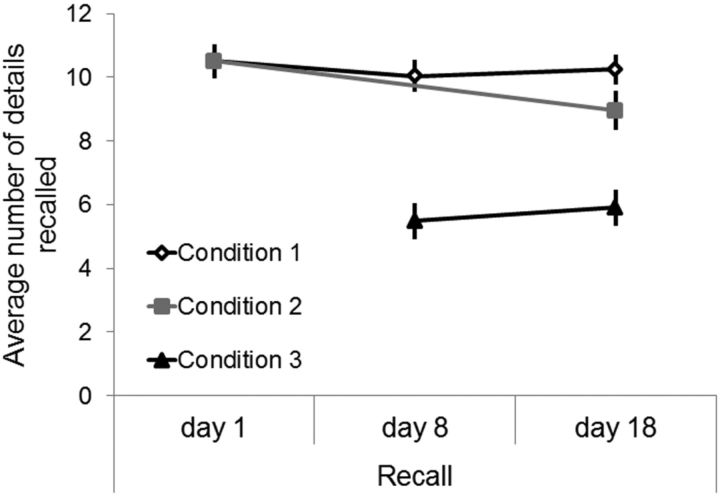
Behavioral results from Experiment 1. Videos that were recalled on days 1, 8, and 18 (Set 1) were recalled best, with only 4.5% of the details forgotten between day 1 and day 8 and a 2% improvement in recall on day 18. Videos that were recalled on day 1 and day 18 (Set 2) were also remembered reasonably well, with only 14.7% of the details forgotten by day 18. By contrast, videos that were not recalled on day 1 but were first recalled on day 8 (Set 3) showed substantial forgetting, with the number of details recalled being 47.8% lower than the level of recall on day 1 on Sets 1 and 2. Performance on Set 3 improved by 7.6% between day 8 and day 18. Error bars indicate SEM.
Figure 3.
Figure 3.
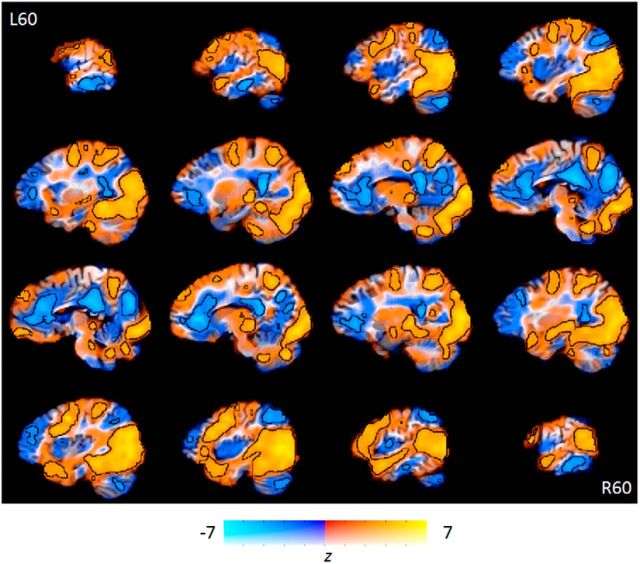
Brain regions involved in memory encoding compared with rest periods. Orange regions were more active when encoding videos. Blue regions were deactivated during encoding periods compared with rest. Increased opacity of the color corresponds to higher t values. Regions significant at p < 0.001 (uncorrected for multiple comparisons) are outlined in black.
Figure 4.
Figure 4.
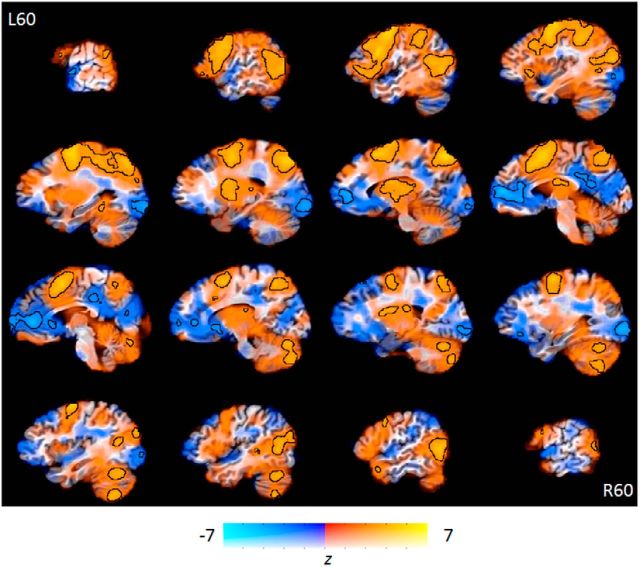
Brain regions involved in memory rehearsal compared with rest periods. Orange regions were more active when rehearsing the videos. Blue regions were deactivated during rehearsal periods compared with rest. Increased opacity of the color corresponds to higher t values. Regions significant at p < 0.001 (uncorrected for multiple comparisons) are outlined in black.
Figure 5.
Figure 5.
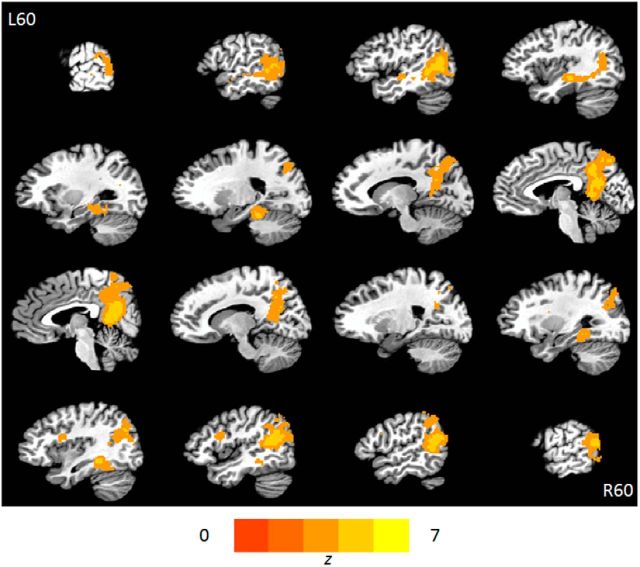
Brain regions involved in memory reinstatement. Heatmap shows regions where the pattern of BOLD signal when encoding the videos is correlated with BOLD signal when rehearsing the corresponding videos (compared with rehearsing noncorresponding videos). The map is thresholded at p < 0.001 (whole-brain family-wise error corrected for cluster size).
Figure 6.
Figure 6.
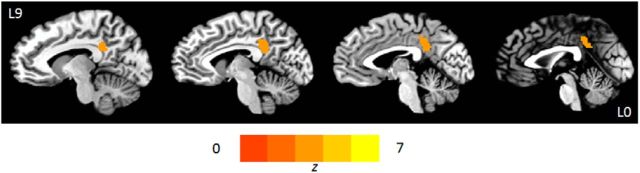
Region where the strength of reinstatement is associated with the amount recalled 1 week later. In the posterior cingulate cortex, the strength of correlation between the pattern of activity during encoding and rehearsal of matched video clips was associated with the number of details recalled on day 7. The map is thresholded at p < 0.001 (whole-brain family-wise error corrected for cluster size).

References

    1. Aggleton JP, Brown MW. Episodic memory, amnesia, and the hippocampal-anterior thalamic axis. Behav Brain Sci. 1999;22:425–444. discussion 444–489. - PubMed
    1. Anderson MC, Bjork EL, Bjork RA. Retrieval-induced forgetting: evidence for a recall-specific mechanism. Psychon Bull Rev. 2000;7:522–530. doi: 10.3758/BF03214366. - DOI - PubMed
    1. Andersson JL, Hutton C, Ashburner J, Turner R, Friston K. Modeling geometric deformations in EPI time series. Neuroimage. 2001;13:903–919. doi: 10.1006/nimg.2001.0746. - DOI - PubMed
    1. Axmacher N, Elger CE, Fell J. Ripples in the medial temporal lobe are relevant for human memory consolidation. Brain. 2008;131:1806–1817. doi: 10.1093/brain/awn103. - DOI - PubMed
    1. Bartlett FC. Remembering. London: Cambridge UP; 1932.

Publication types