Review
. 2015 Oct 23;16(10):25234-63.
doi: 10.3390/ijms161025234.

Diabetic Cardiovascular Disease Induced by Oxidative Stress

Affiliations
Review

Diabetic Cardiovascular Disease Induced by Oxidative Stress

Yosuke Kayama et al. Int J Mol Sci. .

Abstract

Cardiovascular disease (CVD) is the leading cause of morbidity and mortality among patients with diabetes mellitus (DM). DM can lead to multiple cardiovascular complications, including coronary artery disease (CAD), cardiac hypertrophy, and heart failure (HF). HF represents one of the most common causes of death in patients with DM and results from DM-induced CAD and diabetic cardiomyopathy. Oxidative stress is closely associated with the pathogenesis of DM and results from overproduction of reactive oxygen species (ROS). ROS overproduction is associated with hyperglycemia and metabolic disorders, such as impaired antioxidant function in conjunction with impaired antioxidant activity. Long-term exposure to oxidative stress in DM induces chronic inflammation and fibrosis in a range of tissues, leading to formation and progression of disease states in these tissues. Indeed, markers for oxidative stress are overexpressed in patients with DM, suggesting that increased ROS may be primarily responsible for the development of diabetic complications. Therefore, an understanding of the pathophysiological mechanisms mediated by oxidative stress is crucial to the prevention and treatment of diabetes-induced CVD. The current review focuses on the relationship between diabetes-induced CVD and oxidative stress, while highlighting the latest insights into this relationship from findings on diabetic heart and vascular disease.

Keywords: cardiovascular disease; diabetes mellitus; diabetic heart; diabetic vascular disease; oxidative stress.


Figures
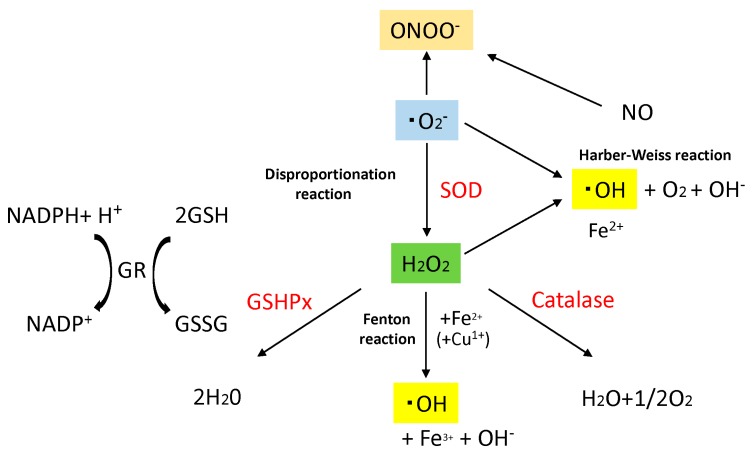
Figure 1
Figure 1
Major generative and eliminative reaction of reactive oxygen species (ROS). Sequential reduction of oxygen resulting in ROS generation, and major ROS generative reaction and eliminative reaction are shown. Superoxide dismutase (SOD) catalyzes the dismutation of superoxide (·O2) into H2O2 and O2. Catalase dismutates H2O2 into water and molecular oxygen. Glutathione peroxidase (GSHPx) eliminates H2O2 by using GR for another substrate, and generates water. Disproportionation reaction, Harber–Weiss reaction and Fenton reaction are shown. Superoxide anion (·O2), hydrogen peroxide (H2O2), hydroxyl radical (·OH), Peroxynitrite (ONOO), Superoxide dismutase (SOD), Glutathione peroxidase (GSHPx), Glutathione (GSH), Glutathione–S–S–Glutathione (GSSG), Glutathione Reductase (GR), Nicotinamide adenine dinucleotide phosphate (NADPH), Nitric Oxide (NO).
Figure 2
Figure 2
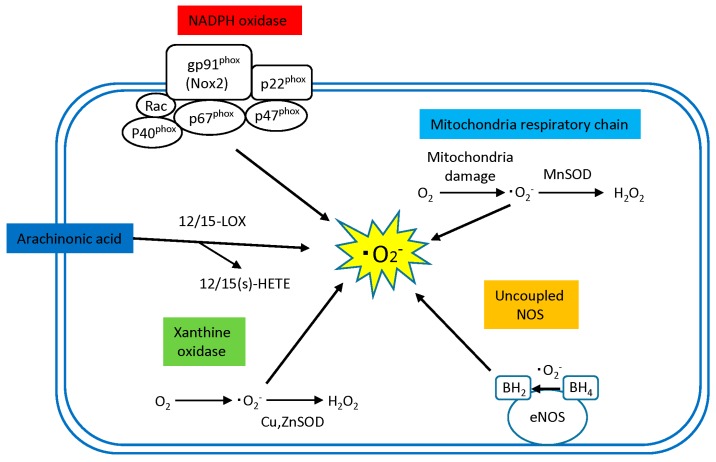
Sources of ROS in the diabetic heart. NADPH oxidase, mitochondria respiratory chain, Arachidonic acid (AA), xanthine oxidase and uncoupling of NOS are major source of ROS in the diabetic heat. Activated NADPH, dysfunctional mitochondrial respiratory chain, decreased availability of tetrahydrobiopterin (BH4) in uncoupled eNOS, activated 12/15-LOX pathway in AA and xanthine oxidase generate superoxide anion (·O2) in the heart. SOD isoforms, MnSOD, and CuZn SOD dismutate superoxide anion (·O2) to produce hydrogen peroxide (H2O2). Superoxide anion (·O2), hydrogen peroxide (H2O2), hydroxyl radical (·OH), endothelial nitric oxide synthase (eNOS), superoxide dismutase (SOD), dihydrobiopterin (BH2), tetrahydrobiopterin (BH4).
Figure 3
Figure 3
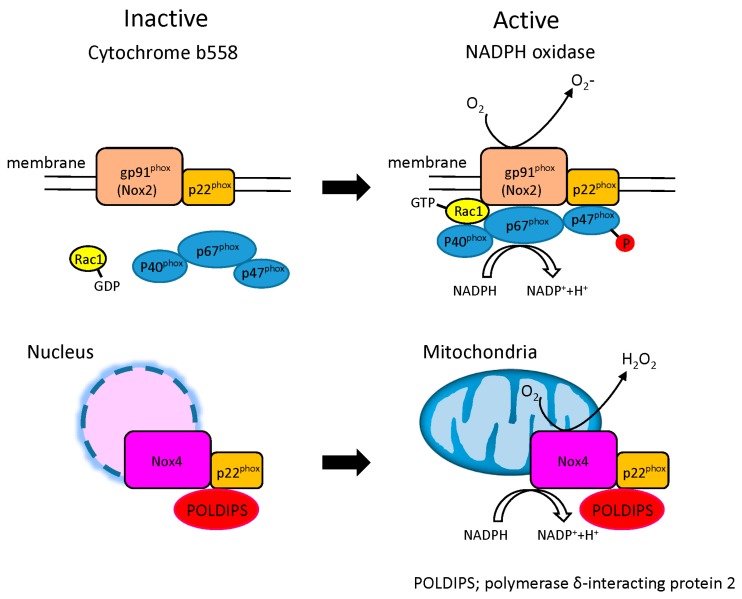
Structure of NADPH oxidase in the heart. NADPH oxidase complex is composed of two major components. Plasma membrane spanning cytochrome b558 composed of p22phox and a Nox subunit (gp91phox (Nox2), Nox4) and cytosolic components composed of four regulatory subunits (p47 phox, p67 phox, p40 phox and Rac1). The low molecular weight G protein rac1 participates in assembly of the active complex. Upon activation, cytosolic components interact with cytochrome b558 to form an active NADPH oxidase enzyme complex, resulting in release of ·O2. The primary Nox subunit isoforms in cardiac cells are Nox2 and Nox4. Nox4 oxidase localizes intracellular organelles around the nucleus. The activity of Nox4 results in the direct release of hydrogen peroxide (H2O2) in mitochondria. The mechanisms underlying the generation of hydrogen peroxide by Nox4 oxidase are yet to be fully characterized.
Figure 4
Figure 4
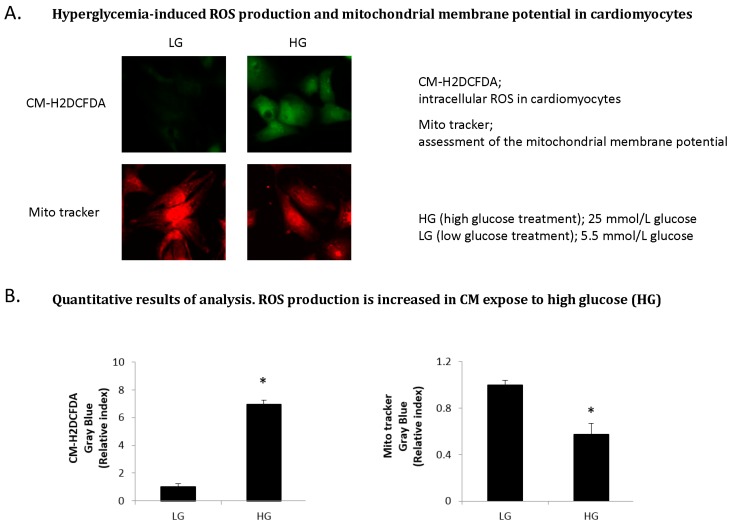
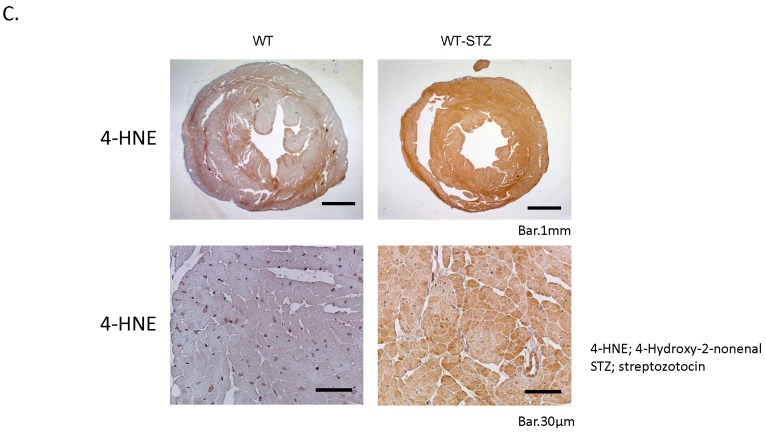
ROS production and oxidative stress in the diabetic heart in vitro and in vivo. (Copyright 2015 American Diabetes Association from [44]. Reprinted with permission from The American Diabetes Association). (A) Hyperglycemia-induced ROS production and mitochondrial membrane potential in cardiomyocytes. Intracellular ROS level is increased in cardiomyocytes (CM) expose to high glucose (HG) by using chloromethyl-2,7-dichlorodihydro-fluorescein diacetate (CM–H2DCFDA). There was loss of mitochondrial membrane potential (ΔΨm) in CM expose to high glucose as indicated by a decrease in the fluorescence intensity assessed using Mito Tracker red; (B) Quantitative results of analysis. ROS production is increased in CM expose to high glucose (HG). CM-H2DCFDA, intracellular ROS in cardiomyocytes. Mito tracker, assessment of the mitochondrial membrane potential. HG (high glucose treatment), 25 mmol/L glucose; LG (low glucose treatment), 5.5 mmol/L glucose. * p < 0.05 vs. LG. Error bars indicate s.e.m. n = 4–6; (C) Cardiac oxidative stress in the diabetic heart. Immunohistological staining (brown) of 4-hydroxy-2-nonenal (4-HNE) in the hearts of wild-type (WT), wild-STZ (WT-STZ) mice. Upper panel is 20×, lower panel is 400×; Scale bar, 1 mm and 30 μm, respectively. Cardiac 4-HNE, a major marker of oxidative stress, is up-regulated in myocardium in WT-STZ heart compared to WT heart.
Figure 4
Figure 4
ROS production and oxidative stress in the diabetic heart in vitro and in vivo. (Copyright 2015 American Diabetes Association from [44]. Reprinted with permission from The American Diabetes Association). (A) Hyperglycemia-induced ROS production and mitochondrial membrane potential in cardiomyocytes. Intracellular ROS level is increased in cardiomyocytes (CM) expose to high glucose (HG) by using chloromethyl-2,7-dichlorodihydro-fluorescein diacetate (CM–H2DCFDA). There was loss of mitochondrial membrane potential (ΔΨm) in CM expose to high glucose as indicated by a decrease in the fluorescence intensity assessed using Mito Tracker red; (B) Quantitative results of analysis. ROS production is increased in CM expose to high glucose (HG). CM-H2DCFDA, intracellular ROS in cardiomyocytes. Mito tracker, assessment of the mitochondrial membrane potential. HG (high glucose treatment), 25 mmol/L glucose; LG (low glucose treatment), 5.5 mmol/L glucose. * p < 0.05 vs. LG. Error bars indicate s.e.m. n = 4–6; (C) Cardiac oxidative stress in the diabetic heart. Immunohistological staining (brown) of 4-hydroxy-2-nonenal (4-HNE) in the hearts of wild-type (WT), wild-STZ (WT-STZ) mice. Upper panel is 20×, lower panel is 400×; Scale bar, 1 mm and 30 μm, respectively. Cardiac 4-HNE, a major marker of oxidative stress, is up-regulated in myocardium in WT-STZ heart compared to WT heart.
Figure 5
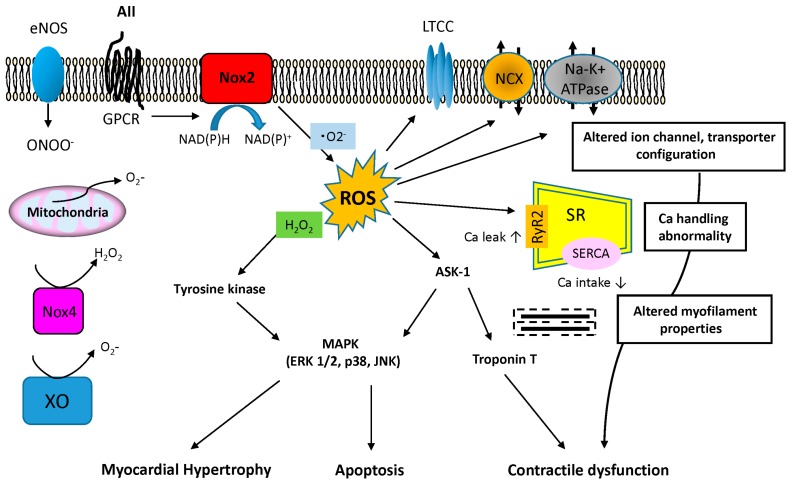
Figure 5
AII-associated ROS pathway and alternation of the structure and function in cardiomyocyte. AII involves activation of ·O2 production by NADPH oxidase NOX2. AII induces cardiac hypertrophy and apoptosis via G-protein-linked pathway that involves ROS-related activation of several downstream signals, including MAPKs (ERK 1/2, p38, JNK). ASK1 is also activated by ROS and in turn activates p38, JNK and induces cardiac hypertrophy and apoptosis. ASK1 may promote troponin T phosphorylation and implicate in contractile dysfunction. AII-associated ROS pathway may influence the alternation of structure and function of excitation-contraction coupling and ionic homeostasis, including LTCC, NCX, Na–K+ ATPase and Ca handling. The potential effects of dysregulated ion channel, transporter and calcium in SR are shown. G-protein receptor (GPCR), l type Ca2+ channels (LTCC), Sodium/calcium exchanger (NCX), Sarcoplasmic reticulum (SR), Sarcoplasmic reticulum calcium calcium ATPase (SERCA), Ryanodine receptor (RyR2), Xanthine oxidase (XO).

References

    1. King H., Aubert R.E., Herman W.H. Global burden of diabetes, 1995–2025: Prevalence, numerical estimates, and projections. Diabetes Care. 1998;21:1414–1431. doi: 10.2337/diacare.21.9.1414. - DOI - PubMed
    1. Haffner S.M., Lehto S., Ronnemaa T., Pyorala K., Laakso M. Mortality from coronary heart disease in subjects with type 2 diabetes and in nondiabetic subjects with and without prior myocardial infarction. N. Engl. J. Med. 1998;339:229–234. doi: 10.1056/NEJM199807233390404. - DOI - PubMed
    1. Brownlee M. Biochemistry and molecular cell biology of diabetic complications. Nature. 2001;414:813–820. doi: 10.1038/414813a. - DOI - PubMed
    1. Kannel W.B., Hjortland M., Castelli W.P. Role of diabetes in congestive heart failure: The Framingham study. Am. J. Cardiol. 1974;34:29–34. doi: 10.1016/0002-9149(74)90089-7. - DOI - PubMed
    1. Kannel W.B., McGee D.L. Diabetes and cardiovascular disease. The Framingham study. JAMA. 1979;241:2035–2038. doi: 10.1001/jama.1979.03290450033020. - DOI - PubMed

Publication types