


Comparison of NK-1 Receptor Antagonist (Maropitant) to Morphine as a Pre-Anaesthetic Agent for Canine Ovariohysterectomy
- PMID: 26513745
- PMCID: PMC4626099
- DOI: 10.1371/journal.pone.0140734
Comparison of NK-1 Receptor Antagonist (Maropitant) to Morphine as a Pre-Anaesthetic Agent for Canine Ovariohysterectomy
Abstract
Objective: To compare the NK-1 receptor antagonist maropitant to morphine during and after surgery in dogs undergoing ovariohysterectomy (OHE).
Methods: 30 healthy female dogs were randomly divided to receive either a pre-anaesthetic dose of morphine (0.5 mg/kg SQ) or maropitant (1 mg/kg, SQ) prior to OHE. Anaesthesia was induced with propofol and maintained with isoflurane. Expired isoflurane concentration, heart rate (HR), systolic arterial pressure (SAP) and respiratory rate were measured. Post-operative pain scores and appetite were evaluated during the recovery period. Rescue analgesia (morphine 0.1 mg/kg IV) was administered as needed post-operatively based on blinded pain score assessments.
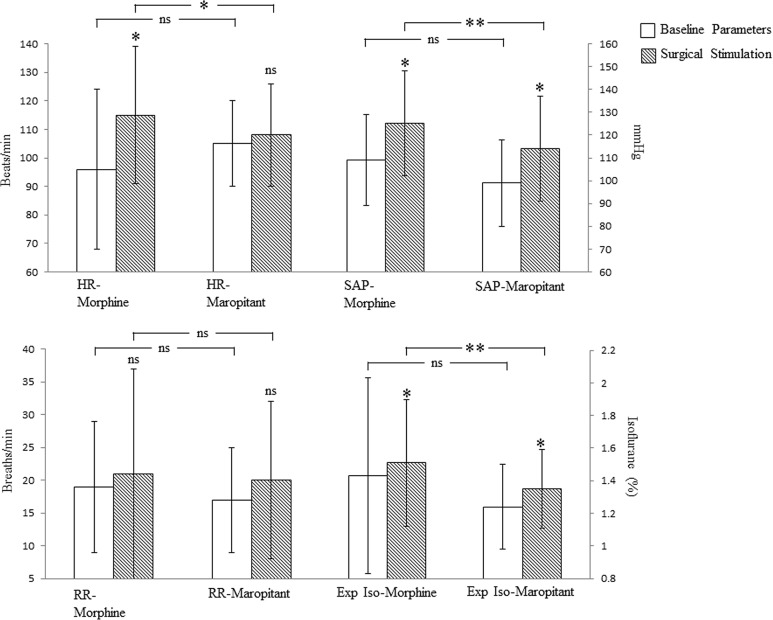
Results: Although clinically comparable; during surgical stimulation, the maropitant group had lower HR (108±18 vs 115±24 bpm; p = 0.04), lower SAP (114±23 vs 125±23 mmHg; p = 0.003) and required slightly lower percent of isoflurane anaesthetic (1.35±0.2 vs 1.51±0.4%; p = 0.005), when compared to the morphine group. In the recovery period, the maropitant group had lower pain scores at extubation (1.7±0.7 vs 3.4±2.3; p = 0.0001) and were more likely to eat within 3 hours after extubation (64.7 vs 15.3%). However, post-operative rescue analgesia requirements were similar between groups. All other measured parameters were similar between groups. The overall difference observed between groups was small and all monitored and measured parameters were within the expected range for anesthetized dogs.
Clinical significance: No major differences in cardiorespiratory parameters or anaesthetic requirements were observed between maropitant and morphine when used as a pre-anesthetic agent for OHE. Further studies are necessary to fully elucidate the benefits of maropitant as a pre-anaesthetic agent for canine OHE.
Conflict of interest statement
Figures
References
-
- Sakurada T, Katsumata K, Yogo H, Tan-No K, Sakurada S, Ohba M, et al. The neurokinin-1 receptor antagonist, sendide, exhibits antinociceptive activity in the formalin test. Pain. 1995; 60: 175–80. - PubMed
-
- Laird JM, Olivar T, Roza C, De Felipe C, Hunt SP, Cervero F. Deficits in visceral pain and hyperalgesia of mice with a disruption of the tachykinin NK1 receptor gene. Neuroscience. 2000; 98: 345–52. - PubMed
-
- Ruggieri MR, Filer-Maerten S, Hieble JP, Hay DW. Role of neurokinin receptors in the behavioral effect of intravesical antigen infusion in guinea pig bladder. J Urol. 2000; 164: 197–202. - PubMed
-
- Laird J. Gut feelings about tachykinin NK1 receptor antagonists. Trends Pharmacol Sci. 2001; 22: 169 - PubMed
-
- Okano S, Ikeura Y, Inatomi N. Effects of tachykinin NK1 receptor antagonists on the viscerosensory response caused by colorectal distention in rabbits. J.Pharmacol Exp Ther. 2002; 300: 925–931. - PubMed
Publication types
MeSH terms
Substances
LinkOut - more resources
Full Text Sources
Other Literature Sources
Medical
Miscellaneous
