The Roles of Maternal Depression, Serotonin Reuptake Inhibitor Treatment, and Concomitant Benzodiazepine Use on Infant Neurobehavioral Functioning Over the First Postnatal Month
- PMID: 26514656
- PMCID: PMC4742381
- DOI: 10.1176/appi.ajp.2015.14080989
The Roles of Maternal Depression, Serotonin Reuptake Inhibitor Treatment, and Concomitant Benzodiazepine Use on Infant Neurobehavioral Functioning Over the First Postnatal Month
Abstract
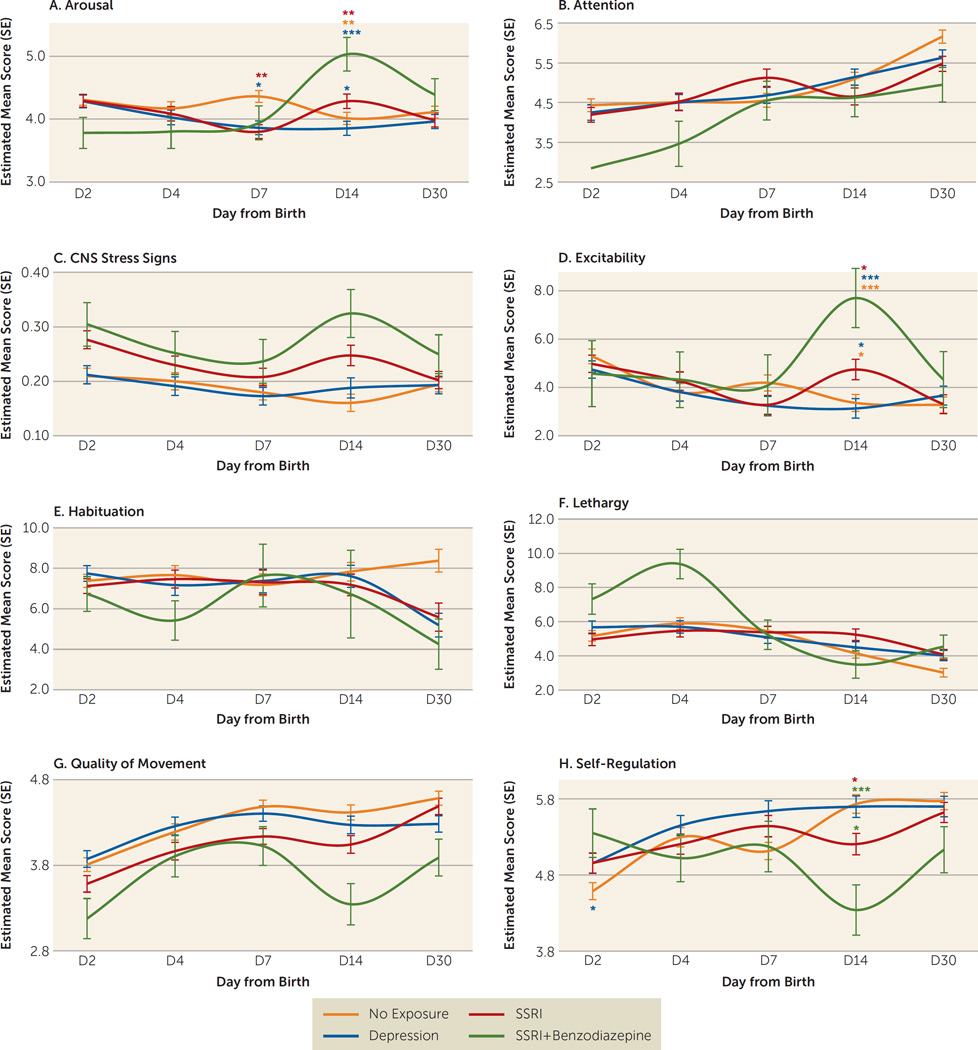
Objective: The purpose of this article was to systematically compare the developmental trajectory of neurobehavior over the first postnatal month for infants with prenatal exposure to pharmacologically untreated maternal depression, selective serotonin reuptake inhibitors or serotonin and norepinephrine reuptake inhibitors (collectively: SSRIs), SSRIs with concomitant benzodiazepines (SSRI plus benzodiazepine), and no maternal depression or drug treatment (no exposure).
Method: Women (N=184) were assessed at two prenatal time points to determine psychiatric diagnoses, symptom severity, and prenatal medication usage. Infants were examined with a structured neurobehavioral assessment (Neonatal Intensive Care Unit Network Neurobehavioral Scale) at multiple time points across the first postnatal month. SSRI exposure was confirmed in a subset of participants with plasma SSRI levels. General linear-mixed models were used to examine group differences in neurobehavioral scores over time with adjustment for demographic variables and depression severity.
Results: Infants in the SSRI and SSRI plus benzodiazepine groups had lower motor scores and more CNS stress signs across the first postnatal month, as well as lower self-regulation and higher arousal at day 14. Infants in the depression group had low arousal throughout the newborn period. Infants in all three clinical groups had a widening gap in scores from the no-exposure group at day 30 in their response to visual and auditory stimuli while asleep and awake. Infants in the SSRI plus benzodiazepine group had the least favorable scores on the Neonatal Intensive Care Unit Network Neurobehavioral Scale.
Conclusions: Neonatal adaptation syndrome was not limited to the first 2 weeks postbirth. The profile of neurobehavioral development was different for SSRI exposure than depression alone. Concomitant benzodiazepine use may exacerbate adverse behavioral effects.
Figures
Comment in
-
Mothers, Babies, Depression, and Medications: Understanding the Complex Interplay of Illness and Treatment on Neonatal Symptoms.Am J Psychiatry. 2016 Feb 1;173(2):101-2. doi: 10.1176/appi.ajp.2015.15111416. Am J Psychiatry. 2016. PMID: 26844789 No abstract available.
References
-
- Gavin NI, Gaynes BN, Lohr KN, et al. Perinatal depression: a systematic review of prevalence and incidence. Obstet Gynecol. 2005;106:1071–1083. - PubMed
Publication types
MeSH terms
Substances
Grants and funding
- R01 DA031188/DA/NIDA NIH HHS/United States
- R03DA035896/DA/NIDA NIH HHS/United States
- R01 MH079153/MH/NIMH NIH HHS/United States
- R03 DA035896/DA/NIDA NIH HHS/United States
- R03 MH096036/MH/NIMH NIH HHS/United States
- R01DA031188/DA/NIDA NIH HHS/United States
- R01 MH078033/MH/NIMH NIH HHS/United States
- R01MH078033/MH/NIMH NIH HHS/United States
- R34 MH079108/MH/NIMH NIH HHS/United States
- R34MH079108/MH/NIMH NIH HHS/United States
- R01MH79153/MH/NIMH NIH HHS/United States
- R01HD076223/HD/NICHD NIH HHS/United States
- R03MH096036/MH/NIMH NIH HHS/United States
LinkOut - more resources
Full Text Sources
Other Literature Sources
Medical
Miscellaneous