


Resistant and Refractory Hypertension: Antihypertensive Treatment Resistance vs Treatment Failure
- PMID: 26514749
- PMCID: PMC5636623
- DOI: 10.1016/j.cjca.2015.06.033
Resistant and Refractory Hypertension: Antihypertensive Treatment Resistance vs Treatment Failure
Abstract
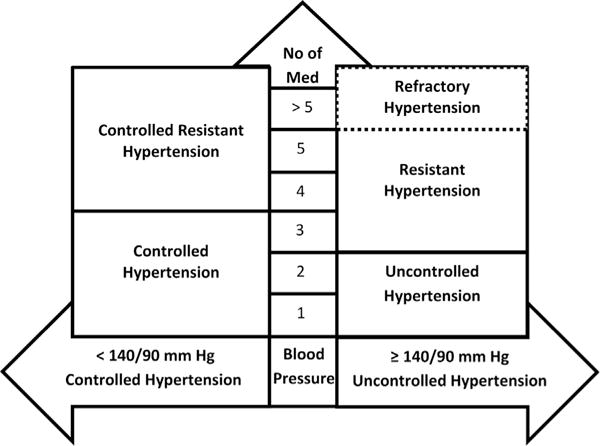
Resistant or difficult to treat hypertension is defined as high blood pressure that remains uncontrolled with 3 or more different antihypertensive medications, including a diuretic. Recent definitions also include controlled blood pressure with use of 4 or more medications as also being resistant to treatment. Recently, refractory hypertension, an extreme phenotype of antihypertensive treatment failure has been defined as hypertension uncontrolled with use of 5 or more antihypertensive agents, including a long-acting thiazide diuretic and a mineralocorticoid receptor antagonist. Patients with resistant vs refractory hypertension share similar characteristics and comorbidities, including obesity, African American race, female sex, diabetes, coronary heart disease, chronic kidney disease, and obstructive sleep apnea. Patients with refractory vs resistant hypertension tend to be younger and are more likely to have been diagnosed with congestive heart failure. Refractory hypertension might also differ from resistant hypertension in terms of underlying cause. Preliminary evidence suggests that refractory hypertension is more likely to be neurogenic in etiology (ie, heightened sympathetic tone), vs a volume-dependent hypertension that is more characteristic of resistant hypertension in general.
Copyright © 2016 Canadian Cardiovascular Society. Published by Elsevier Inc. All rights reserved.
Conflict of interest statement
The authors have no conflicts of interest to disclose.
Figures
References
-
- Setaro JF, Black HR. Refractory hypertension. N Engl J Med. 1992;327:543–7. - PubMed
-
- Redon J, Campos C, Narciso ML, et al. Prognostic value of ambulatory blood pressure monitoring in refractory hypertension: a prospective study. Hypertension. 1998;31:712–8. - PubMed
-
- Calhoun DA, Jones D, Textor S, et al. Resistant hypertension: diagnosis, evaluation, and treatment. A scientific statement from the American Heart Association Professional Education Committee of the Council for High Blood Pressure Research. Hypertension. 2008;51:1403–19. - PubMed
Publication types
MeSH terms
Substances
Grants and funding
LinkOut - more resources
Full Text Sources
Other Literature Sources
Medical
