Analysis of Clinical and Dosimetric Factors Influencing Radiation-Induced Lung Injury in Patients with Lung Cancer
- PMID: 26516366
- PMCID: PMC4615354
- DOI: 10.7150/jca.12314
Analysis of Clinical and Dosimetric Factors Influencing Radiation-Induced Lung Injury in Patients with Lung Cancer
Abstract
Purpose: Dose escalation of thoracic radiation can improve the local tumor control and surivival, and is in the meantime limited by the occurrence of radiation-induced lung injury (RILI). This study investigated the clinical and dosimetric factors influencing RILI in lung-cancer patients receiving chemoradiotherapy for better radiation planning.
Methods and materials: A retrospective analysis was carried out on 161 patients with non-small-cell or small-cell lung cancer (NSCLC and SCLC, respectively), who underwent chemoradiotherapy between April 2010 and May 2011 with a median follow-up time of 545 days (range: 39-1453). Chemotherapy regimens were based on the histological type (squamous cell carcinoma, adenocarcinoma, or SCLC), and radiotherapy was delivered in 1.8-3.0 Gy (median, 2.0 Gy) fractions, once daily, to a total of 39-66 Gy (median, 60 Gy). Univariate analysis was performed to analyze clinical and dosimetric factors associated with RILI. Multivariate analysis using logistic regression identified independent risk factors correlated to RILI.
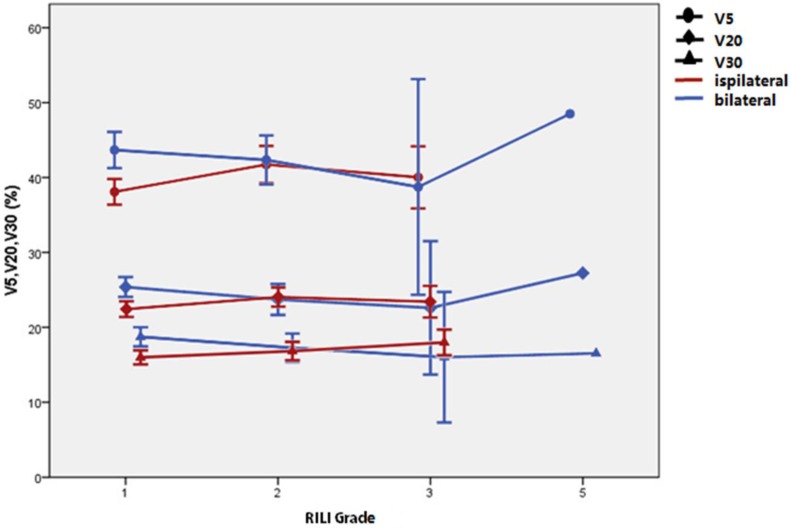
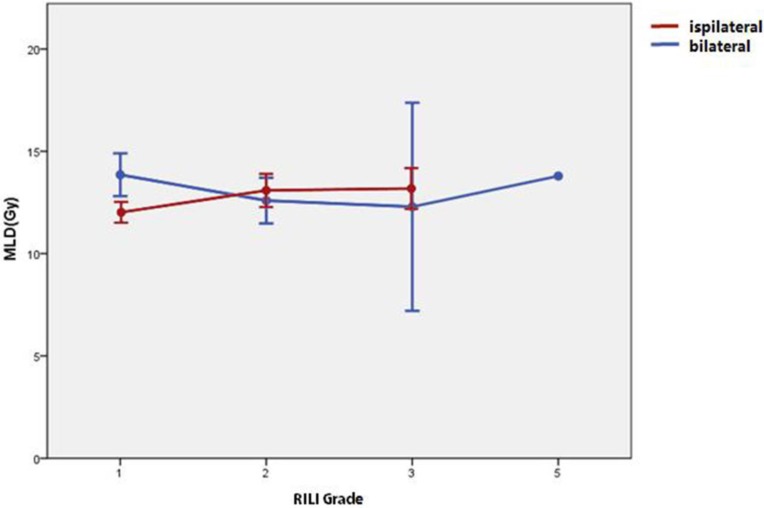
Results: The incidence of symptomatic RILI (≥grade 2) was 31.7%. Univariate analysis showed that V5, V20, and mean lung dose (MLD) were significantly associated with RILI incidence (P=0.029, 0.048, and 0.041, respectively). The association was not statistically significant for histological type (NSCLC vs. SCLC, P = 0.092) or radiation technology (IMRT vs. 3D-CRT, P = 0.095). Multivariate analysis identified MLD as an independent risk factor for symptomatic RILI (OR=1.249, 95%CI=1.055-1.48, P= 0.01). The incidence of bilateral RILI in cases where the tumor was located unilaterally was 22.7% (32/141) and all dosimetric-parameter values were not significantly different (P>0.05) for bilateral versus ipsilateral injury, except grade-1 (low) RILI (P < 0.05). The RILI grade was higher in cases of ipsilateral lung injury than in bilateral cases (Mann-Whitney U test, z=8.216, P< 0.001).
Conclusion: The dosimetric parameter, MLD, was found to be an independent predictive factor for RILI. Additional contralateral injury does not seem to be correlated with increased RILI grade under the condition of conventional radiotherapy treatment planning.
Keywords: Dose-volume-histogram; lung cancer; radiation-induced lung injury.
Conflict of interest statement
Competing Interests: The authors have declared that no competing interest exists.
Figures
References
-
- Kong FM, Ten Haken RK, Schipper MJ. et al. High-dose radiation improved local tumor control and overall survival in patients with inoperable/unresectable non-small-cell lung cancer: long-term results of a radiation dose escalation study. International journal of radiation oncology, biology, physics. 2005;63:324–333. - PubMed
-
- Warde P, Payne D. Does thoracic irradiation improve survival and local control in limited-stage small-cell carcinoma of the lung? A meta-analysis. Journal of clinical oncology: official journal of the American Society of Clinical Oncology. 1992;10:890–895. - PubMed
-
- Pignon JP, Arriagada R, Ihde DC. et al. A meta-analysis of thoracic radiotherapy for small-cell lung cancer. The New England journal of medicine. 1992;327:1618–1624. - PubMed
LinkOut - more resources
Full Text Sources
Other Literature Sources
Research Materials
Miscellaneous