


Therapies targeting cancer stem cells: Current trends and future challenges
- PMID: 26516409
- PMCID: PMC4620424
- DOI: 10.4252/wjsc.v7.i9.1185
Therapies targeting cancer stem cells: Current trends and future challenges
Abstract
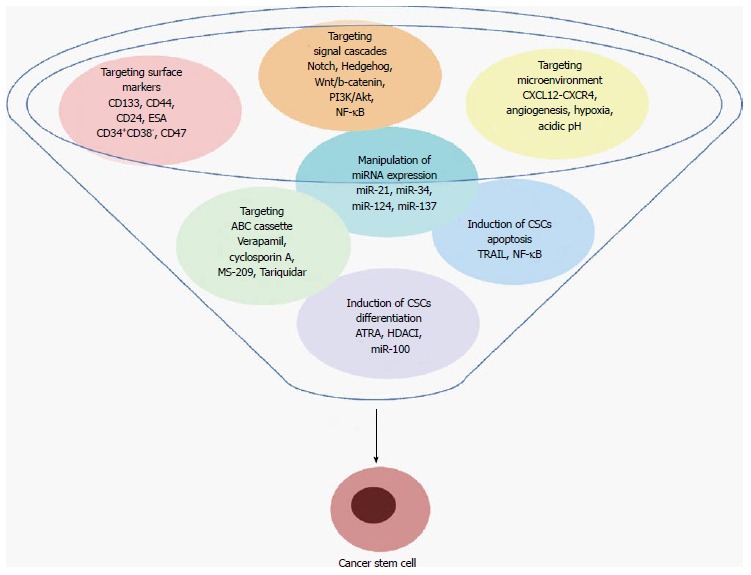
Traditional therapies against cancer, chemo- and radiotherapy, have multiple limitations that lead to treatment failure and cancer recurrence. These limitations are related to systemic and local toxicity, while treatment failure and cancer relapse are due to drug resistance and self-renewal, properties of a small population of tumor cells called cancer stem cells (CSCs). These cells are involved in cancer initiation, maintenance, metastasis and recurrence. Therefore, in order to develop efficient treatments that can induce a long-lasting clinical response preventing tumor relapse it is important to develop drugs that can specifically target and eliminate CSCs. Recent identification of surface markers and understanding of molecular feature associated with CSC phenotype helped with the design of effective treatments. In this review we discuss targeting surface biomarkers, signaling pathways that regulate CSCs self-renewal and differentiation, drug-efflux pumps involved in apoptosis resistance, microenvironmental signals that sustain CSCs growth, manipulation of miRNA expression, and induction of CSCs apoptosis and differentiation, with specific aim to hamper CSCs regeneration and cancer relapse. Some of these agents are under evaluation in preclinical and clinical studies, most of them for using in combination with traditional therapies. The combined therapy using conventional anticancer drugs with CSCs-targeting agents, may offer a promising strategy for management and eradication of different types of cancers.
Keywords: Anticancer drugs; Apoptosis; Biomarkers; Cancer stem cells; Signaling pathways; Targeted therapy.
Figures
References
-
- Holohan C, Van Schaeybroeck S, Longley DB, Johnston PG. Cancer drug resistance: an evolving paradigm. Nat Rev Cancer. 2013;13:714–726. - PubMed
-
- Kelly PN, Dakic A, Adams JM, Nutt SL, Strasser A. Tumor growth need not be driven by rare cancer stem cells. Science. 2007;317:337. - PubMed
-
- Reya T, Morrison SJ, Clarke MF, Weissman IL. Stem cells, cancer, and cancer stem cells. Nature. 2001;414:105–111. - PubMed
Publication types
LinkOut - more resources
Full Text Sources
Other Literature Sources
