. 2015 Oct 30;11(10):e1004587.
doi: 10.1371/journal.pcbi.1004587. eCollection 2015 Oct.

Emergence of Shared Intentionality Is Coupled to the Advance of Cumulative Culture

Affiliations

Emergence of Shared Intentionality Is Coupled to the Advance of Cumulative Culture

Simon D Angus et al. PLoS Comput Biol. .

Abstract

There is evidence that the sharing of intentions was an important factor in the evolution of humans' unique cognitive abilities. Here, for the first time, we formally model the coevolution of jointly intentional behavior and cumulative culture, showing that rapid techno-cultural advance goes hand in hand with the emergence of the ability to participate in jointly intentional behavior. Conversely, in the absence of opportunities for significant techno-cultural improvement, the ability to undertake jointly intentional behavior is selected against. Thus, we provide a unified mechanism for the suppression or emergence of shared intentions and collaborative behavior in humans, as well as a potential cause of inter-species diversity in the prevalence of such behavior.


Conflict of interest statement

The authors have declared that no competing interests exist.

Figures
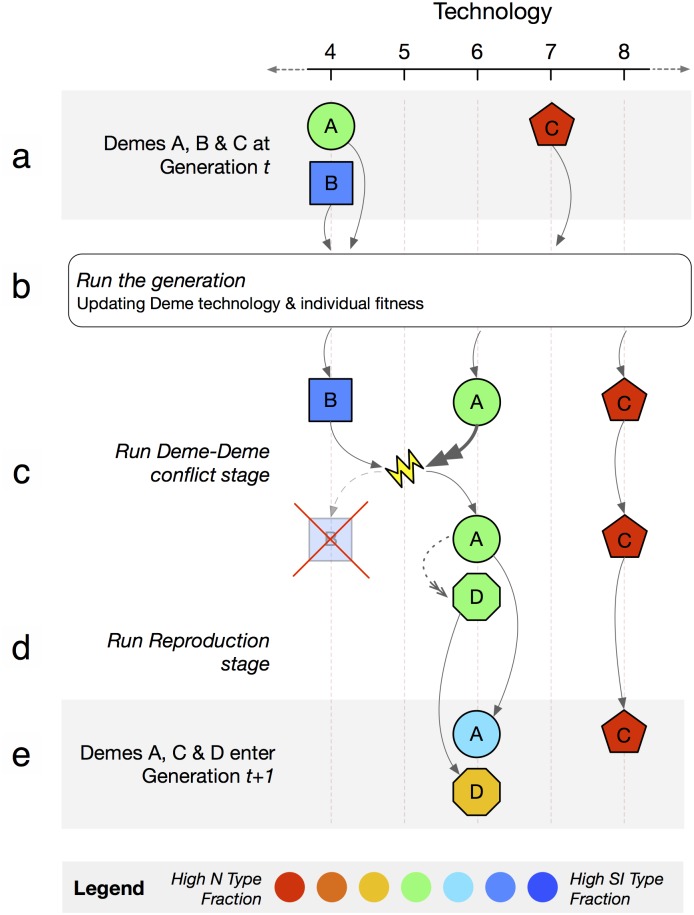
Fig 1
Fig 1. Model timing.
a: Demes begin a generation with given technology and number of SI types. b: Interaction during a generation gives individual fitnesses and causes advances in deme technology (here, demes A and C increase their tech level). c: Some demes (here, deme B) face invasion by other demes (deme A). If the invading deme has higher technology, the invaded deme is eliminated and replaced by a replica of the invading deme (here, deme B is eliminated and replaced by deme D, a replica of deme A). d: Demes reproduce and populate the next generation via a finite population replicator dynamic (here, we see within-deme selection and genetic drift in demes A and D changing the number of SI types). e: Technology levels and number of SI types are carried forward into the next generation.
Fig 2
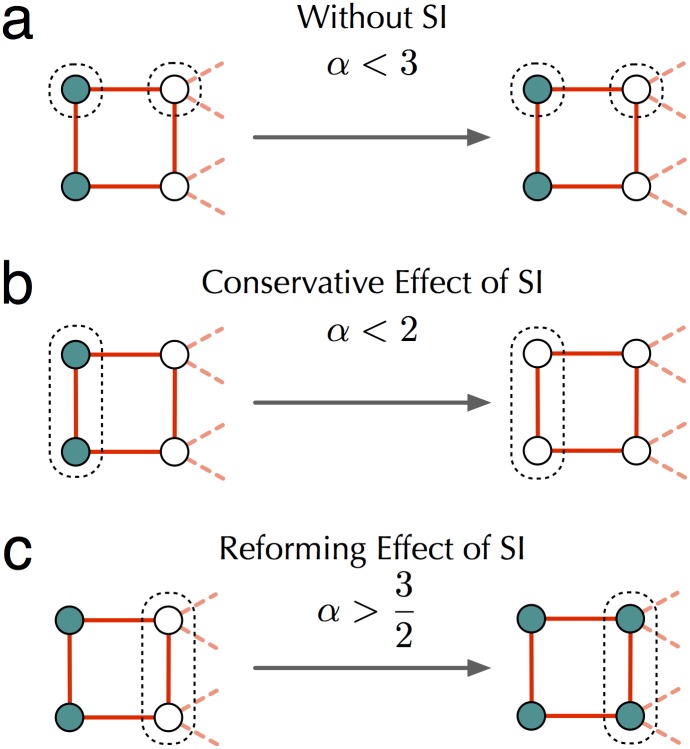
Fig 2. The effect of shared intentionality on technology dynamics.
Blue-colored vertices represent individuals playing ‘new’, white vertices represent individuals playing ‘old’. Individuals not shown are assumed to be playing ‘old’. a: In the absence of SI, the only better response for any individual is to retain his current strategy. b: For low α, coalitions of SI type individuals can coordinate payoff improving switches back to ‘old’. c: For high α, coalitions of SI type individuals can coordinate payoff improving switches to ‘new’ [14]. Note that threshold values of α depend on graph structure and that different interaction structures can yield different thresholds [14, 46]. For an example with explicitly calculated thresholds, see Section S2.2.
Fig 3
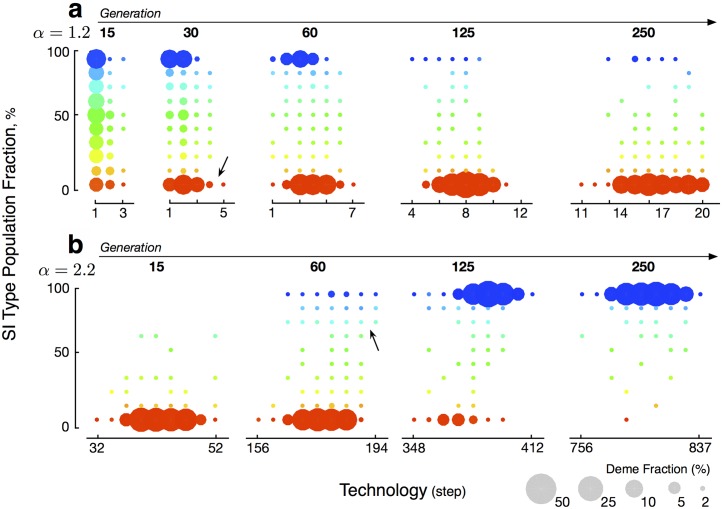
Fig 3. Demes with given fraction of SI type individuals and technology level per generation under benchmark conditions.
a: α = 1.2, starting from a state in which each individual is SI or N type with equal probability, b: α = 2.2, starting from a state in which no individuals are SI type. Arrows indicate where demes rich in N and SI types respectively gain a technological advantage.
Fig 4
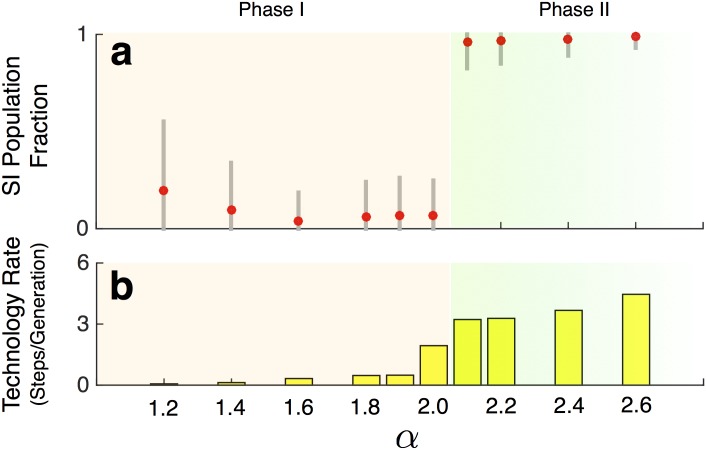
Fig 4. The dramatic switch to a high SI, high technological change, phase for sufficiently high α.
Starting with each individual equiprobably SI or N type under benchmark conditions, a: Mean and standard deviation of fraction of SI type individuals across all 64 demes and 10 replicates during generations 451 to 500, b: Average rates of technological change (steps per generation) across all 64 demes and 10 replicates over generations 451 to 500.

References

    1. Call J. Contrasting the social cognition of humans and nonhuman apes: The shared intentionality hypothesis. Topics in Cognitive Science. 2009;1(2):368–379. - PubMed
    1. Vygotsky LS. Mind in society: The development of higher psychological processes. Harvard University Press; 1980.
    1. Tomasello M. A natural history of human thinking. Harvard University Press; 2014.
    1. Moll H, Tomasello M. Cooperation and human cognition: the Vygotskian intelligence hypothesis. Philosophical Transactions of the Royal Society B: Biological Sciences. 2007;362(1480):639–648. 10.1098/rstb.2006.2000 - DOI - PMC - PubMed
    1. Tomasello M, Herrmann E. Ape and Human Cognition What’s the Difference? Current Directions in Psychological Science. 2010;19(1):3–8. 10.1177/0963721409359300 - DOI

LinkOut - more resources