


Evaluation of Membrane Ultrafiltration and Residual Chlorination as a Decentralized Water Treatment Strategy for Ten Rural Healthcare Facilities in Rwanda
- PMID: 26516883
- PMCID: PMC4627051
- DOI: 10.3390/ijerph121013602
Evaluation of Membrane Ultrafiltration and Residual Chlorination as a Decentralized Water Treatment Strategy for Ten Rural Healthcare Facilities in Rwanda
Abstract
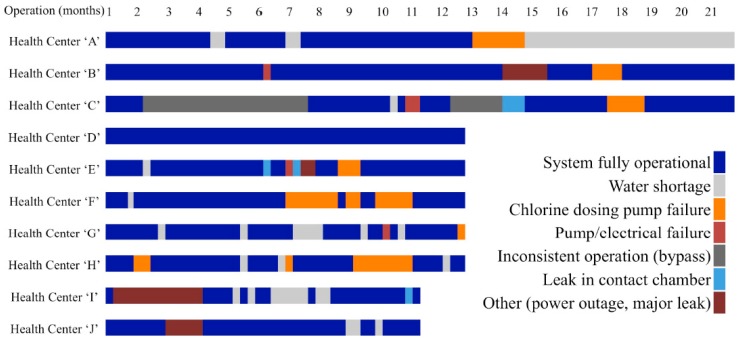
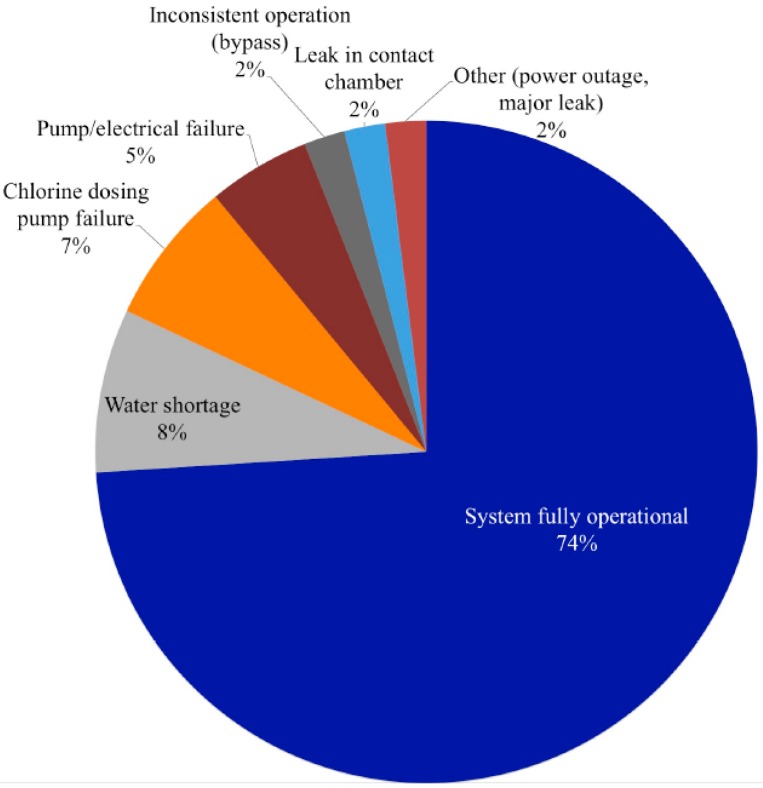
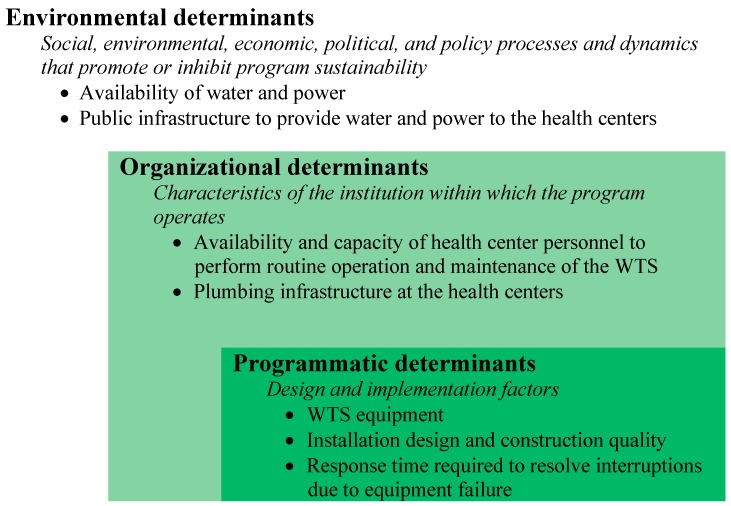
There is a critical need for safe water in healthcare facilities (HCF) in low-income countries. HCF rely on water supplies that may require additional on-site treatment, and need sustainable technologies that can deliver sufficient quantities of water. Water treatment systems (WTS) that utilize ultrafiltration membranes for water treatment can be a useful technology in low-income countries, but studies have not systematically examined the feasibility of this technology in low-income settings. We monitored 22 months of operation of 10 WTS, including pre-filtration, membrane ultrafiltration, and chlorine residual disinfection that were donated to and operated by rural HCF in Rwanda. The systems were fully operational for 74% of the observation period. The most frequent reasons for interruption were water shortage (8%) and failure of the chlorination mechanism (7%). When systems were operational, 98% of water samples collected from the HCF taps met World Health Organization (WHO) guidelines for microbiological water quality. Water quality deteriorated during treatment interruptions and when water was stored in containers. Sustained performance of the systems depended primarily on organizational factors: the ability of the HCF technician to perform routine servicing and repairs, and environmental factors: water and power availability and procurement of materials, including chlorine and replacement parts in Rwanda.
Keywords: chlorination; implementation; low-income countries; maintenance; membrane water treatment; operation; quality; sustainability; ultrafiltration.
Figures
References
-
- Adams J., Bartram J., Chartier Y. Essential Environmental Health Standards in Health Care. World Health Organization; Geneva, Switzerland: 2008. [ (accessed on 10 October 2015)]. Available online: http://www.who.int/water_sanitation_health/hygiene/settings/ehs_health_c....
-
- Shordt K., Smet E. Getting It Right: Improving Maternal Health Through Water, Sanitation & Hygiene; SIMAVI: 2012. [(accessed on 10 October 2015)]. Available online: http://simavi.org/wp-content/uploads/2015/03/Simavi-Publicatie-Getting-I....
-
- Velleman Y., Mason E., Graham W., Benova L., Chopra M., Campbell O.M.R., Gordon B., Wijesekera S., Hounton S., Mills J.E., et al. From joint thinking to joint action: A call to action on improving water, sanitation, and hygiene for maternal and newborn health. PLoS Med. 2014;11 doi: 10.1371/journal.pmed.1001771. - DOI - PMC - PubMed
Publication types
MeSH terms
LinkOut - more resources
Full Text Sources
Other Literature Sources
Medical
Miscellaneous
