


Azathioprine or 6-mercaptopurine for maintenance of remission in Crohn's disease
- PMID: 26517527
- PMCID: PMC9578512
- DOI: 10.1002/14651858.CD000067.pub3
Azathioprine or 6-mercaptopurine for maintenance of remission in Crohn's disease
Abstract
Background: The therapeutic role of 6-mercaptopurine (6-MP) and azathioprine (AZA) remains controversial due to their perceived relatively slow-acting effect and adverse effects. An updated meta-analysis was performed to evaluate the efficacy of these agents for the maintenance of remission in quiescent Crohn's disease.
Objectives: To assess the efficacy of AZA and 6-MP for maintenance of remission in quiescent Crohn's disease.
Search methods: We searched MEDLINE, EMBASE, and the Cochrane Library from inception to June 30, 2015.
Selection criteria: Randomized controlled trials of oral azathioprine or 6-mercaptopurine compared to placebo or active therapy involving adult patients (> 18 years) with quiescent Crohn's disease were considered for inclusion. Patients with surgically-induced remission were excluded.
Data collection and analysis: At least two authors independently extracted data and assessed study quality using the Cochrane risk of bias tool. For dichotomous outcomes, we calculated the risk ratio (RR) and corresponding 95% confidence interval (CI). The primary outcomes was maintenance of remission. Secondary outcomes included steroid sparing, adverse events, withdrawals due to adverse events and serious adverse events. All data were analyzed on an intention-to-treat basis. The overall quality of the evidence supporting the primary outcome and selected secondary outcomes was assessed using the GRADE criteria.
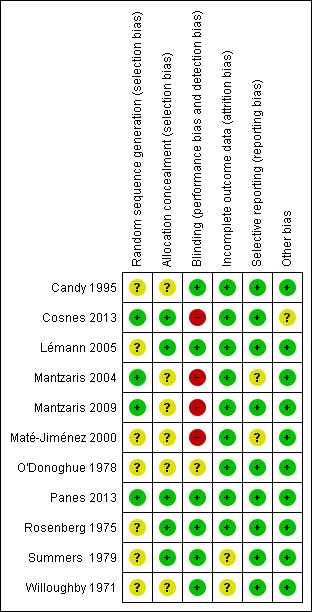
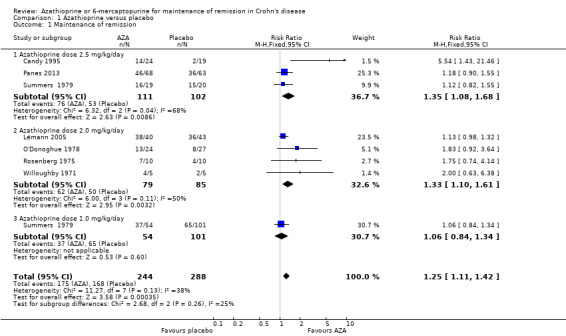
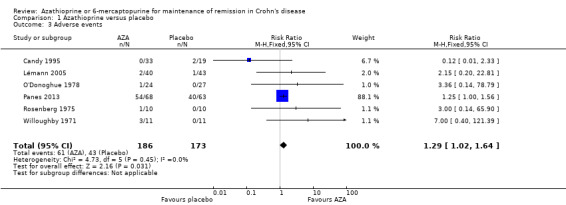
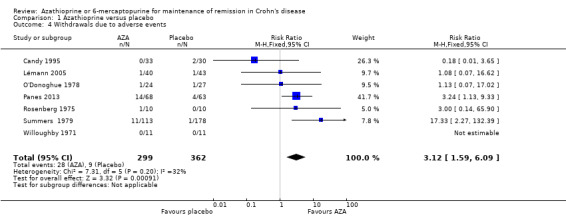
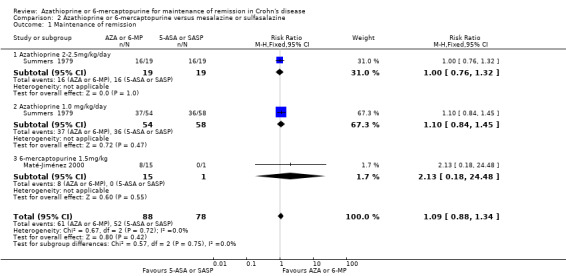
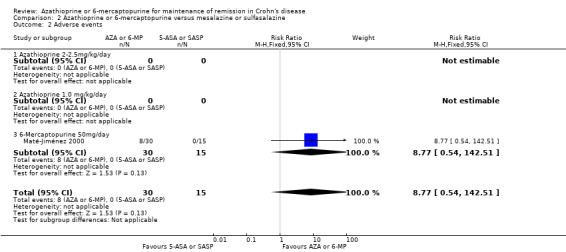
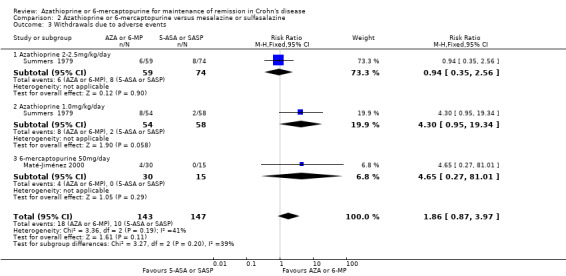
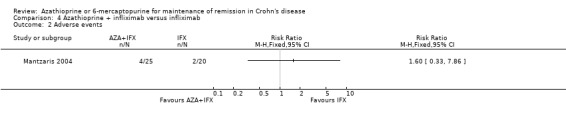
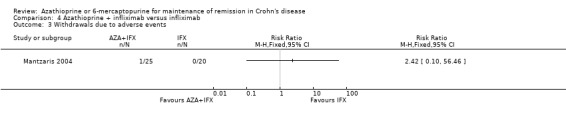
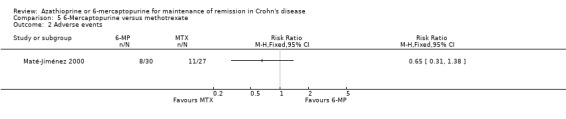
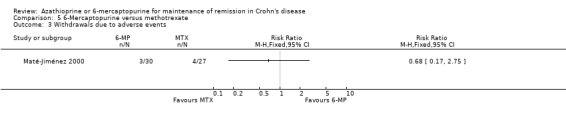
Main results: Eleven studies (881 participants) were included. Comparisons included AZA versus placebo (7 studies, 532 participants), AZA or 6-MP versus mesalazine or sulfasalazine (2 studies, 166 participants), AZA versus budesonide (1 study, 77 participants), AZA and infliximab versus infliximab (1 study, 36 patients), 6-MP versus methotrexate (1 study, 31 patients), and early AZA versus conventional management (1 study, 147 participants). Two studies were rated as low risk of bias. Three studies were rated as high risk of bias for being non-blinded. Six studies were rated as unclear risk of bias. A pooled analysis of six studies (489 participants) showed that AZA (1.0 to 2.5 mg/kg/day) was significantly superior to placebo for maintenance of remission over a 6 to 18 month period. Seventy-three per cent of patients in the AZA group maintained remission compared to 62% of placebo patients (RR 1.19, 95% CI 1.05 to 1.34). The number needed to treat for an additional beneficial outcome was nine. A GRADE analysis indicated that the overall quality of the evidence supporting this outcome was low due to sparse data (327 events) and unclear risk of bias. A pooled analysis of two studies (166 participants) showed no statistically significant difference in the proportion of patients who maintained remission between AZA (1.0 to 2.5 mg/kg/day) or 6-MP (1.0 mg/day) and mesalazine (3 g/day) sulphasalazine (0.5 g/15 kg) therapy. Sixty-nine per cent of patients in the AZA/6-MP group maintained remission compared to 67% of mesalazine/sulphasalazine patients (RR 1.09, 95% CI 0.88 to 1.34). A GRADE analysis indicated that the overall quality of the evidence supporting this outcome was low due to sparse data (113 events) and high or unclear risk of bias. One small study found AZA (2.0 to 2.5 mg/kg/day) to be superior to budesonide (6 to 9 mg/day) for maintenance of remission at one year. Seventy-six per cent (29/38) of AZA patients maintained remission compared to 46% (18/39) of budesonide patients (RR 1.65, 95% CI 1.13 to 2.42). GRADE indicated that the overall quality of the evidence supporting this outcome was low due to sparse data (47 events) and high risk of bias. One small study found no difference in maintenance of remission rates at one year between combination therapy with AZA (2.5 mg/kg) and infliximab (5 mg/kg every 8 weeks) compared to infliximab monotherapy. Eighty-one per cent (13/16) of patients in the combination therapy group maintained remission compared to 80% (16/20) of patients in the infliximab group (RR 1.02, 95% CI 0.74 to 1.40). GRADE indicated that the overall quality of the evidence supporting this outcome was very low due to very sparse data (29 events) and unclear risk of bias. One small study found no difference in maintenance of remission rates at one year between 6-MP (1 mg/day) and methotrexate (10 mg/week). Fifty per cent (8/16) of 6-MP patients maintained remission at one year compared to 53% (8/15) of methotrexate patients (RR 0.94, 95% CI 0.47 to 1.85). GRADE indicated that the overall quality of the evidence supporting this outcome was very low due to very sparse data (16 events) and high risk of bias. One study (147 participants) failed to show any significant benefit for early azathioprine treatment over a conventional management strategy. In the early azathioprine treatment group 67% (11-85%) of the trimesters were spent in remission compared to 56% (29-73%) in the conventional management group. AZA when compared to placebo had significantly increased risk of adverse events (RR 1.29, 95% CI 1.02 to 1.64), withdrawal due to adverse events (3.12, 95% CI 1.59 to 6.09) and serious adverse events (RR 2.45, 95% CI 1.22 to 4.90). AZA/6-MP also demonstrated a significantly higher risk of serious adverse events when compared to mesalazine or sulphasalazine (RR 9.37, 95% CI 1.84 to 47.7). AZA/6-MP did not differ significantly from other active therapies with respect to adverse event data. Common adverse events included pancreatitis, leukopenia, nausea, allergic reaction and infection.
Authors' conclusions: Low quality evidence suggests that AZA is more effective than placebo for maintenance of remission in Crohn's disease. Although AZA may be effective for maintenance of remission its use is limited by adverse effects. Low quality evidence suggests that AZA may be superior to budesonide for maintenance of remission but because of small study size and high risk of bias, this result should be interpreted with caution. No conclusions can be drawn from the other active comparator studies because of low and very low quality evidence. Adequately powered trials are needed to determine the comparative efficacy and safety of AZA and 6-MP compared to other active maintenance therapies. Further research is needed to assess the efficacy and safety of the use of AZA with infliximab and other biologics and to determine the optimal management strategy for patients quiescent Crohn's disease.
Conflict of interest statement
Nilesh Chande has received fees for consultancy from Abbott/AbbVie, Ferring, and Actavis; fees for lectures from Abbott, travel expenses from Merck and has stock/stock options in Pfizer, Glaxo Smith Kline, Proctor and Gamble and Johnson and Johnson. All of these financial activities are outside the submitted work.
Petrease H Patton: None known
David J Tsoulis: None known
Benson S Thomas: None known
John K MacDonald: None known
Figures









Update of
-
Azathioprine or 6-mercaptopurine for maintenance of remission in Crohn's disease.Cochrane Database Syst Rev. 2009 Jan 21;(1):CD000067. doi: 10.1002/14651858.CD000067.pub2. Cochrane Database Syst Rev. 2009. Update in: Cochrane Database Syst Rev. 2015 Oct 30;(10):CD000067. doi: 10.1002/14651858.CD000067.pub3. PMID: 19160175 Updated.
References
References to studies included in this review
Candy 1995 {published data only}
-
- Candy S, Wright JP, Gerber M, Adams G, Gerig M, Goodman R. A double blind controlled study of azathioprine in the treatment and maintenance of remission in Crohn's disease [abstract]. Gastroenterology 1994;106:A659.
Cosnes 2013 {published data only}
-
- Cosnes J, Bourrier A, Bouhnik Y, Laharie D, Nahon S, Bonnet J, et al. Accelerated step‐care therapy with early azathioprine (AZA) vs. conventional step‐care therapy in Crohn's disease: a randomized study. Gastroenterology 2012;142(5 Suppl 1):S161.
-
- Cosnes J, Bourrier A, Laharie D, Nahon S, Bouhnik Y, Carbonnel F, et al. Early administration of azathioprine vs conventional management of Crohn's Disease: a randomized controlled trial. Gastroenterology 2013;145(4):758‐65.e2; quiz e14‐5. - PubMed
Lémann 2005 {published data only}
-
- Colombel JF, Lemann M, Bouhnik Y, Duclos B, Soule JC, Lerebours E, et al. Endoscopic healing of Crohn's ileo‐colitis with azathioprine. Gastroenterology 2003;124(4 Suppl 1):A196‐7.
-
- Lemann M, Bouhnik Y, Colombel JF, Duclos B, Soule JC, Lerebours E, et al. Randomized, double‐blind, placebo‐controlled, multicenter, azathioprine (AZA) withdrawal trial in Crohn’s disease (CD). Gastroenterology 2002;122(4 Suppl 1):A23. - PubMed
-
- Lémann M, Mary JY, Colombel JF, Duclos B, Soule JC, Lerebours E, et al. A randomized, double‐blind, controlled withdrawal trial in Crohn's disease patients in long‐term remission on azathioprine. Gastroenterology 2005;128(7):1812‐8. - PubMed
Mantzaris 2004 {published data only}
-
- Mantzaris GJ, Ployzou P, Karagiannidis A, Christidou A, Koilakou S, Tsounis D, et al. A prospective, randomized trial of infliximab and azathioprine for the induction and maintenance of remission of steroid‐dependent Crohn's disease. Gastroenterology 2004;126:A54.
Mantzaris 2009 {published data only}
-
- Mantzaris G, Christidou A, Sfakianakis M, Roussos A, Koilakou S, Petraki K, et al. Azathioprine is superior to budesonide in achieving and maintaining mucosal healing and histologic remission in steroid‐dependent Crohn's disease. Inflammtory Bowel Diseases 2009;15:375‐82. - PubMed
-
- Mantzaris GJ, Petraki K, Chadio‐Iordanides H, Christidou A, Karagiannidis A, Glarakis J, et al. Maintenance therapy with azathioprine is superior to budesonide in healing endoscopic lesions and improving histology in clinically quiescent Crohn's disease. Gastroenterology 2002;122(4 Suppl 1):A81.
Maté‐Jiménez 2000 {published data only}
-
- Hermida C, Cantero J, Moreno‐Otero R, Mate‐Jimenez J. Methotrexate and 6‐mercaptopurine in steroid‐dependent inflammatory bowel disease patients: A randomized controlled clinical trial. Gut 1999;45(Suppl V):A132.
-
- Maté‐Jiménez J, Hermida C, Cantero Pernoa J, Moreno Otero R. 6‐mercaptopurine or methotrexate added to prednisone induces and maintains remission in steroid‐dependent inflammatory bowel disease. European Journal of Gastroenterology and Hepatology 2000;12:1227‐33. - PubMed
O'Donoghue 1978 {published data only}
-
- O'Donoghue DP, Dawson AM, Powell‐Tuck J. Azathioprine as a maintenance treatment for Crohn's disease: a double blind withdrawal trial. Gastroenterology 1978;72(5 II):1138. - PubMed
-
- O'Donoghue DP, Dawson AM, Powell‐Tuck J, Bown RL, Lennard‐Jones JE. Double‐blind withdrawal trial of azathioprine as maintenance treatment for Crohn's disease. Lancet 1978;2:955‐7. - PubMed
Panes 2013 {published data only}
-
- Panés J, López‐Sanromán A, Bermejo F, García‐Sánchez V, Esteve M, Torres Y, et al. Early azathioprine therapy is no more effective than placebo for newly diagnosed Crohn's disease. Gastroenterology 2013;145(4):766‐74. - PubMed
-
- Sans M, López‐San Romain A, Esteve M, Bermejo F, Garcia‐Sánchez V, Torres Y, et al. Early use of azathioprine has a steroid sparing effect on recently diagnosed Crohn's disease patients. Gastroenterology 2012;142(5 Suppl 1):S109.
Rosenberg 1975 {published data only}
-
- Rosenberg JL, Levin B, Wall AJ, Kirsner JB. A controlled trial of azathioprine in Crohn's disease. American Journal of Digestive Diseases 1975;20:721‐6. - PubMed
Summers 1979 {published data only}
-
- Singleton J, Law D, Kelley M, Mekhjian H, Sturdevant R. National Cooperative Crohn's Disease Study: Adverse reactions to study drugs. Gastroenterology 1979;77:870‐82. - PubMed
-
- Summers RW, Singleton JW. National Cooperative Crohn's Disease Study (NCCDS): a controlled prospective trial of three drugs vs placebo. Gut 1977;18(11):A972‐3.
-
- Summers RW, Switz DM, Sessions JT, Becktel JM, Best WR, Kern F, et al. National Cooperative Crohn's Disease Study: results of drug treatment. Gastroenterology 1979;77:847‐69. - PubMed
Willoughby 1971 {published data only}
References to studies excluded from this review
Abdelli 2007 {published data only}
-
- Abdelli MN, Ben Abdallah H, Houissa F, Bouali MR, Khediri MF. Azathioprine for prevention of postoperative recurrence in Crohn's disease. Tunisie Médicale 2007;85:569‐72. - PubMed
Ardizzone 2004 {published data only}
-
- Ardizzone S, Maconi G, Sampietro GM, Russo A, Radice E, Colombo E, et al. Azathioprine and mesalamine for prevention of relapse after conservative surgery for Crohn's disease.. Gastroenterology 2004;127:730‐40. - PubMed
Armuzzi 2013 {published data only}
-
- Armuzzi A, Felice C, Marzo M, Pugliese D, Andrisani G, Papa A, et al. Prevention of postoperative recurrence with azathioprine or anti‐TNF alpha in patients with Crohn's disease: A pilot study. Digestive and Liver Disease 2012;44:S194.
-
- Armuzzi A, Felice C, Marzo M, Pugliese D, Andrisani G, Papa A, et al. Prevention of postoperative recurrence with azathioprine or anti‐TNF alpha in patients with Crohn's disease: An open‐label pilot study. Gastroenterology 2012;142(5 Suppl 1):S780. - PubMed
-
- Armuzzi A, Felice C, Papa A, Marzo M, Pugliese D, Andrisani G, et al. Prevention of postoperative recurrence with azathioprine or infliximab in patients with Crohn's disease: an open‐label pilot study. Journal of Crohn's and Colitis 2013;7(12):e623‐9. - PubMed
Chebli 2007 {published data only}
-
- Chebli JM, Gaburri PD, Souza AF, Pinto AL, Chebli LA, Felga GE, et al. Long‐term results with azathioprine therapy in patients with corticosteroid‐dependent Crohn's disease: open‐label prospective study. Journal of Gastroenterology and Hepatology 2007;22:268‐74. - PubMed
Colombel 2010 {published data only}
-
- Colombel J, Sandborn W, Reinisch W, Mantzaris G, Kornbluth A, Rachmilewitz D, et al. Infliximab, azathioprine, or combination therapy for Crohn's disease. New England Journal of Medicine 2010;362(15):1383‐95. - PubMed
D'Haens 2008a {published data only}
-
- D’Haens G, Baert F, Assche G, Caenepeel P, Vergauwe P, Tuynman H, et al. Early combined immunosuppression or conventional management in patients with newly diagnosed Crohn’s disease: an open randomised trial. Lancet 2008;371:660‐7. - PubMed
D'Haens 2008b {published data only}
-
- D'Haens G, Vermeire S, Assche G, Noman M. Therapy of metronidazole with azathioprine to prevent postoperative recurrence of Crohn’s disease: a controlled randomized trial. Gastroenterology 2008;135(4):1123–29. - PubMed
-
- D'Haens GR, Noman M, Assche GA, Olmen G, Aerden I, Wermeire S, et al. Combination therapy with metronidazole and azathioprine reduces severe postoperative recurrence of Crohn's disease: a double‐blind controlled randomized trial. Gastroenterology 2007;132(4 Suppl 2):A52. - PubMed
de Souza 2013 {published data only}
Hanauer 2004a {published data only}
-
- Hanauer SB, Korelitz BI, Rutgeerts P, Peppercorn MA, Thisted RA, Cohen RD, et al. Postoperative maintenance of Crohn's disease remission with 6‐mercaptopurine, mesalamine, or placebo: a 2‐year trial. Gastroenterology 2004;127(3):723‐9. - PubMed
Herfarth 2006 {published data only}
-
- Herfarth H, Obermeier F, Tjaden C, Lukas M, Serclova Z, Dignass AU, et al. Double‐blind, double dummy, randomized, multicentre, comparative study on the efficacy and safety of azathioprine (AZA) versus mesalazine (5‐ASA) for prevention of postoperative endoscopic recurrence in Crohn's disease. Gastroenterology 2006;130(4 Suppl 2):A480.
Klein 1974 {published data only}
-
- Klein M, Binder HJ, Mitchell M, Aaronson R, Spiro H. Treatment of Crohn's disease with azathioprine: a controlled evaluation. Gastroenterology 1974;66(5):916‐22. - PubMed
Korelitz 1998 {published data only}
-
- Korelitz B, Hanauer S, Rutgeerts P, Present D, Peppercorn M. Post‐operative prophylaxis with 6‐MP, 5‐ASA or placebo in Crohn’s Disease: a 2 year multicenter trial. Gastroenterology 1998;114(4 Pt 2):A‐486.
Lémann 2006 {published data only}
-
- Lémann M, Mary JY, Duclos B, Veyrac M, Dupas JL, Delchier JC, et al. Infliximab plus azathioprine for steroid‐dependent Crohn’s disease patients: a randomized placebo‐controlled trial. Gastroenterology 2006;130:1054‐61. - PubMed
Manosa 2013 {published data only}
-
- Manosa M, Cabre E, Bernal I, Esteve M, Garcia‐Planella E, Ricart E, et al. Addition of metronidazole to azathioprine for the prevention of postoperative recurrence of Crohn's disease: a randomized, double‐blind, placebo‐controlled trial. Inflammatory Bowel Diseases 2013;19(9):1889‐95. - PubMed
-
- Manosa M, Cabre E, Bernal I, Esteve M, Garcia‐Planella E, Ricart E, et al. Azathioprine versus azathioprine plus metronidazole for the prevention of postoperative endoscopic recurrence of Crohn's disease: a randomized, placebo‐controlled trial. Journal of Crohn's and Colitis 2012;6:S93. - PubMed
Mantzaris 2007 {published data only}
-
- Mantzaris GJ, Roussos A, Christidou A, Koilakou S, Kalantzis CN, Petraki K, et al. The long‐term efficacy of azathioprine does not wane after four years of continuous treatment in patients with steroid‐dependent luminal Crohn's disease. Journal of Crohn's and Colitis 2007;1(1):28‐34. - PubMed
Nos 2000 {published data only}
-
- Nos P, Hinojosa J, Aguilera V, Moles JR, Pastor M, Ponce J, et al. Azathioprine and 5‐ASA in the prevention of postoperative recurrence of Crohn's disease. Gastroenterología y Hepatología 2000;23:374‐8. - PubMed
Oren 1997 {published data only}
-
- Oren R, Moshkowitz M, Odes S, Becker S, Keter D, Pomeranz I, et al. Methotrexate in chronic active Crohn's disease: a double‐blind, randomized, Israeli multicenter trial. American Journal of Gastroenterology 1997;92(12):2203‐9. - PubMed
Present 1980 {published data only}
-
- Present DH, Korelitz BI, Wisch N. Treatment of Crohn's disease with 6‐mercatopurine ‐ a long‐term, randomized, double‐blind study. Innere Medizin 1980;7(4):147‐8. - PubMed
-
- Present DH, Korelitz BI, Wisch N, Glass JL, Sachar DB, Pasternack BS. Treatment of Crohn's disease with 6‐mercaptopurine. A long‐term, randomized, double‐blind study. New England Journal of Medicine 1980;302(18):981‐7. - PubMed
Reinisch 2008 {published data only}
-
- Reinisch W, Panés J, Lémann M, Schreiber S, Feagan B, Schmidt S, et al. A multicenter, randomized, double‐blind trial of everolimus versus azathioprine and placebo to maintain steroid‐induced remission in patients with moderate‐to‐severe active Crohn's disease. American Journal of Gastroenterology 2008;103:2284‐93. - PubMed
Reinisch 2010 {published data only}
-
- Reinisch W, Angelberger S, Herrlinger K, Shonova O, Lukas S, Bar‐Meir S, et al. A double‐blind, double‐dummy, randomized, controlled, multicenter trial on the efficacy and safety of azathioprine vs mesalamine for prevention of clinical relapses in Crohn's disease patients with postoperative moderate or severe endoscopic recurrence. Gastroenterology 2008;134(4 Suppl 1):A‐70.
-
- Reinisch W, Angelberger S, Petritsch W, Shonova O, Lukas M, Bar‐Meir S, et al. Azathioprine versus mesalazine for prevention of postoperative clinical recurrence in patients with Crohn's disease with endoscopic recurrence: efficacy and safety results of a randomised, double‐blind, double‐dummy, multicentre trial. Gut 2010;59:752‐9. - PubMed
-
- Reinisch W, Angelberger S, Petritsch W, Shonova O, Lukas M, Greinwald R, et al. Azathioprine versus mesalazine for prevention of postoperative clinical recurrence in Crohn's disease patients with endoscopic recurrence: Follow‐up data of a randomised, double‐blind, double‐dummy, 1‐year, multicentre trial. Journal of Crohn's and Colitis 2013;7:S254. - PubMed
Rhodes 1971 {published data only}
Savarino 2013 {published data only}
-
- Savarino E, Bodini G, Dulbecco P, Assandri L, Bruzzone L, Mazza F, et al. Adalimumab is more effective than azathioprine and mesalamine at preventing postoperative recurrence of Crohn's disease: a randomized controlled trial. The American journal of gastroenterology 2013;108(11):1731‐42. - PubMed
Treton 2009 {published data only}
-
- Treton X, Bouhnik Y, Mary J, Colombel J, Duclos B, Soule J, et al. Azathioprine withdrawal in patients with Crohn's disease (CD) maintained on prolonged remission under treatment is associated with a high risk of relapse. Gastroenterology 2004;126(4 Suppl 2):A113. - PubMed
-
- Treton X, Bouhnik Y, Mary J, Colombel J, Duclos B, Soule J, et al. Azathioprine withdrawal in patients with Crohn's disease maintained on prolonged remission: a high risk of relapse. Clinical Gastroenterology and Hepatology 2009;7(1):80‐5. - PubMed
van Assche 2008 {published data only}
-
- Assche G, Magdelaine‐Beuzelin C, D'Haens G, Baert F, Noman M, Vermeire S, et al. Withdrawal of immunosuppression in crohn’s disease treated with scheduled infliximab maintenance: A randomized trial. Gastroenterology 2008;134(7):1861‐8. - PubMed
Vilien 2004 {published data only}
-
- Vilien M, Dahlerup JF, Munck LK, Norregaard P, Gronbaek K, Falligborg J. Randomized controlled azathioprine withdrawal after more than two years treatment in Crohn's disease: increased relapse rate the following year. Alimentary Pharmacology and Therapeutics 2004;19(11):1147‐52. - PubMed
Watson 1979 {published data only}
-
- Watson WC, Bukosdky M. Azathioprine in management of Crohn's disease: a randomized cross‐over study. Gastroenterology 1974;66:796.
Willoughby 1990 {published data only}
-
- Willoughby JM, Thomas JM, Sudweeks DM. Azathioprine and levamisole in Crohn's disease: a double blind controlled trial of one year's treatment with long follow up. Gut 1990;31(Suppl 10):A1193.
Additional references
Beaugerie 2008
-
- Beaugerie L, Carrat F, Bouvier AM, Brousse N, Carbonnel F, Colombel JF, et al. Excess risk of lymphoproliferative disorders (Lpd) in inflammatory bowel diseases (IBD): Interim results of the Cesame cohort. Gastroenterology 2008;134(4 Suppl 1):A116.
Best 1976
-
- Best WR, Becktel JM, Singleton JW, Kern F Jr. Development of a Crohn's disease activity index. National Cooperative Crohn's Disease Study. Gastroenterology 1976;70:439–44. - PubMed
Chande 2013
Dubinsky 2004
-
- Dubinsky MC. Azathioprine, 6‐mercaptopurine in inflammatory bowel disease: Pharmacology, efficacy, and safety. Clinical Gastroenterology and Hepatology 2004;2(9):731‐43. - PubMed
Dyer 1970
-
- Dyer N. Studies on Crohn's disease. MD Thesis University of Cambridge 1970.
Gearry 2004
-
- Gearry RB, Barclay ML, Burt MJ, Collett JA, Chapman BA. Thiopurine drug adverse effects in a population of New Zealand patients with inflammatory bowel disease. Pharmacoepidemiology and Drug Safety 2004;13(8):563‐7. - PubMed
Gearry 2005
-
- Gearry RB, Barclay ML. Azathioprine and 6‐mercaptopurine pharmacogenetics and metabolite monitoring in inflammatory bowel disease. Journal of Gastroenterology and Hepatology 2005;20(8):1149‐57. - PubMed
Gordon 2014
Guyatt 2008
Hanauer 2004b
-
- Hanauer SB, Wagner CL, Bala M, Mayer L, Travers S, Diamond RH, et al. Incidence and importance of antibody responses to infliximab after maintenance or episodic treatment in Crohn's disease. Clinical Gastroenterology and Hepatology 2004;2(7):542‐53. - PubMed
Higgins 2011a
-
- Higgins JPT, Altman DG, Sterne JAC (editors). Chapter 8: Assessing risk of bias in included studies. In: Higgins JPT, Green S editor(s). Cochrane Handbook for Systematic Reviews of Interventions Version 5.1.0 (updated March 2011). The Cochrane Collaboration, 2011 Available from www.cochrane‐handbook.org.
Higgins 2011b
-
- Higgins JPT, Deeks JJ, Altman DG (editors). Chapter 16: Special topics in statistics. In: Higgins JPT, Green S editor(s). Cochrane Handbook for Systematic Reviews of Interventions Version 5.1.0 (updated March 2011). The Cochrane Collaboration, 2011. Available from www.cochrane‐handbook.org.
Kandiel 2005
NIDDK 2008
-
- National Institute of Diabetes and Digestive and Kidney Diseases. A multi‐site trial of azathioprine dosing in Crohn's disease. ClinicalTrials.gov, NCT00113503, 2008. [NCT00113503]
Patel 2014
Rhodes 1970
-
- Rhodes J, Bainton D, Beck P. Azathioprine in Crohn's disease. Lancet 1970;2:1142. - PubMed
Sahasranaman 2008
-
- Sahasranaman S, Howard D, Roy S. Clinical pharmacology and pharmacogenetics of thiopurines. European Journal of Clinical Pharmacology 2008;64:753‐67. - PubMed
Schünemann 2011
-
- Schünemann HJ, Oxman AD, Vist GE, Higgins JPT, Deeks JJ, Glasziou P, et al. Chapter 12: Interpreting results and drawing conclusions. In: Higgins JPT, Green S editor(s). Cochrane Handbook for Systematic Reviews of Interventions Version 5.1.0 (updated March 2011). The Cochrane Collaboration, 2011. Available from www.cochrane‐handbook.org.
References to other published versions of this review
Pearson 1995
-
- Pearson DC, May GR, Fick GH, Sutherland LR. Azathioprine and 6‐mercaptopurine in Crohn disease: a meta‐analysis. Annals of Internal Medicine 1995;122:132‐42. - PubMed
Pearson 1998
Publication types
MeSH terms
Substances
LinkOut - more resources
Full Text Sources
Medical
