Review
. 2016 Mar 15;213(6):883-90.
doi: 10.1093/infdis/jiv517. Epub 2015 Oct 30.

Improving Control of Antibiotic-Resistant Gonorrhea by Integrating Research Agendas Across Disciplines: Key Questions Arising From Mathematical Modeling

Affiliations
Review

Improving Control of Antibiotic-Resistant Gonorrhea by Integrating Research Agendas Across Disciplines: Key Questions Arising From Mathematical Modeling

Yonatan H Grad et al. J Infect Dis. .

Abstract

The rise in gonococcal antibiotic resistance and the threat of untreatable infection are focusing attention on strategies to limit the spread of drug-resistant gonorrhea. Mathematical models provide a framework to link the natural history of infection and patient behavior to epidemiological outcomes and can be used to guide research and enhance the public health impact of interventions. While limited knowledge of key disease parameters and networks of spread has impeded development of operational models of gonococcal transmission, new tools in gonococcal surveillance may provide useful data to aid tracking and modeling. Here, we highlight critical questions in the management of gonorrhea that can be addressed by mathematical models and identify key data needs. Our overarching aim is to articulate a shared agenda across gonococcus-related fields from microbiology to epidemiology that will catalyze a comprehensive evidence-based clinical and public health strategy for management of gonococcal infections and antimicrobial resistance.

Keywords: Neisseria gonorrhoeae; antibiotic resistance; gonorrhea; immunity; mathematical modeling; sexually transmitted infections; vaccine.


Figures

Figure 1.
Figure 1.
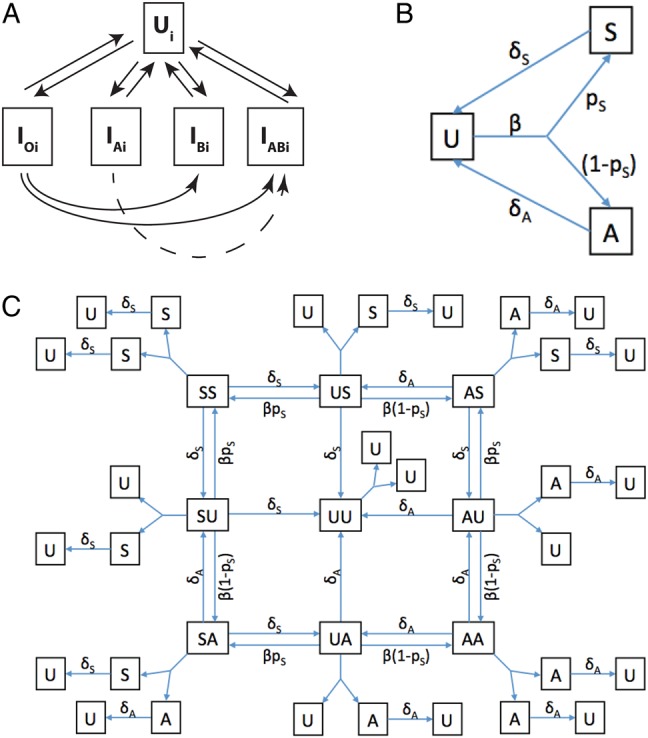
Examples of different structures of transmission models for gonorrhea. A, In the diagram (adapted from [11]) of a model to explore drug resistance, uninfected (U) and infected (I) individuals may be of multiple risk classes (denoted by the subscript “i”), and the infected strain may be susceptible to both drugs (subscript “o”), resistant to drug A (subscript “A”), resistant to drug B (subscript “B”), or resistant to both (subscript “AB”). B, This model considers a single strain and distinguishes symptomatic (S) and asymptomatic (A) infections, with uninfected individuals denoted by “U.” Here, β is the effective contact rate leading to transmission, pS is the probability that infection will be symptomatic, and the rates of recovery from symptomatic and asymptomatic infection are δS and δA, respectively. The models in panels A and B are examples of compartmental models, which track numbers of individuals in the population who are in different states regarding infection and do not explicitly represent sex partnerships. C, This model represents the natural history of gonorrhea in the same way as the model in panel B, but it is a pair model, which explicitly represents the process of formation and dissolution of partnerships. Arrows denoting partnership formation have been omitted for clarity. Boxes with single letters denote singletons, who are uninfected (U), have symptomatic infection (S), or asymptomatic infection (A); boxes with pairs of letters denote partnerships and the status of the 2 partners. The model tracks the numbers of singletons and partnerships of each type. Singletons can have an infection acquired in a previous partnership. If so, then they can recover from it but cannot transmit it, as transmission of infection requires being in partnership with an infected partner. While the pair formulation has greater complexity, it allows explicit representation of processes such as treated index patients becoming reinfected from an infected partner and for partner notification and treatment to prevent this occurrence.
Figure 2.
Figure 2.
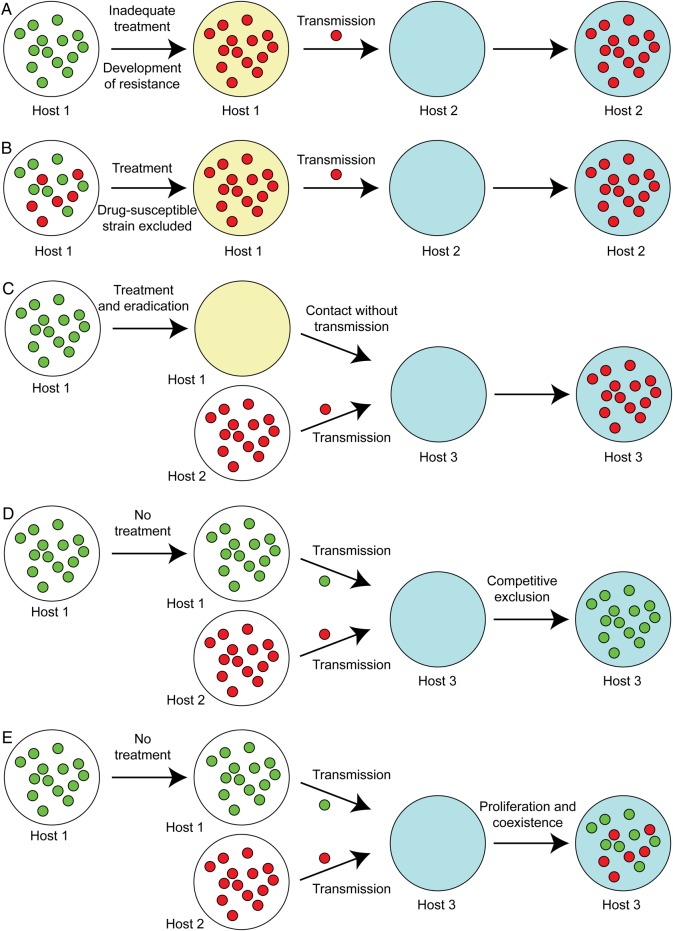
Mechanisms that represent possible relationships between antibiotic treatment and resistance (based on Figure 3 in [18]). Untreated hosts (white large circles) infected with Neisseria gonorrhoeae (small circles [green, antibiotic susceptible; red, antibiotic resistant]) can remain untreated, such as in asymptomatic infection, or receive treatment (yellow large circles). Sex partners/new hosts (blue large circles) can then acquire N. gonorrhoeae through transmission. A, Inadequate treatment (as suspected may occur in pharyngeal infections, which require higher antibiotic concentrations for eradication than at other sites) may result in selection for resistance, which can then be transmitted to uninfected individuals. B, Treatment of an individual infected with a mixed population of resistant and susceptible strains may select for the resistant strains. C, Successful treatment of an individual infected with an antibiotic-susceptible strain prevents the strain from transmitting to other hosts, making those hosts more likely to be infected by resistant strains than they would otherwise have been and shifting the competitive balance toward resistant strains. D, Exposure to an individual with antibiotic-susceptible gonococcus and to an individual with resistant gonococcus may result in infection with antibiotic-susceptible gonococcus, if there is a sufficiently large relative fitness cost to resistance, or in mixed infection. E, Mixed infections then present the opportunity for transformation of antibiotic-susceptible strains into resistant strains through horizontal gene transfer.
Figure 3.
Figure 3.
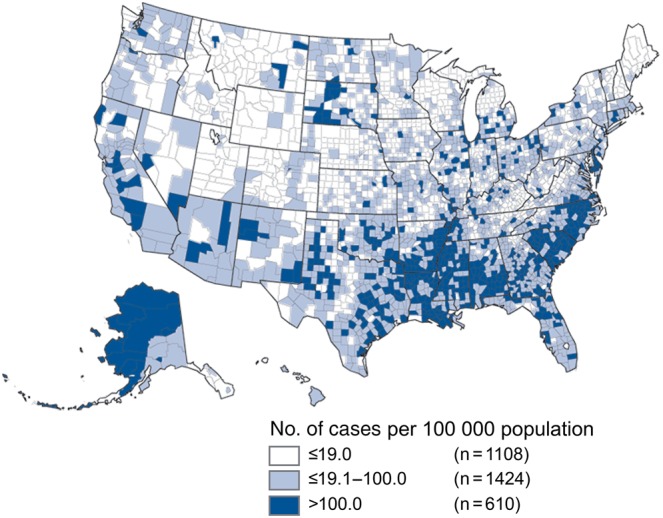
Geographic heterogeneity in gonococcal infection incidence. A major challenge to mathematical modeling of gonococcal disease dynamics and spread is geographic heterogeneity. County-based incidence data (white, ≤19.0 cases/100 000 population; gray, 19.1–100.0 cases/100 000 population; and blue, >100.0 cases/100 000 population). The underlying demographic and geographic sexual contact network structure is unknown [30].

References

    1. Lax E. The mold in Dr. Florey's coat: the story of the penicillin miracle. 1st ed New York: H. Holt, 2004.
    1. Bolan GA, Sparling PF, Wasserheit JN. The emerging threat of untreatable gonococcal infection. N Engl J Med 2012; 366:485–7. - PubMed
    1. Satterwhite CL, Torrone E, Meites E et al. Sexually transmitted infections among US women and men: prevalence and incidence estimates, 2008. Sex Transm Dis 2013; 40:187–93. - PubMed
    1. Department of Reproductive Health and Research, World Health Organization (WHO). Global incidence and prevalence of selected curable sexually transmitted infections: 2008. Geneva: WHO, 2012. http://www.who.int/reproductivehealth/publications/rtis/2008_STI_estimat... Accessed 8 February 2013.
    1. Head MG, Fitchett JR, Cooke MK, Wurie FB, Hayward AC, Atun R. UK investments in global infectious disease research 1997–2010: a case study. Lancet Infect Dis 2013; 13:55–64. - PubMed

Publication types

MeSH terms

Substances