


Factors associated with infant feeding of human milk at discharge from neonatal intensive care: Cross-sectional analysis of nurse survey and infant outcomes data
- PMID: 26518107
- PMCID: PMC4784116
- DOI: 10.1016/j.ijnurstu.2015.09.016
Factors associated with infant feeding of human milk at discharge from neonatal intensive care: Cross-sectional analysis of nurse survey and infant outcomes data
Abstract
Context: Nurses are principal caregivers in the neonatal intensive care unit and support mothers to establish and sustain a supply of human milk for their infants. Whether an infant receives essential nutrition and immunological protection provided in human milk at discharge is an issue of health care quality in this setting.
Objectives: To examine the association of the neonatal intensive care unit work environment, staffing levels, level of nurse education, lactation consultant availability, and nurse-reported breastfeeding support with very low birth weight infant receipt of human milk at discharge.
Design and setting: Cross sectional analysis combining nurse survey data with infant discharge data.
Participants: A national sample of neonatal intensive care units (N=97), nurses (N=5614) and very low birth weight infants (N=6997).
Methods: Sequential multivariate linear regression models were estimated at the unit level between the dependent variable (rate of very low birth weight infants discharged on "any human milk") and the independent variables (nurse work environment, nurse staffing, nursing staff education and experience, lactation consultant availability, and nurse-reported breastfeeding support).
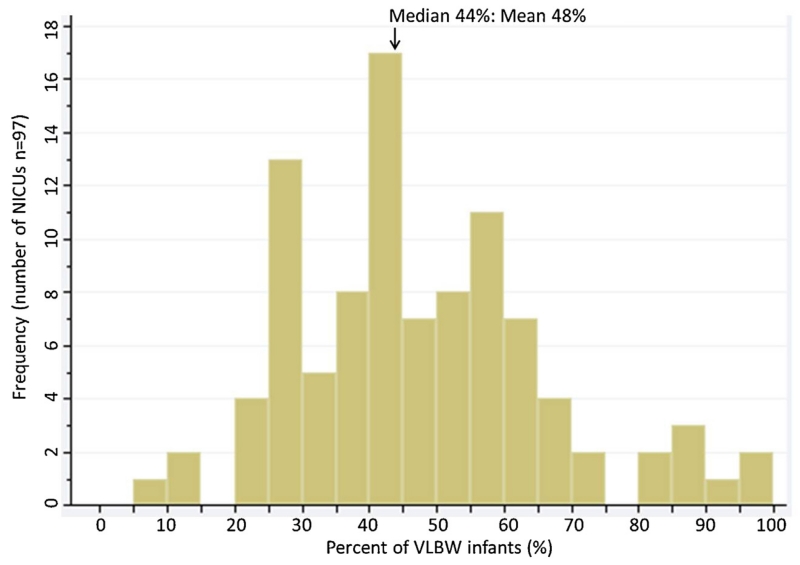
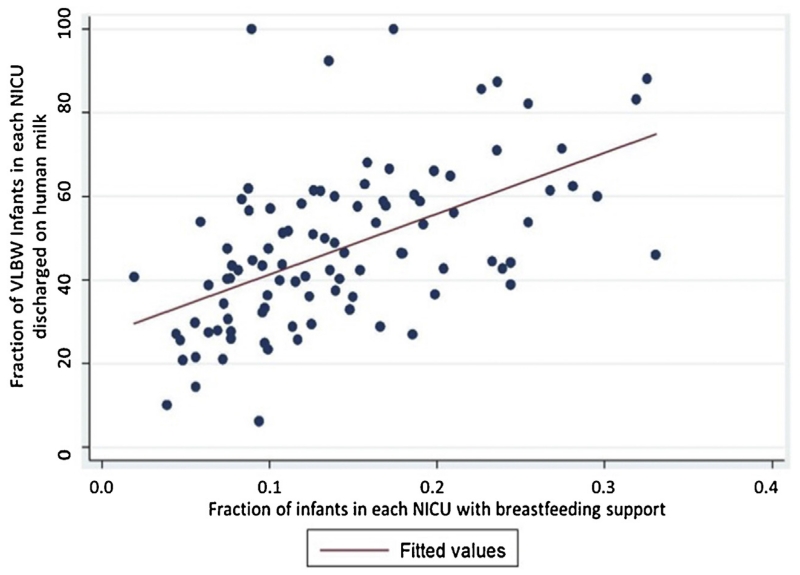
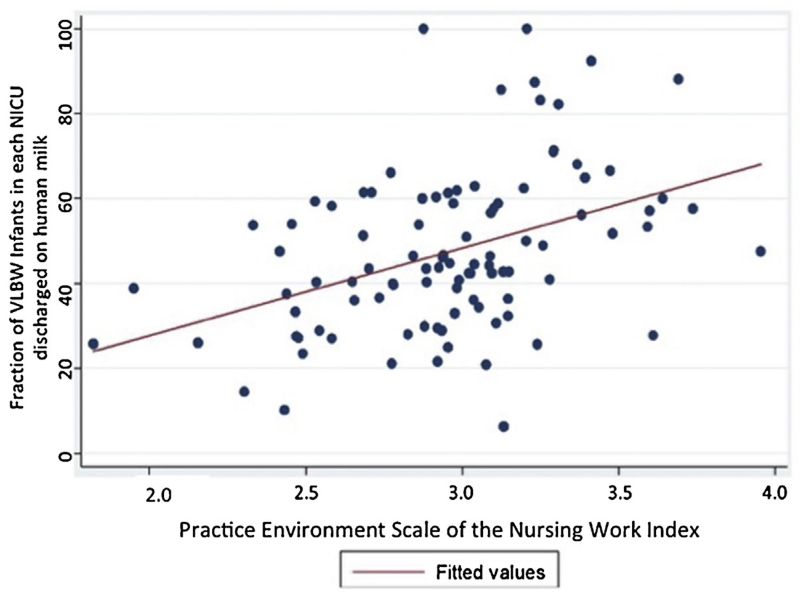
Results: The majority of very low birth weight infants (52%) were discharged on formula only. Fewer infants (42%) received human milk mixed with fortifier or formula. Only 6% of infants were discharged on exclusive human milk. A 1 SD increase (0.25) in the Practice Environment Scale of the Nursing Work Index composite score was associated with a four percentage point increase in the fraction of infants discharged on human milk (p<0.05). A 1 SD increase (0.15) in the fraction of nurses with a bachelor's degree in nursing was associated with a three percentage point increase in the fraction infants discharged on human milk (p<0.05). The acuity-adjusted staffing ratio was marginally associated with the rate of human milk at discharge (p=.056). A 1 SD increase (7%) in the fraction of infants who received breastfeeding support was associated with an eight percentage point increase in the fraction of infants discharged on human milk (p<0.001).
Conclusions: Neonatal intensive care units with better work environments, better educated nurses, and more infants who receive breastfeeding support by nurses have higher rates of very low birth weight infants discharged home on human milk. Investments by nurse administrators to improve work environments and support educational preparation of nursing staff may ensure that the most vulnerable infants have the best nutrition at the point of discharge.
Keywords: Breast feeding; Human milk; Infant; Intensive care, Neonatal; Nurse staffing; Nurse work environment; Practice Environment Scale of the Nursing Work Index; Very low birth weight.
Copyright © 2015 Elsevier Ltd. All rights reserved.
Figures
References
-
- Academy of Breastfeeding Medicine Position on Breastfeeding. Breastfeed. Med. 2008;3(4):267–270. - PubMed
-
- Aiken LH, Cimiotti JP, Sloane DM, Smith HL, Flynn L, Neff DF. Effects of nurse staffing and nurse education on patient deaths in hospitals with different nurse work environments. J. Nurs. Adm. 2012;42(10 Suppl.):S10–S16. http://dx.doi.org/10.1097/01.NNA.0000420390.87789.67. - DOI - PMC - PubMed
-
- Aiken LH, Clarke SP, Cheung RB, Sloane DM, Silber JH. Educational levels of hospital nurses and surgical patient mortality. JAMA. 2003;290(12):1617–1623. http://dx.doi.org/10.1001/jama.290.12.1617. - DOI - PMC - PubMed
-
- Aiken LH, Clarke SP, Sloane DM, Lake ET, Cheny T. Effects of hospital care environment on patient mortality and nurse outcomes. J. Nurs. Adm. 2008;38(5):223–229. http://dx.doi.org/10.1097/01.NNA.0000312773.42352.d7. - DOI - PMC - PubMed
-
- Aiken LH, Sloane DM, Bruyneel L, Van den Heede K, Griffiths P, Busse R, Diomidous M, Kinnunen J, Kózka M, Lesaffre E, McHugh MD, Moreno-Casbas MT, Rafferty AM, Schwendimann R, Scott PA, Tishelman C, van Achterberg T, Sermeus W. Nurse staffing and education and hospital mortality in nine European countries: a retrospective observational study. Lancet. 2014;383(9931):1824–1830. http://dx.doi.org/10.1016/s0140-6736(13)62631-8. - DOI - PMC - PubMed
Publication types
MeSH terms
Grants and funding
LinkOut - more resources
Full Text Sources
Other Literature Sources
Medical
