. 2015 Nov;27(11):3081-98.
doi: 10.1105/tpc.15.00679. Epub 2015 Oct 30.

The Maize PI/GLO Ortholog Zmm16/sterile tassel silky ear1 Interacts with the Zygomorphy and Sex Determination Pathways in Flower Development

Affiliations

The Maize PI/GLO Ortholog Zmm16/sterile tassel silky ear1 Interacts with the Zygomorphy and Sex Determination Pathways in Flower Development

Madelaine E Bartlett et al. Plant Cell. 2015 Nov.

Abstract

In monocots and eudicots, B class function specifies second and third whorl floral organ identity as described in the classic ABCE model. Grass B class APETALA3/DEFICIENS orthologs have been functionally characterized; here, we describe the positional cloning and characterization of a maize (Zea mays) PISTILLATA/GLOBOSA ortholog Zea mays mads16 (Zmm16)/sterile tassel silky ear1 (sts1). We show that, similar to many eudicots, all the maize B class proteins bind DNA as obligate heterodimers and positively regulate their own expression. However, sts1 mutants have novel phenotypes that provide insight into two derived aspects of maize flower development: carpel abortion and floral asymmetry. Specifically, we show that carpel abortion acts downstream of organ identity and requires the growth-promoting factor grassy tillers1 and that the maize B class genes are expressed asymmetrically, likely in response to zygomorphy of grass floral primordia. Further investigation reveals that floral phyllotactic patterning is also zygomorphic, suggesting significant mechanistic differences with the well-characterized models of floral polarity. These unexpected results show that despite extensive study of B class gene functions in diverse flowering plants, novel insights can be gained from careful investigation of homeotic mutants outside the core eudicot model species.


Figures

Figure 1.
Figure 1.
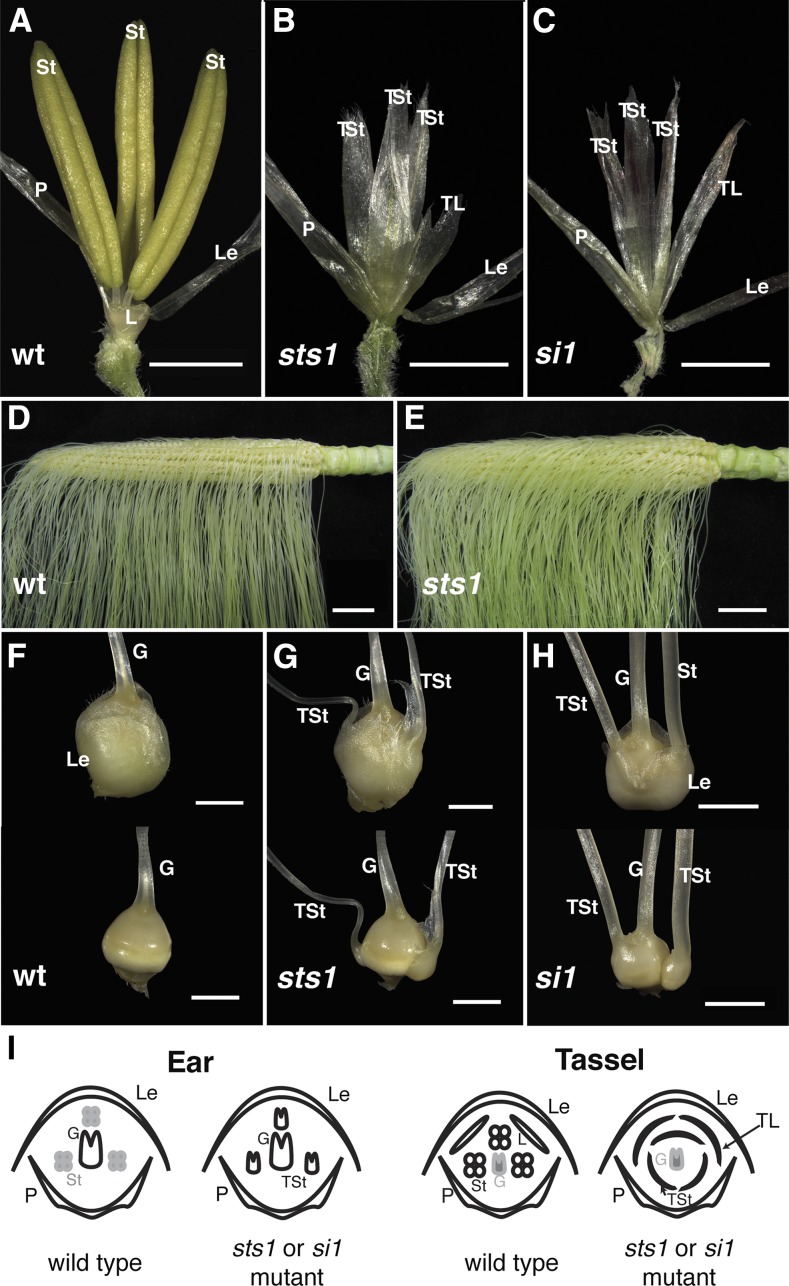
Phenotypes of the sts1 and si1 Mutants. (A) Wild-type tassel floret. (B) and (C) sts1-1 (B) and si1-mum2 (C) tassel florets showing conversion of both stamens and lodicules into lemma/palea-like organs. (D) Wild-type ear. (E) sts1-1 mutant ear. (F) Wild-type ear spikelet (above) and floret (below) with glumes removed. (G) and (H) sts1-1 (G) and si-mum2 (H) mutant ear spikelets (above) and florets (below) with glumes removed showing transformation of aborted stamens to carpels (I) Floral diagrams of wild-type and B class mutant ear and tassel florets. G, gynoecium; St, stamen; TSt, transformed stamen; L, lodicule; TL, transformed lodicule; P, palea; Le, lemma. Bars = 2 cm in (D) and (E) and 2 mm in all other panels.
Figure 2.
Figure 2.
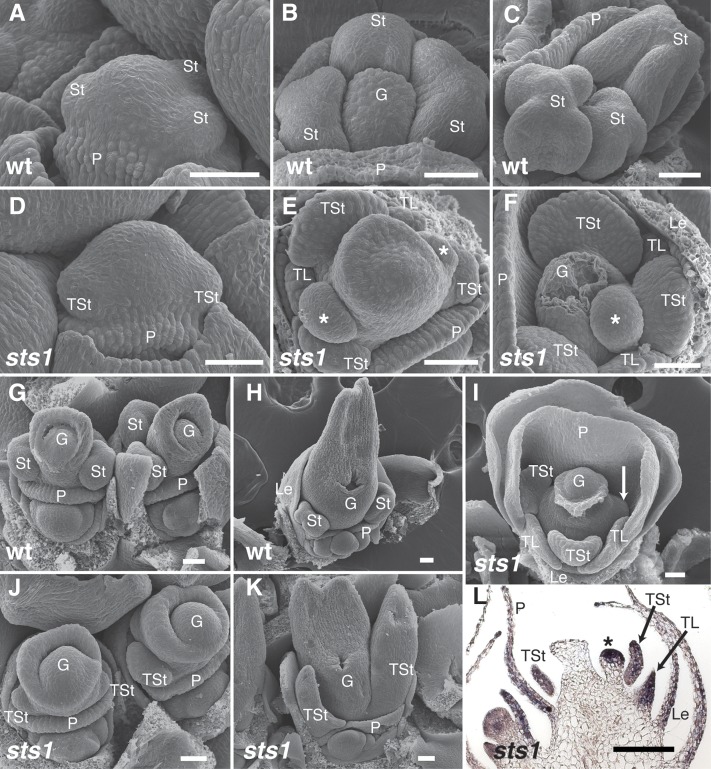
Early Floral Development in sts1-1 Mutants. (A) to (C) Scanning electron micrographs of wild-type tassel florets at successively older stages. (D) to (F) Scanning electron micrographs of sts1-1 tassel florets at similar developmental stages as in (A) to (C). No clear differences compared with the wild type are observable in the earliest stage ([A] and [D]), but after floral organs emerge, sts1-1 mutants show transformation of lodicules and stamens into flattened lemma/palea-like organs, as well as ectopic floral organs (asterisk) that appear directly above the transformed stamens. (G) and (H) Ear florets of the wild type. (I) sts1-1 tassel floret showing failure of one lateral stamen to grow (arrow). (J) and (K) Ear florets of sts1-1 mutants have transformation of stamens into carpels. (L) In situ hybridization of lateral organ marker Zyb15 on sts1-1 tassel floret reveals that the ectopic primordium has a lateral organ identity. G, gynoecium; St, stamen; P, palea; Le, lemma; TSt, transformed stamen; TL, transformed lodicule; Le, lemma. Asterisk indicates ectopic organ. Bar = 50 µm in (A) to (K) and 100 µm in (L).
Figure 3.
Figure 3.
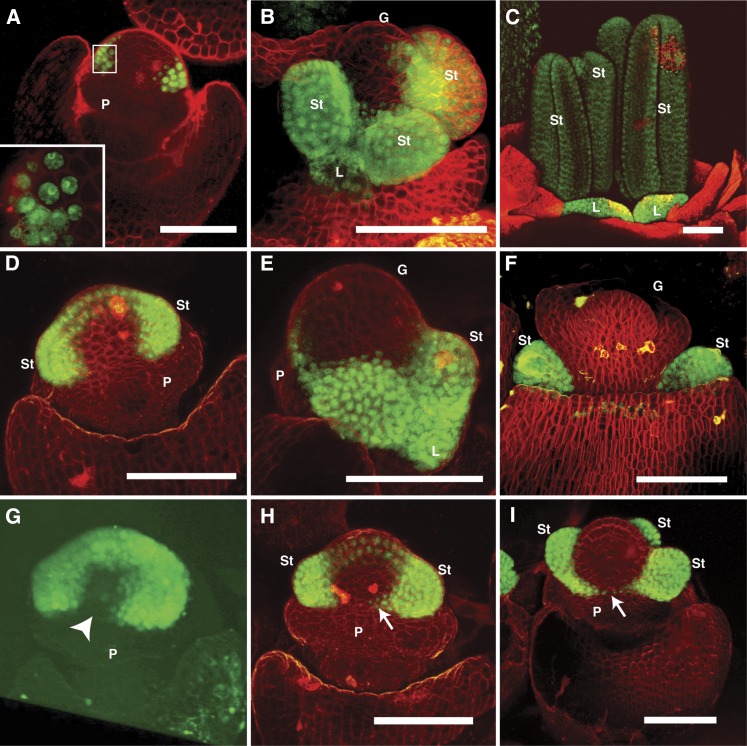
STS1-YFP Localization. (A) to (C) STS1-YFP localization in early (A), mid (B), and late (C) stages of tassel florets. Expression is detected throughout second and third whorl organs from early to late stages. Inset in (A) shows that in early stages, STS1-YFP is detected in the nucleus in cells proximal to the meristem, while cells more distal from the meristem also have cytoplasmic STS1-YFP. (D) to (F) STS1-YFP localization in early (D), mid (E), and late (F) stages of ear florets. STS1-YFP is present throughout the development of second and third whorl organs, but absent from the gynoecium. (G) to (I) Asymmetric localization of STS1-YFP during early stages of floret development. Three-dimensional reconstruction of STS1-YFP domain in an early tassel floret (G); note the absence of signal in an adaxial medial domain (arrowhead) that corresponds to the position of the missing medial lodicule. As stamens begin to initiate (H), STS1-YFP signal begins to appear in cells at the margins of the adaxial medial domain (arrow in [H]), eventually forming a narrow continuous stripe across the domain (arrow in [I]). P, palea; St, stamen; L, lodicule; G, gynoecium. Bar = 100 µm in all panels.
Figure 4.
Figure 4.
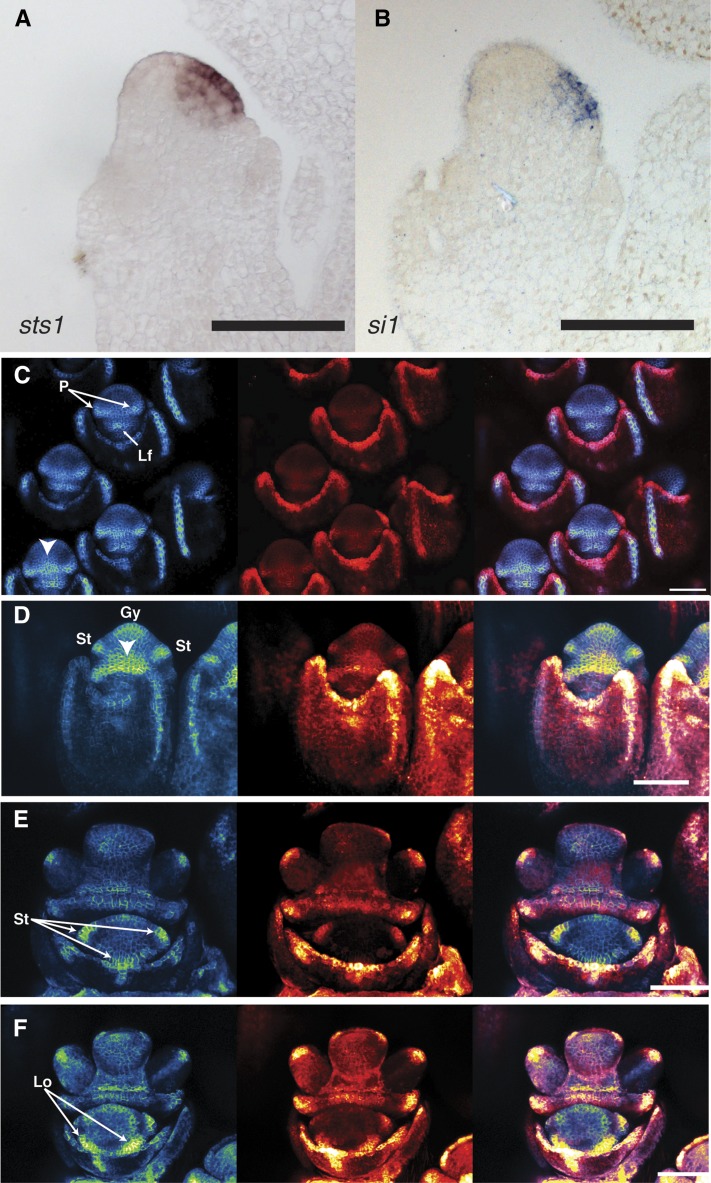
Zygomorphy in B Class Expression and Phyllotaxy of Maize Florets. (A) Medial section of male floret hybridized with anti-sts1 probe. Expression is observed in the abaxial domain, but absent from the adaxial domain. (B) Section similar to (A) hybridized with anti-si1 probe shows similar expression pattern to sts1. (C) to (F) Confocal z-stacks of Zm-PIN1-YFP (left), DR5-RFP (center), and merge (left). Early stages of the upper floret ([C], top) show two distinct PIN1 foci corresponding to the palea anlagen. As the florets mature, PIN1 and DR5 both increase in the center of the palea (arrowhead in [C], bottom). Later floral stages (D), when stamen primordia begin to emerge, show a broad area of PIN1 activity associated with the palea that spreads throughout the adaxial region of the flower primordium (arrowhead). Three distinct stamen PIN1 DR5 anlagen can be detected at early stages of the lower floret (E); however, only two lodicule anlagen are marked by PIN1 and DR5 (F). Gy, gynoecium; Lo, lodicule; Lf, lower floret; P, palea; St, stamen. Bar = 100 µm.
Figure 5.
Figure 5.
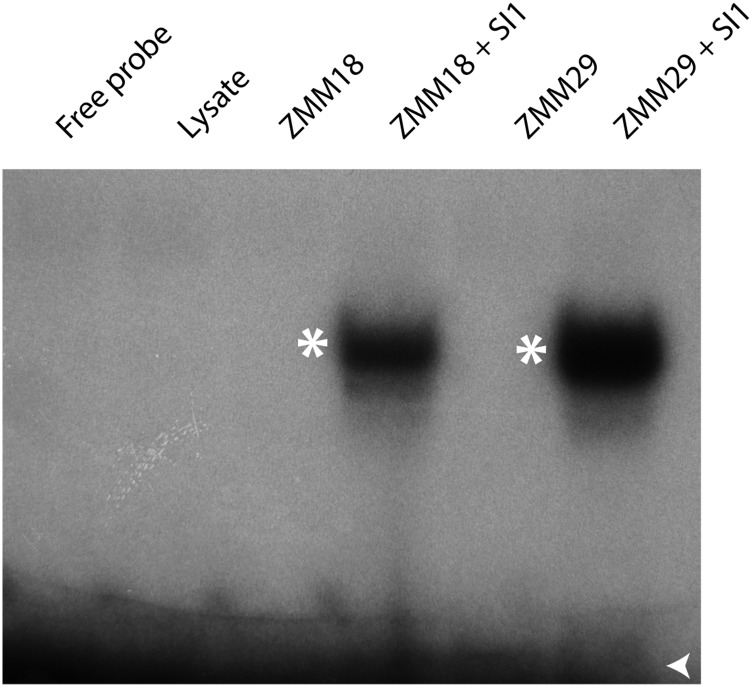
Maize PI/GLO Orthologs Bind DNA as an Obligate Heterodimer. EMSA using in vitro-transcribed and translated ZMM18, ZMM29, and SI1 proteins and P32-labeled CArG-box probe. Neither ZMM18 nor ZMM29 on its own is capable of binding the CArG-box probe, but both bind DNA with the maize AP3/DEF ortholog SI1. Free probe indicated with an open arrowhead and shifted bands by an asterisk.
Figure 6.
Figure 6.
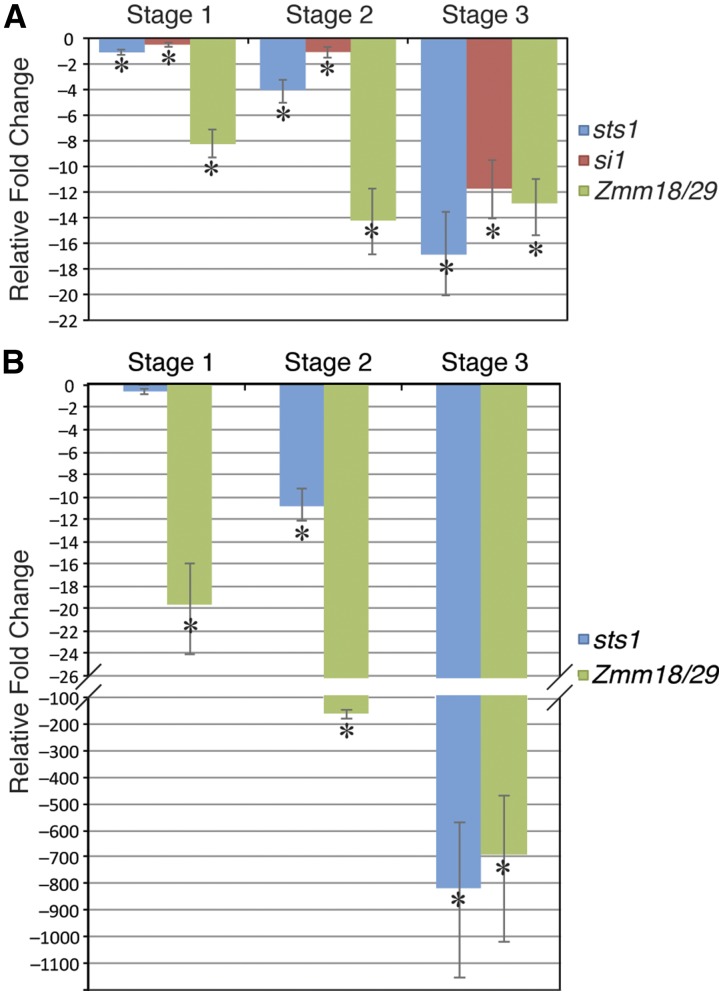
Positive Autoregulation of Maize B Class Genes. (A) RT-qPCR expression analysis of B class genes in successively older stages of sts1-1 tassel florets. Expression of all B class genes show significant downregulation at all stages, but the downregulation is more dramatic at later stages. (B) RT-qPCR expression analysis of B class genes in si1-mum2 tassel florets. In both (A) and (B), fold change is calculated relative to wild-type controls at the same stage. Error bars show sd from the mean, while asterisk indicates downregulation that is significant at P < 0.05 as determined by a t test.
Figure 7.
Figure 7.
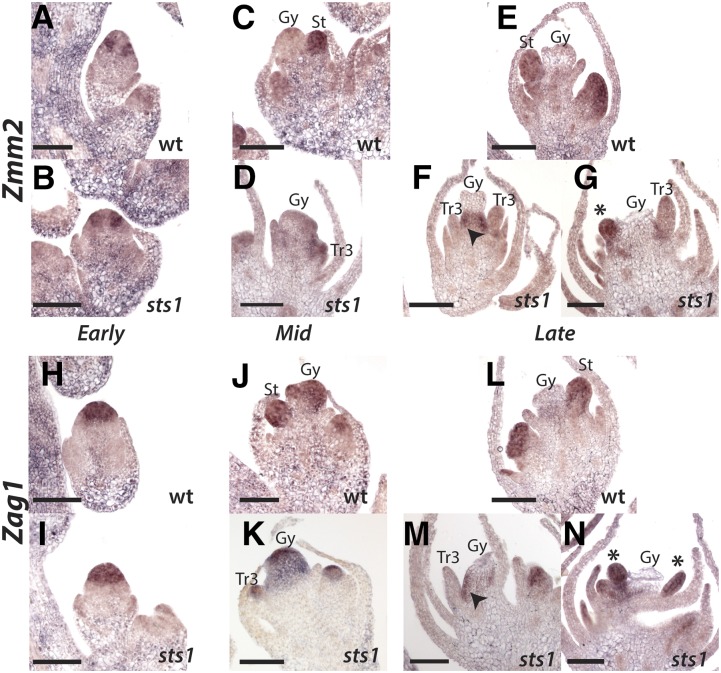
C Class Gene Expression in Male Florets of the Wild Type and sts1. (A) to (G) Anti-Zmm2 probe hybridized to male florets of wild-type (top) and sts1 mutants (bottom) at early, middle, and late stages. In early stages, both the wild type (A) and sts1 (B) have expression in the presumptive future stamen whorl, which is absent from the central domain of the meristem that will give rise to carpels. In middle stages, when stamen primordia emerge, Zmm2 is expressed in stamens of the wild type (C) and weakly in transformed third whorl organs of sts1 (D). At later stages, Zmm2 expression is maintained strongly in growing stamens (E) but absent from transformed third whorl organs ([F] and [G]). In late sts1 florets, Zmm2 is expressed at the base of the aborting gynoecium (arrowhead in [F]) and in ectopic third whorl organs (asterisk in [G]). (H) to (N) Anti-Zag1 probe hybridized as in (A) to (G). Early Zag1 expression is throughout the center of the floral meristem in both the wild type and sts1 ([H] and [I]). Expression continues in the stamens and gynoecium of middle staged florets of the wild type (J), as well as the gynoecium and transformed third whorl of sts1. At later stages, Zag1 is absent from the aborting gynoecium of the wild type but maintained in the stamen. In late sts1 florets, Zag1 is absent from the aborting gynoecium as well as the transformed third whorl (M). Similar to Zmm2, there is some Zag1 expression at the base of the gynoecium (arrowhead in [M]) and in ectopic primordia (asterisk in [N]) of sts1 mutants. Gy, gynoecium; St, stamen; Tr3, transformed third whorl organs. Asterisk indicates ectopic organs.
Figure 8.
Figure 8.
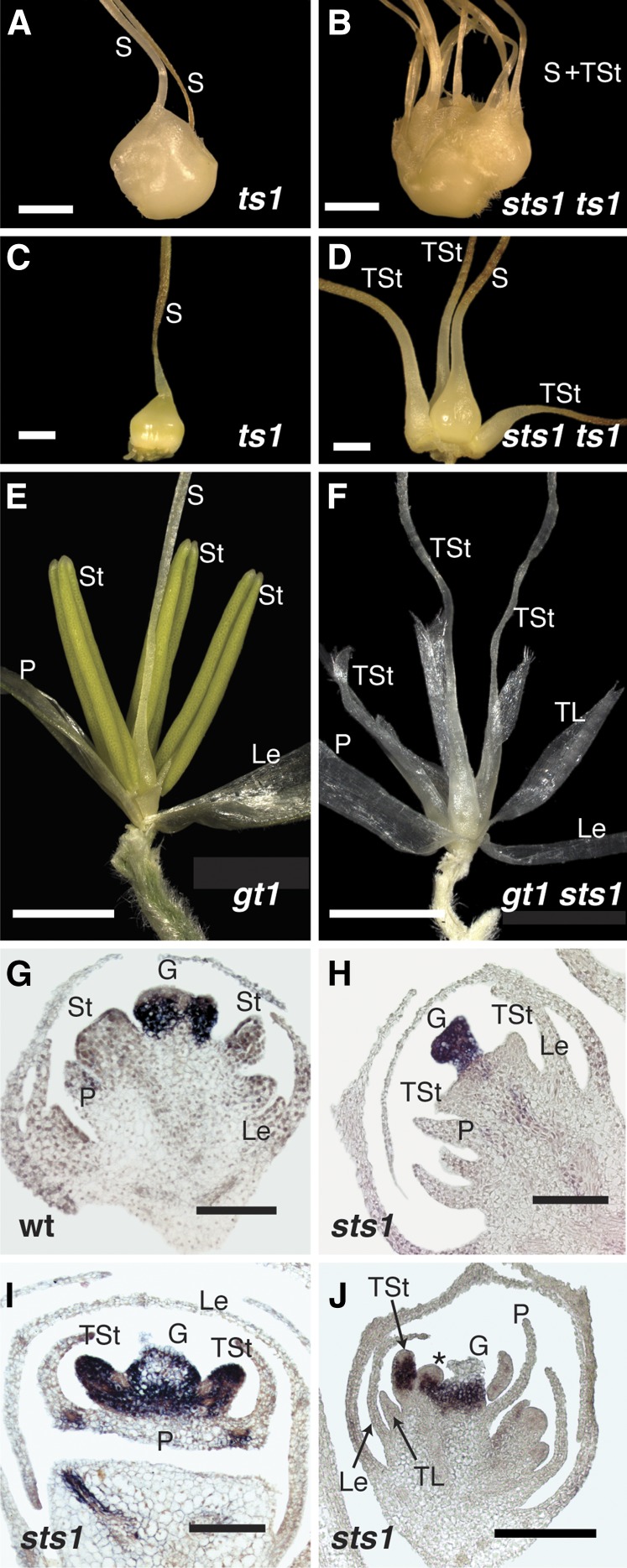
Carpel Abortion Occurs Downstream of Organ Identity, Not Position. (A) Tassel spikelet of a ts1 mutant showing complete feminization of both primary and secondary sex characters. A silk emerges from both the upper and lower floret. (B) Tassel spikelet of sts1 ts1 double mutant, showing the emergence of silks and transformed stamens. (C) Upper floret dissected from ts1 spikelet shown in (A). (D) Upper floret dissected from sts1 ts1 spikelet shown in (B). (E) Tassel floret of gt1 showing normal masculine secondary sex characteristics but failure to abort the carpel in the center of the floret. (F) Tassel floret of gt1 sts1 double mutant, with stamens transformed into organs with partial carpel identity evidenced by a distinct silk at their apex. (G) to (J) In situ hybridization with gt1 probe on wild-type (G) and sts1 tassel florets ([H] to [J]). There is strong gt1 expression in the central gynoecium of both the wild-type and sts1. During early stages of third whorl organ initiation in sts1 florets (H), gt1 is not detected in transformed stamens. In later stages ([I] and [J]), gt1 is strongly express in third whorl transformed stamens, as well as in ectopic organs (J). G, gynoecium; Le, lemma; P, palea; S, silk; St, stamen; TSt, transformed stamen; TL, transformed lodicule. Asterisk indicates ectopic organ. Bar = 2.0 mm in (A) to (F) and 100 µm in (G) to (J).

References

    1. Acosta I.F., Laparra H., Romero S.P., Schmelz E., Hamberg M., Mottinger J.P., Moreno M.A., Dellaporta S.L. (2009). tasselseed1 is a lipoxygenase affecting jasmonic acid signaling in sex determination of maize. Science 323: 262–265. - PubMed
    1. Ambrose B.A., Lerner D.R., Ciceri P., Padilla C.M., Yanofsky M.F., Schmidt R.J. (2000). Molecular and genetic analyses of the silky1 gene reveal conservation in floral organ specification between eudicots and monocots. Mol. Cell 5: 569–579. - PubMed
    1. Bai F., Reinheimer R., Durantini D., Kellogg E.A., Schmidt R.J. (2012). TCP transcription factor, BRANCH ANGLE DEFECTIVE 1 (BAD1), is required for normal tassel branch angle formation in maize. Proc. Natl. Acad. Sci. USA 109: 12225–12230. - PMC - PubMed
    1. Bartlett M.E., Specht C.D. (2011). Changes in expression pattern of the teosinte branched1-like genes in the Zingiberales provide a mechanism for evolutionary shifts in symmetry across the order. Am. J. Bot. 98: 227–243. - PubMed
    1. Benková E., Michniewicz M., Sauer M., Teichmann T., Seifertová D., Jürgens G., Friml J. (2003). Local, efflux-dependent auxin gradients as a common module for plant organ formation. Cell 115: 591–602. - PubMed

Publication types

MeSH terms

LinkOut - more resources