Review
. 2016 Apr 10;343(1):14-20.
doi: 10.1016/j.yexcr.2015.10.029. Epub 2015 Oct 28.

Focal adhesions, stress fibers and mechanical tension

Affiliations
Review

Focal adhesions, stress fibers and mechanical tension

Keith Burridge et al. Exp Cell Res. .

Abstract

Stress fibers and focal adhesions are complex protein arrays that produce, transmit and sense mechanical tension. Evidence accumulated over many years led to the conclusion that mechanical tension generated within stress fibers contributes to the assembly of both stress fibers themselves and their associated focal adhesions. However, several lines of evidence have recently been presented against this model. Here we discuss the evidence for and against the role of mechanical tension in driving the assembly of these structures. We also consider how their assembly is influenced by the rigidity of the substratum to which cells are adhering. Finally, we discuss the recently identified connections between stress fibers and the nucleus, and the roles that these may play, both in cell migration and regulating nuclear function.

Keywords: Integrins; Myosin II; RhoA; Substratum rigidity.


Figures

Fig. 1
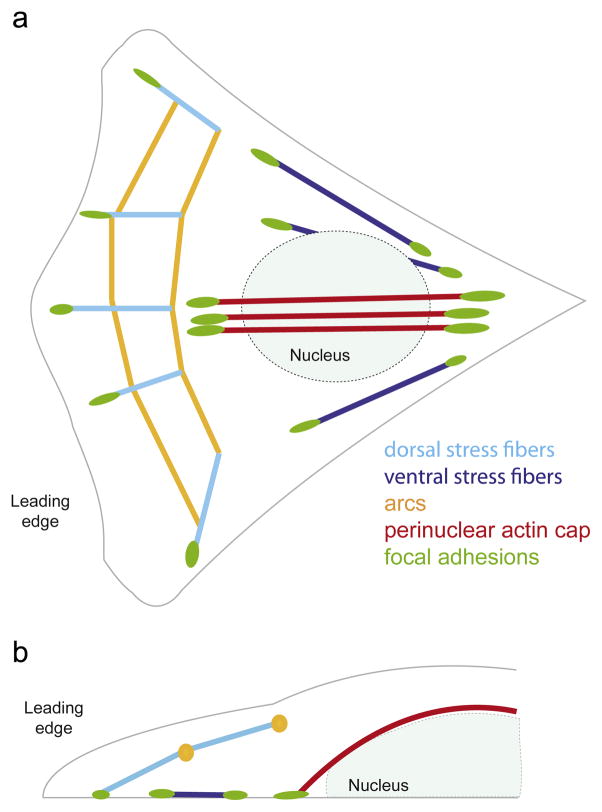
Fig. 1
Types of stress fiber in migrating cells. Schematic representation of SFs in motile cells, (a) top and (b) side views. Four categories of SFs are observed: dorsal SFs, transverse arcs, ventral SFs and the perinuclear actin cap.
Fig. 2
Fig. 2
Mechanical tension activates signaling pathways at adhesion sites. a. Exposure of cryptic sites. Tension can affect protein conformation to expose protein binding sites (e.g. talin) or sites for kinases or other protein modifications (e.g. p130cas). b. RhoA regulation of adhesion maturation through Rock and mDia. Adhesion to fibronectin activates RhoA through p115 RhoGEF and LARG [91], leading to Rock-mediated myosin stimulation. In response to tension, GEF-H1, LARG and mDia are recruited [32,37] and promote actin polymerization. B1 (1) and αv (2) integrin subtypes cooperate to regulate RhoA signaling and adhesion maturation [62].

References

    1. Burridge K. Are stress fibres contractile? Nature. 1981;294:691–692. - PubMed
    1. Geiger B, Bershadsky A. Exploring the neighborhood: adhesion-coupled cell mechanosensors. Cell. 2002;110:139–142. - PubMed
    1. Hoffman BD, Grashoff C, Schwartz MA. Dynamic molecular processes mediate cellular mechanotransduction. Nature. 2011;475:316–323. - PMC - PubMed
    1. Case LB, Waterman CM. Integration of actin dynamics and cell adhesion by a three-dimensional, mechanosensitive molecular clutch. Nat Cell Biol. 2015;17:955–963. - PMC - PubMed
    1. Burridge K, Wittchen ES. The tension mounts: stress fibers as force-generating mechanotransducers. J Cell Biol. 2013;200:9–19. - PMC - PubMed

Publication types