Review
. 2016 Jun;125(2):265-76.
doi: 10.1007/s00412-015-0552-7. Epub 2015 Oct 31.

RPA homologs and ssDNA processing during meiotic recombination

Affiliations
Review

RPA homologs and ssDNA processing during meiotic recombination

Jonathan Ribeiro et al. Chromosoma. 2016 Jun.

Abstract

Meiotic homologous recombination is a specialized process that involves homologous chromosome pairing and strand exchange to guarantee proper chromosome segregation and genetic diversity. The formation and repair of DNA double-strand breaks (DSBs) during meiotic recombination differs from those during mitotic recombination in that the homologous chromosome rather than the sister chromatid is the preferred repair template. The processing of single-stranded DNA (ssDNA) formed on intermediate recombination structures is central to driving the specific outcomes of DSB repair during meiosis. Replication protein A (RPA) is the main ssDNA-binding protein complex involved in DNA metabolism. However, the existence of RPA orthologs in plants and the recent discovery of meiosis specific with OB domains (MEIOB), a widely conserved meiosis-specific RPA1 paralog, strongly suggest that multiple RPA complexes evolved and specialized to subdivide their roles during DNA metabolism. Here we review ssDNA formation and maturation during mitotic and meiotic recombination underlying the meiotic specific features. We describe and discuss the existence and properties of MEIOB and multiple RPA subunits in plants and highlight how they can provide meiosis-specific fates to ssDNA processing during homologous recombination. Understanding the functions of these RPA homologs and how they interact with the canonical RPA subunits is of major interest in the fields of meiosis and DNA repair.

Keywords: MEIOB; Meiosis; RPA; Recombination; SPATA22; ssDNA.


Figures
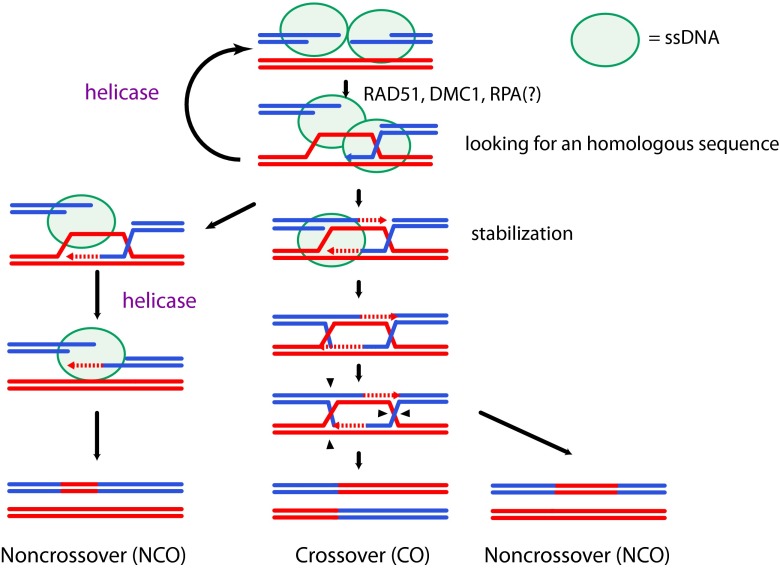
Fig. 1
Fig. 1
Meiotic recombination and ssDNA. Meiotic double strand breaks are repaired as crossovers (CO) or non-crossovers (NCOs) through different intermediates. After DSBs formation, resection is initiated to form 3′-ssDNA tails. The 3′-tail is then coated by the recombinases to invade the homologous sequence on the homolog. A ssDNA-binding protein such as RPA must help to stabilize and protect ssDNA before the formation of the presynaptic filament. Proper strand invasion is stabilized to initiate DNA synthesis and then either further stabilized or destabilized to be repaired by synthesis-dependent strand annealing (SDSA). The stabilized intermediates (double Holliday junctions) can either form a NCO outcome or be resolved by nuclease activity to form a CO or a NCO outcome. Green circles show ssDNA
Fig. 2
Fig. 2
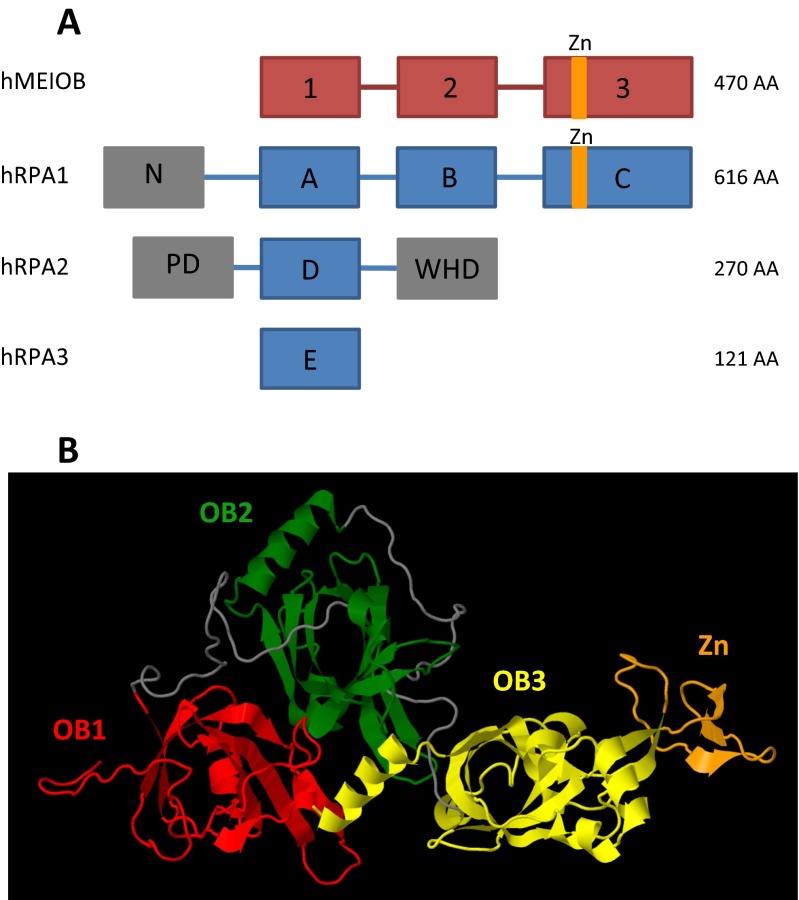
Domain structures of RPA subunits and MEIOB. a Schematic representation of MEIOB and RPA subunits protein domains. The folded domains and unfolded linkers are presented as boxes and lines respectively. The red and blue boxes represent MEIOB and RPA subunit OB- folds, respectively. The orange domains illustrate zinc ion-binding domains. The grey boxes represent domains that are not involved in ssDNA-binding activity, such as the N-terminal domain of RPA1 and the phosphorylation domain (PD) and the winged-helix domain (WHD) of RPA2. b Stereo ribbon presentation of predicted MEIOB structure model obtained from the RaptorX server (Kallberg et al. 2012) and visualized with Jmol (www.jmol.org). OB-folds 1, 2, and 3 and zinc ion-binding domain are represented in red, green, yellow, and orange, respectively. Unfolded linkers are represented in grey
Fig. 3
Fig. 3
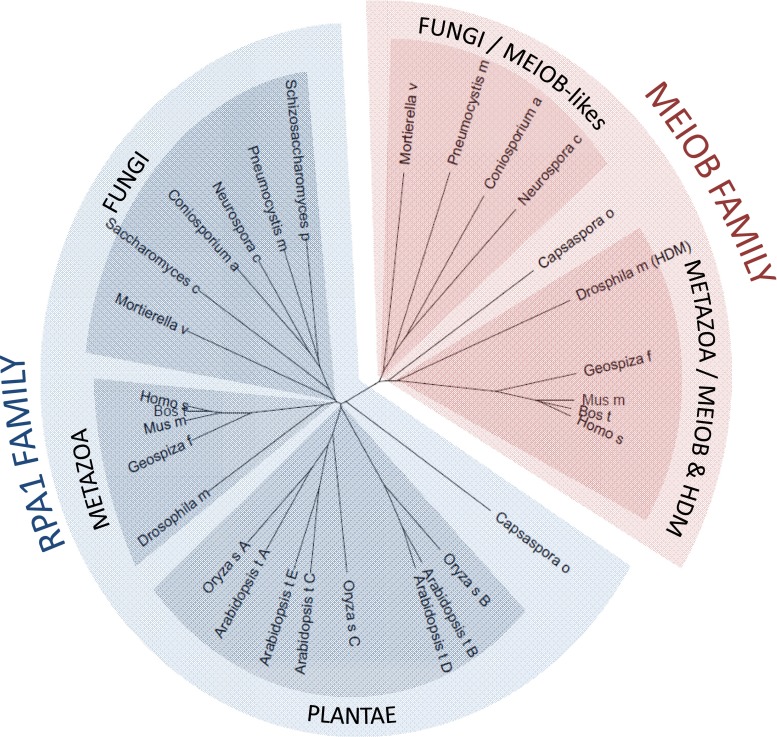
Phylogenetic relationship between RPA and MEIOB homologs. Multiple alignments of full-length MEIOB and RPA1 protein were processed with Clustal Omega (http://www.ebi.ac.uk/Tools/msa/clustalo/). The phylogenetic tree obtained with Clustal Omega was visualized with Archaeopteryx Version 0.9901 beta (Han and Zmasek 2009). MEIOB and RPA1 proteins form distinct families. Represented species: H. sapiens, Homo sapiens; B. taurus, Bos taurus; M. musculus, Mus musculus; G. fortis, Geospiza fortis; D. melanogaster, Drosophilae melanogaster; C. owczarzaki, Capsaspora owczarzaki; N. crassa, Neurospora crassa; C. apollinis, Coniosporium apollinis; P. murina, Pneumocystis murina; M. verticillata, Mortierella verticillata; S. pombe, Schizosaccharomyces pombe; S. cerevisiae, Saccharomyces cerevisiae; O. sativa, Oryza sativa; A. thaliana, Arabidopsis thaliana. The amino acid sequences and accession numbers are available in supplementary material (Sup. 1)
Fig. 4
Fig. 4
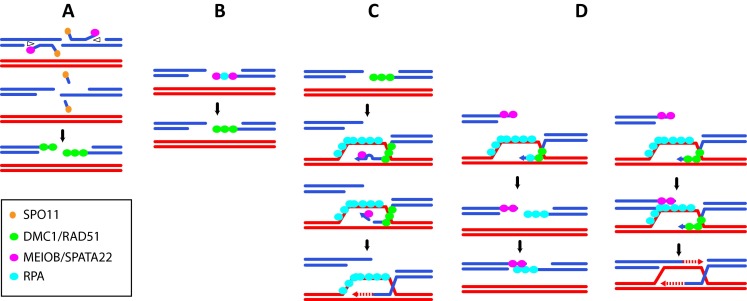
Putative roles for MEIOB during meiotic recombination. a MEIOB is loaded during the early steps of resection to release Spo11-oligo through its 3′-exonuclease activity with the help of a helicase (opened triangle). b MEIOB is loaded with or without RPA on the 3′-ssDNA tail. c MEIOB 3′-exonuclease activity removes the 3′ end of the invading strand in the presence of mismatches formed between the donor and invading strand to allow initiation of DNA synthesis. d MEIOB is loaded on one side of the broken end to allow strand annealing or second-end capture

References

    1. Aklilu BB, Soderquist RS, Culligan KM. Genetic analysis of the replication protein A large subunit family in Arabidopsis reveals unique and overlapping roles in DNA repair, meiosis and DNA replication. Nucleic Acids Res. 2014;42:3104–3118. doi: 10.1093/nar/gkt1292. - DOI - PMC - PubMed
    1. Alani E, Thresher R, Griffith JD, Kolodner RD. Characterization of DNA-binding and strand-exchange stimulation properties of y-RPA, a yeast single-strand-DNA-binding protein. J Mol Biol. 1992;227:54–71. doi: 10.1016/0022-2836(92)90681-9. - DOI - PubMed
    1. Anderson LK, Reeves A, Webb LM, Ashley T. Distribution of crossing over on mouse synaptonemal complexes using immunofluorescent localization of MLH1 protein. Genetics. 1999;151:1569–1579. - PMC - PubMed
    1. Bartrand AJ, Iyasu D, Marinco SM, Brush GS. Evidence of meiotic crossover control in Saccharomyces cerevisiae through Mec1-mediated phosphorylation of replication protein A. Genetics. 2006;172:27–39. doi: 10.1534/genetics.105.047845. - DOI - PMC - PubMed
    1. Bishop DK, Park D, Xu L, Kleckner N. DMC1: a meiosis-specific yeast homolog of E. coli recA required for recombination, synaptonemal complex formation, and cell cycle progression. Cell. 1992;69:439–456. doi: 10.1016/0092-8674(92)90446-J. - DOI - PubMed

Publication types

LinkOut - more resources