


Trends in Opioid Prescriptions Among Part D Medicare Recipients From 2007 to 2012
- PMID: 26522794
- PMCID: PMC4718856
- DOI: 10.1016/j.amjmed.2015.10.002
Trends in Opioid Prescriptions Among Part D Medicare Recipients From 2007 to 2012
Erratum in
-
Corrigendum to 'Trends in Opioid Prescriptions Among Part D Medicare Recipients from 2007 to 2012' The American Journal of Medicine (2016) 129, 221.e21-221.e30.Am J Med. 2017 May;130(5):615-616. doi: 10.1016/j.amjmed.2017.02.005. Am J Med. 2017. PMID: 28431672 No abstract available.
Abstract
Background: There is growing concern about potential overuse of, and toxicity from, opioid analgesics. No nationally representative study has examined inter-state variations in opioid use and impact of policy on opioid use among older adults.
Methods: We used national Medicare data from 2007-2012 to assess temporal and geographic trends in rates of opioid prescription and relationship to opioid toxicity and different state regulations in Part D Medicare recipients. We excluded those with a cancer diagnosis. Multilevel, multivariable regression analyses evaluated rates of prolonged prescriptions for schedule II, schedule III, and combination II/III opioid for each state, adjusting for patient characteristics.
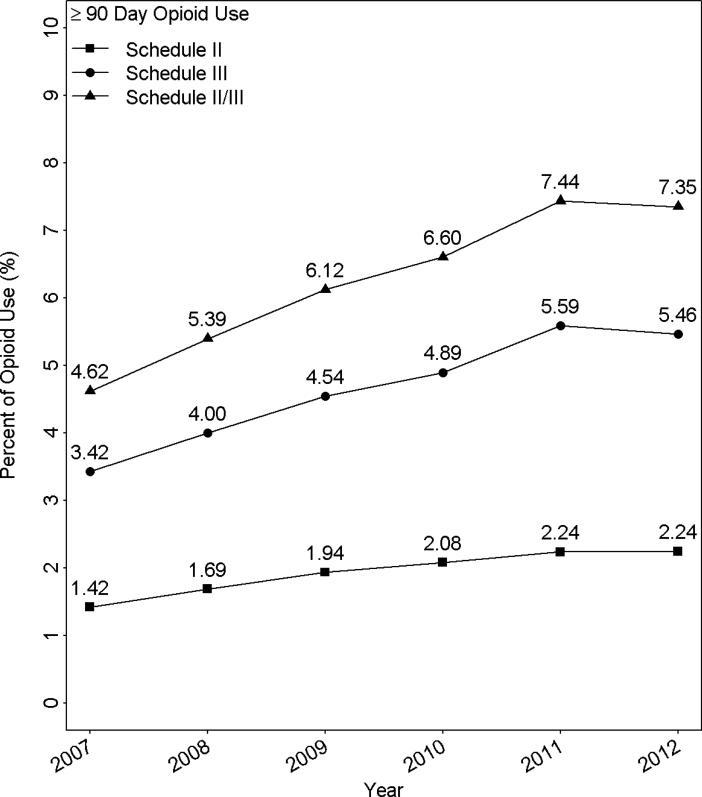
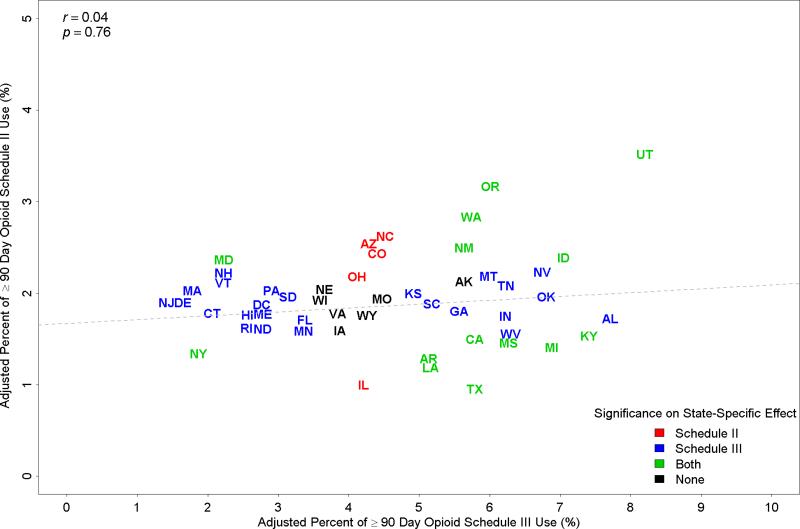
Results: The percent of Part D recipients receiving prescriptions for combined schedule II/III opioid more than 90 days in a year increased from 4.62% in 2007 to 7.35% in 2012. Large variations existed among states in rates of opioid prescriptions: from 2.84% in New York to 10.93% in Utah, in 2012 data. The state variation was larger for schedule III than schedule II. Individual characteristics independently associated with prolonged use included older age, female gender, white race, low income, living in a lower-education area, and comorbidity of drug abuse, rheumatoid arthritis, and depression. Only state law regulating pain clinic was associated with reduction of schedule II opioid prescriptions. Prolonged opioid prescription use increased the odds of opioid overdose-related emergency room visits or hospitalization by 60%.
Conclusions: Analyses of Medicare Part D data demonstrated a substantial growth in opioid prescriptions from 2007 to 2011 and large variation in opioid prescriptions across states.
Keywords: Medicare; Opioid; Overdose; Regulations.
Copyright © 2016 Elsevier Inc. All rights reserved.
Figures
References
-
- Centers for Disease Control and Prevention Vital signs: overdoses of prescription opioid pain relievers — United States, 1999–2008. MMWR Morb Mortal Wkly Rep. 2011;60:1487–92. - PubMed
-
- Epidemic: Responding to America's prescription drug abuse crisis. Office of National Drug Control Policy; Washington, DC: 2011. [April 15, 2015]. (at http://www.whitehouse.gov/sites/default/files/ondcp/issues-content/presc....)
-
- Betses M, Brennan T. Abusive prescribing of controlled substances–a pharmacy view. N Engl J Med. 2013;369:989–91. - PubMed
-
- Chou R, Ballantyne JC, Fanciullo GJ, Fine PG, Miaskowski C. Research gaps on use of opioids for chronic noncancer pain: findings from a review of the evidence for an American Pain Society and American Academy of Pain Medicine clinical practice guideline. J Pain. 2009;10:147–59. - PubMed
Publication types
MeSH terms
Substances
Grants and funding
LinkOut - more resources
Full Text Sources
Other Literature Sources
Medical
