


Physical Exercise as Therapy for Frailty
- PMID: 26524568
- PMCID: PMC4712448
- DOI: 10.1159/000382065
Physical Exercise as Therapy for Frailty
Abstract
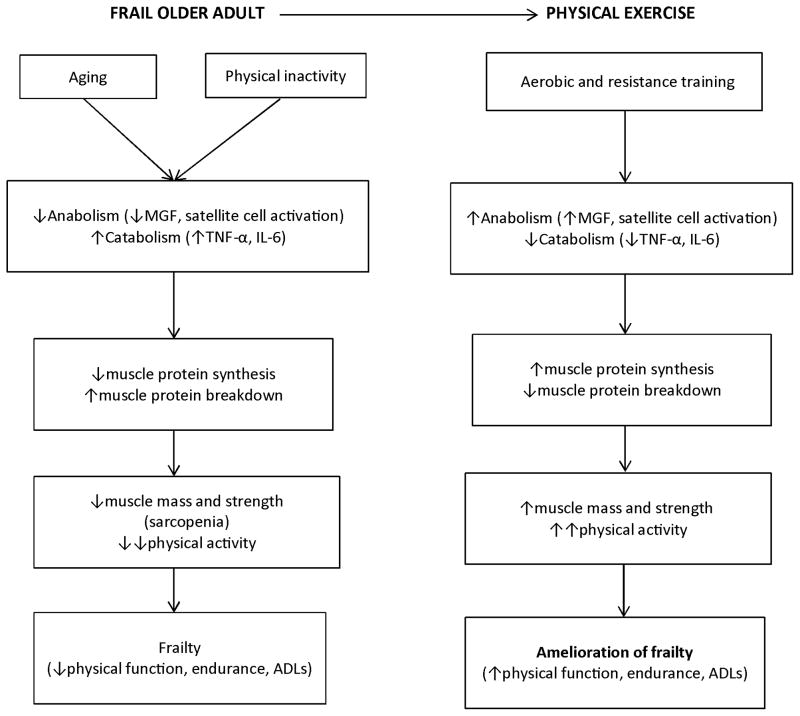
Longitudinal studies demonstrate that regular physical exercise extends longevity and reduces the risk of physical disability. Decline in physical activity with aging is associated with a decrease in exercise capacity that predisposes to frailty. The frailty syndrome includes a lowered activity level, poor exercise tolerance, and loss of lean body and muscle mass. Poor exercise tolerance is related to aerobic endurance. Aerobic endurance training can significantly improve peak oxygen consumption by ∼10-15%. Resistance training is the best way to increase muscle strength and mass. Although the increase in muscle mass in response to resistance training may be attenuated in frail older adults, resistance training can significantly improve muscle strength, particularly in institutionalized patients, by ∼110%. Because both aerobic and resistance training target specific components of frailty, studies combining aerobic and resistance training provide the most promising evidence with respect to successfully treating frailty. At the molecular level, exercise reduces frailty by decreasing muscle inflammation, increasing anabolism, and increasing muscle protein synthesis. More studies are needed to determine which exercises are best suited, most effective, and safe for this population. Based on the available studies, an individualized multicomponent exercise program that includes aerobic activity, strength exercises, and flexibility is recommended to treat frailty.
© 2015 Michael E. DeBakey VA Medical Center (US Government) Published by S. Karger AG, Basel.
Figures
References
-
- U.S.Department of Commerce. US Census Bureau Projections Show a Slower Growing, Older, More Diverse Nation a Half Century from Now. United States Census Bureau; 2014. [cited 2014 Mar 1];Available from: : http://www.census.gov/newsroom/releases/archives/
-
- Lambert CP, Evans WJ. Adaptations to aerobic and resistance exercise in the elderly. Rev Endocr Metab Disord. 2005 May;6(2):137–43. - PubMed
-
- Villareal DT, Banks M, Siener C, Sinacore DR, Klein S. Physical Frailty and Body Composition in Obese Elderly Men and Women. Obes Res. 2004 Jun 1;12(6):913–20. - PubMed
-
- Fried LP, Tangen CM, Walston J, Newman AB, Hirsch C, Gottdiener J, et al. Frailty in older adults: evidence for a phenotype. J Gerontol A Biol Sci Med Sci. 2001 Mar;56(3):M146–M156. - PubMed
Publication types
MeSH terms
Grants and funding
LinkOut - more resources
Full Text Sources
Medical
