Review
. 2016 May 15:101:36-42.
doi: 10.1016/j.ymeth.2015.10.014. Epub 2015 Oct 23.

Controlling transcription in human pluripotent stem cells using CRISPR-effectors

Affiliations
Review

Controlling transcription in human pluripotent stem cells using CRISPR-effectors

Ryan M Genga et al. Methods. .

Abstract

The ability to manipulate transcription in human pluripotent stem cells (hPSCs) is fundamental for the discovery of key genes and mechanisms governing cellular state and differentiation. Recently developed CRISPR-effector systems provide a systematic approach to rapidly test gene function in mammalian cells, including hPSCs. In this review, we discuss recent advances in CRISPR-effector technologies that have been employed to control transcription through gene activation, gene repression, and epigenome engineering. We describe an application of CRISPR-effector mediated transcriptional regulation in hPSCs by targeting a synthetic promoter driving a GFP transgene, demonstrating the ease and effectiveness of CRISPR-effector mediated transcriptional regulation in hPSCs.

Keywords: CRISPR; Cas9; Human pluripotent stem cells; Transcriptional regulation; dCas9-effectors.


Figures

Figure 1
Figure 1. CRISPR/Cas9 effector-mediated transcriptional control
(A) Schematic depicting dCas9-effector mediated transcriptional regulation through fusion of dCas9 to transcriptional activation or repression effector domains. (B) Schematic depicting dCas9-effector mediated transcriptional regulation through recruitment of multiple antibody-fused effector domains to a dCas9-fused epitope array. (C) Schematic depicting dCas9-effector mediated transcriptional regulation through recruitment of MS2-effector fusion proteins to tethered copies of the MS2 bacteriophage coat protein-binding RNA stem loop on the 3’-end of an sgRNA. (D) Schematic depicting dCas9-effector mediated transcriptional regulation through scaffolding of a functional RNA module (such as an aptamer or lncRNA) to an sgRNA. (E) Schematic depicting dCas9-effector mediated transcriptional regulation through fusion of dCas9 to epigenetic modifiers to alter local epigenetic marks.
Figure 2
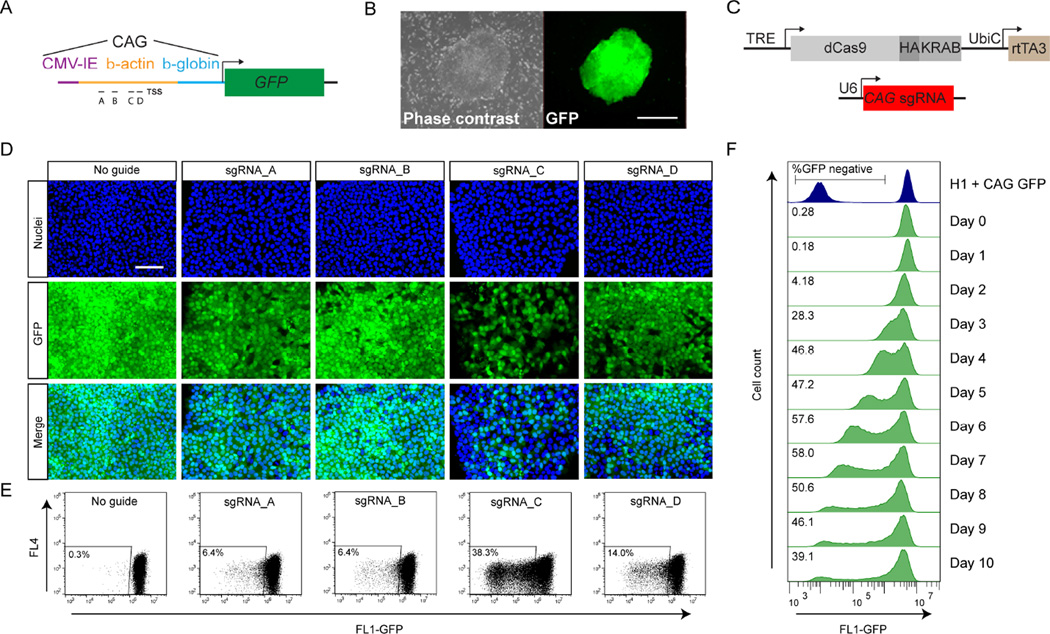
Figure 2. dCas9-KRAB-mediated repression of GFP in H1 CAG-GFP hPSCs
(A) Reporter construct inserted into the AAVS1 locus of H1 hPSCs via zinc finger nuclease gene editing. GFP expression is driven by a CAG (CMV-IE, chicken actin, rabbit beta globin) promoter. Target locations of CAG-specific sgRNAs (A, B, C, and D) and the transcriptional start site (TSS) are indicated. (B) Representative phase contrast and fluorescence images of H1 CAG-GFP cells demonstrating that the targeted cells maintain hPSC morphology and constitutively express GFP. Scale bar = 500 µm (C) Schematic of doxycycline-inducible dCas9-KRAB and CAG-specific sgRNA lentiviral constructs. rtTA expression is constitutively driven by the Ubiquitin C promoter (UbiC) which binds the Tet-responsive element (TRE) in the presence of doxycycline in order to activate dCas9-KRAB expression. CAG-specific sgRNA expression is constitutively driven by the U6 promoter. (D) Fluorescence and (E) flow cytometry analysis of H1 CAG-GFP cells transduced with a CAG-specific sgRNA demonstrating reduced GFP expression in an sgRNA-dependent manner following 9 days of doxycycline treatment. Scale bar = 100 µm. (F) Flow cytometry analysis of H1 CAG-GFP cells mixed with H1 cells (blue) indicating baseline fluorescence levels of both populations. Flow cytometry analysis of H1 CAG-GFP cells transduced with CAG-specific sgRNA C (green) prior to doxycycline treatment (Day 0) and acquired daily following doxycycline treatment (Day 1–Day 10). The percentage of the subset of cells that are losing GFP expression (%GFP negative) is indicated in the upper left of each time-point panel.

References

    1. Horvath P, Barrangou R. CRISPR/Cas, the immune system of bacteria and archaea. Science. 2010;327:167–170. - PubMed
    1. Bhaya D, Davison M, Barrangou R. CRISPR-Cas systems in bacteria and archaea: versatile small RNAs for adaptive defense and regulation. Annu Rev Genet. 2011;45:273–297. - PubMed
    1. Wiedenheft B, Sternberg SH, Doudna JA. RNA-guided genetic silencing systems in bacteria and archaea. Nature. 2012;482:331–338. - PubMed
    1. Barrangou R, Fremaux C, Deveau H, Richards M, Boyaval P, Moineau S, Romero DA, Horvath P. CRISPR provides acquired resistance against viruses in prokaryotes. Science. 2007;315:1709–1712. - PubMed
    1. Jinek M, Chylinski K, Fonfara I, Hauer M, Doudna JA, Charpentier E. A programmable dual-RNA-guided DNA endonuclease in adaptive bacterial immunity. Science. 2012;337:816–821. - PMC - PubMed

Publication types

Substances