Review
. 2015 Oct 28;21(40):11321-30.
doi: 10.3748/wjg.v21.i40.11321.

Pathological and therapeutic interactions between bacteriophages, microbes and the host in inflammatory bowel disease

Affiliations
Review

Pathological and therapeutic interactions between bacteriophages, microbes and the host in inflammatory bowel disease

Janka Babickova et al. World J Gastroenterol. .

Abstract

The intestinal microbiome is a dynamic system of interactions between the host and its microbes. Under physiological conditions, a fine balance and mutually beneficial relationship is present. Disruption of this balance is a hallmark of inflammatory bowel disease (IBD). Whether an altered microbiome is the consequence or the cause of IBD is currently not fully understood. The pathogenesis of IBD is believed to be a complex interaction between genetic predisposition, the immune system and environmental factors. In the recent years, metagenomic studies of the human microbiome have provided useful data that are helping to assemble the IBD puzzle. In this review, we summarize and discuss current knowledge on the composition of the intestinal microbiota in IBD, host-microbe interactions and therapeutic possibilities using bacteria in IBD. Moreover, an outlook on the possible contribution of bacteriophages in the pathogenesis and therapy of IBD is provided.

Keywords: Bacterial therapy; Bacteriophages; Gut; Inflammatory bowel disease; Microbiota.


Figures
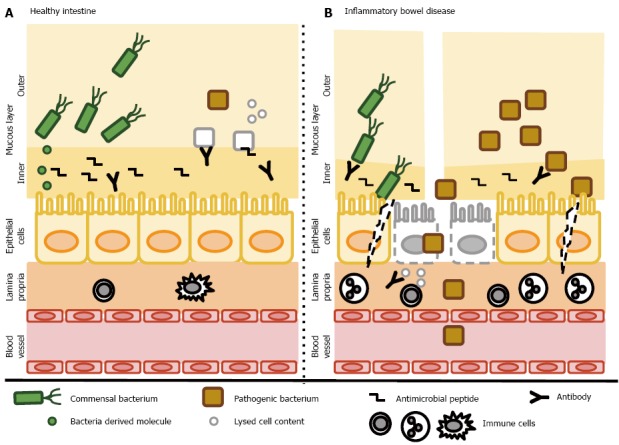
Figure 1
Figure 1
Host-bacteria interactions. A: In the healthy gut, both commensal and pathogenic bacteria reside in the outer layer of the intestinal mucous layer without coming into direct contact with epithelial cells. The inner layer contains abundant antibacterial peptides and secreted antibodies that prevent the invasion of bacteria. Pathogenic bacteria are eradicated by various mechanisms. Commensal bacteria secrete various molecules that help to maintain the intestinal barrier, activate cell survival pathways and suppress inflammatory responses. Epithelial cells form a continuous, selectively permeable layer connected by intercellular junctions. The lamina propria contains only a few resident immune cells; B: In inflammatory bowel disease, the mucous layer is reduced and contains fewer antimicrobial peptides and secretory antibodies. The abundance of commensal bacteria is reduced in favor of pathogenic bacteria and both types enter the inner mucosal barrier and interact directly with epithelial cells. Some epithelial cells undergo cell death and disruption of the epithelial barrier occurs. Cell components are released and trigger further inflammation. Disruption of the epithelial barrier enables bacteria to invade the submucosa and recruit inflammatory cells. Finally, chronic inflammation develops. A dysbalanced immune system leads to the production of antibodies recognizing both commensal bacteria (and further reduce their numbers) and cells of the host, leading to further tissue destruction and inflammation, creating the “circulus vitiosus” typical for inflammatory bowel diseases.
Figure 2
Figure 2
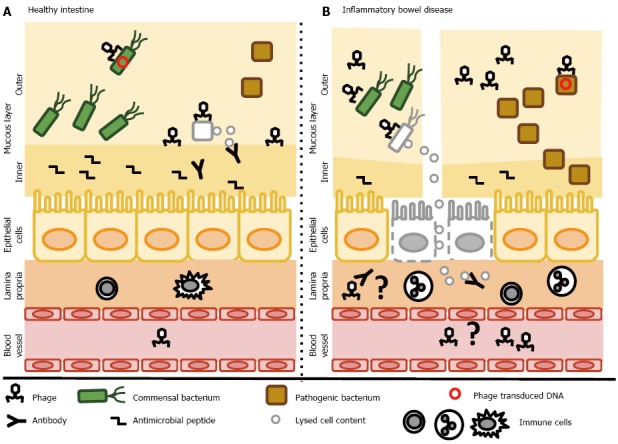
Putative contribution of bacteriophages to regulation of the intestinal bacteria - a simplified scheme. A: In the healthy gut, bacteriophages might increase the fitness of commensal bacteria by the delivery of genes with environmental benefit or contribute to reduction of the pathogenic bacteria. Moreover, phages directly interact with the glycoproteins of the mucous layer and provide protection against invading bacteria. In some healthy individuals, phages have been detected in the circulation, suggesting the possibility that they cross the intestinal epithelial barrier; B: In inflammatory bowel disease, more phages are found in the mucous layer. Higher numbers of phages may be involved in reducing the amount of commensal bacteria, and may drive the transfer of genes with environmental benefit to pathogenic bacteria. Due to the reduced mucosal layer, phage interactions with mucosal glycoproteins may be reduced. Moreover, disruptions in the epithelial barrier might lead to the migration of many phage particles into the lamina propria or even the circulation. In the lamina propria, phages may serve as a local trigger of the immune response. After translocation to the systemic circulation, a systemic immune response might occur.

References

    1. Sartor RB. Mechanisms of disease: pathogenesis of Crohn’s disease and ulcerative colitis. Nat Clin Pract Gastroenterol Hepatol. 2006;3:390–407. - PubMed
    1. Cosnes J, Gower-Rousseau C, Seksik P, Cortot A. Epidemiology and natural history of inflammatory bowel diseases. Gastroenterology. 2011;140:1785–1794. - PubMed
    1. Molodecky NA, Soon IS, Rabi DM, Ghali WA, Ferris M, Chernoff G, Benchimol EI, Panaccione R, Ghosh S, Barkema HW, et al. Increasing incidence and prevalence of the inflammatory bowel diseases with time, based on systematic review. Gastroenterology. 2012;142:46–54.e42; quiz e30. - PubMed
    1. Mitsuoka T. Intestinal flora and aging. Nutr Rev. 1992;50:438–446. - PubMed
    1. Qin J, Li R, Raes J, Arumugam M, Burgdorf KS, Manichanh C, Nielsen T, Pons N, Levenez F, Yamada T, et al. A human gut microbial gene catalogue established by metagenomic sequencing. Nature. 2010;464:59–65. - PMC - PubMed

MeSH terms

Substances